

Climate explained: how particles ejected from the Sun affect Earth's climate
- Written by: Annika Seppälä, Senior Lecturer in Geophysics, University of Otago
 CC BY-ND
Climate Explained is a collaboration between The Conversation, Stuff and the New Zealand Science Media Centre to answer your questions about climate change.
If you have a question you’d like an expert to answer, please send it to climate.change@stuff.co.nz
When the Sun ejects solar particles into space, how does this affect the Earth and climate? Are clouds affected by these particles?
When we consider the Sun’s influence on Earth and our climate, we tend to think about solar radiation. We are acutely aware of the skin-burning dangers of ultraviolet, or UV, radiation.
But the Sun is an active star. It also continuously releases what is known as “solar wind”, made up of charged particles, largely protons and electrons, that travel at speeds of hundreds of kilometres per hour.
Some of these particles that reach Earth are guided into the polar atmosphere by our magnetic field. As a result, we can see the southern lights, aurora australis, in the southern hemisphere, and the northern equivalent, aurora borealis.
CC BY-ND
Climate Explained is a collaboration between The Conversation, Stuff and the New Zealand Science Media Centre to answer your questions about climate change.
If you have a question you’d like an expert to answer, please send it to climate.change@stuff.co.nz
When the Sun ejects solar particles into space, how does this affect the Earth and climate? Are clouds affected by these particles?
When we consider the Sun’s influence on Earth and our climate, we tend to think about solar radiation. We are acutely aware of the skin-burning dangers of ultraviolet, or UV, radiation.
But the Sun is an active star. It also continuously releases what is known as “solar wind”, made up of charged particles, largely protons and electrons, that travel at speeds of hundreds of kilometres per hour.
Some of these particles that reach Earth are guided into the polar atmosphere by our magnetic field. As a result, we can see the southern lights, aurora australis, in the southern hemisphere, and the northern equivalent, aurora borealis.
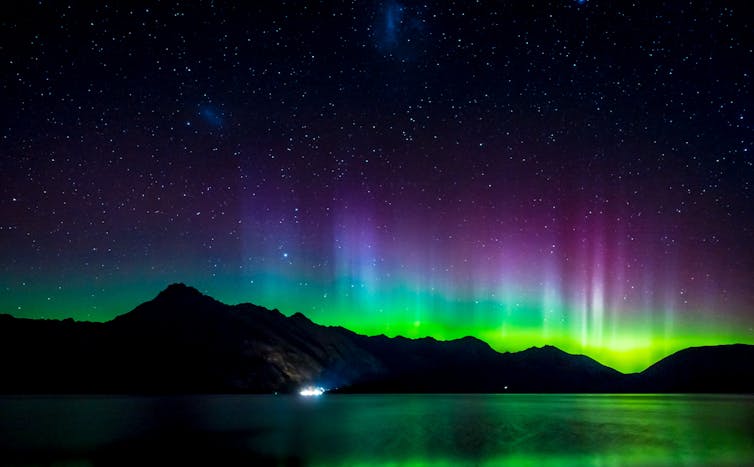 Aurora australis observed above southern New Zealand.
Shutterstock/Fotos593
This visible manifestation of solar particles entering Earth’s atmosphere is a constant reminder there is more to the Sun than sunlight. But the particles have other effects as well.
Read more:
Why is the sun's atmosphere so hot? Spacecraft starts to unravel our star's mysteries
Solar particles and ozone
When solar particles enter the atmosphere, their high energies ionise neutral atmospheric nitrogen and oxygen molecules, which make up 99% of the atmosphere. This “energetic particle precipitation”, named because it’s like a rain of particles from space, is a major source of ionisation in the polar atmosphere above 30km altitude — and it sets off a chain of reactions that produces chemicals that facilitate the destruction of ozone.
The impact of solar particles on atmospheric ozone was first observed in 1969. Since the early 2000s, thanks to new kinds of satellite observations, we have seen growing evidence that solar particles play an important part in influencing polar ozone. During particularly active times, when the Sun releases large amounts of particles into space, up to 60% of ozone at altitudes above 50km can be depleted. The effect can last for weeks.
Lower down in the atmosphere, below 50km, solar particles are important contributors to the year-to-year variability in polar ozone levels, often through indirect pathways. Here, solar particles again contribute to ozone loss, but a recent discovery showed they also help curb some of the depletion in the Antarctic ozone hole.
How ozone affects the climate
Most of the ozone in the atmosphere resides in a thin layer at altitudes of 20-25km — the “ozone layer”.
But ozone is everywhere in the atmosphere, from the Earth’s surface to altitudes above 100km. It is a greenhouse gas and plays a key role in heating and cooling the atmosphere, which makes it critical for climate.
In the southern hemisphere, changes in polar ozone are known to influence regional climate conditions.
Aurora australis observed above southern New Zealand.
Shutterstock/Fotos593
This visible manifestation of solar particles entering Earth’s atmosphere is a constant reminder there is more to the Sun than sunlight. But the particles have other effects as well.
Read more:
Why is the sun's atmosphere so hot? Spacecraft starts to unravel our star's mysteries
Solar particles and ozone
When solar particles enter the atmosphere, their high energies ionise neutral atmospheric nitrogen and oxygen molecules, which make up 99% of the atmosphere. This “energetic particle precipitation”, named because it’s like a rain of particles from space, is a major source of ionisation in the polar atmosphere above 30km altitude — and it sets off a chain of reactions that produces chemicals that facilitate the destruction of ozone.
The impact of solar particles on atmospheric ozone was first observed in 1969. Since the early 2000s, thanks to new kinds of satellite observations, we have seen growing evidence that solar particles play an important part in influencing polar ozone. During particularly active times, when the Sun releases large amounts of particles into space, up to 60% of ozone at altitudes above 50km can be depleted. The effect can last for weeks.
Lower down in the atmosphere, below 50km, solar particles are important contributors to the year-to-year variability in polar ozone levels, often through indirect pathways. Here, solar particles again contribute to ozone loss, but a recent discovery showed they also help curb some of the depletion in the Antarctic ozone hole.
How ozone affects the climate
Most of the ozone in the atmosphere resides in a thin layer at altitudes of 20-25km — the “ozone layer”.
But ozone is everywhere in the atmosphere, from the Earth’s surface to altitudes above 100km. It is a greenhouse gas and plays a key role in heating and cooling the atmosphere, which makes it critical for climate.
In the southern hemisphere, changes in polar ozone are known to influence regional climate conditions.
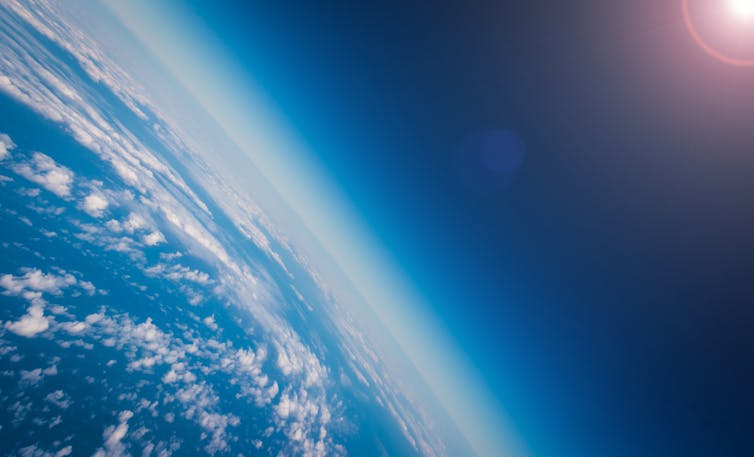 Solar particles ionise nitrogen and oxygen molecules in the atmosphere, which leads to other chemical reactions that contribute to ozone destruction.
Shutterstock/PunyaFamily
Its depletion above Antarctica had a cooling effect, which in turn pulled the westerly wind jet that circles the continent closer. As the Antarctic hole recovers, this wind belt can meander further north and affect rainfall patterns, sea-surface temperatures and ocean currents. The Southern Annular Mode describes this north-south movement of the wind belt that circles the southern polar region.
Ozone is important for future climate predictions, not only in the thin ozone layer, but throughout the atmosphere. It is crucial we understand the factors that influence ozone variability, be it man-made or natural like the Sun.
The Sun’s direct influence
The link between solar particles and ozone is reasonably well established, but what about any direct effects solar particles may have on the climate?
We have observational evidence that solar activity influences regional climate variability at both poles. Climate models also suggest such polar effects link to larger climate patterns (such as the Northern and Southern Annular Modes) and influence conditions in mid-latitudes.
The details are not yet well understood, but for the first time the influence of solar particles on the climate system will be included in climate simulations used for the upcoming Intergovernmental Panel on Climate Change (IPCC) assessment.
Read more:
Solar weather has real, material effects on Earth
Through solar radiation and particles, the Sun provides a key energy input to our climate system. While these do vary with the Sun’s 11-year cycle of magnetic activity, they can not explain the recent rapid increase in global temperatures due to climate change.
We know rising levels of greenhouse gases in the atmosphere are pushing up Earth’s surface temperature (the physics have been known since the 1800s). We also know human activities have greatly increased greenhouse gases in the atmosphere. Together these two factors explain the observed rise in global temperatures.
What about clouds?
Clouds are much lower in the atmosphere than where most solar particles penetrate. Particles know as galactic cosmic rays (coming from the centre of our galaxy rather than the Sun) may be linked to cloud formation.
It has been suggested cosmic rays could influence the formation of condensation nuclei, which act as “seeds” for clouds. But recent research at the CERN nuclear research facility suggests the effects are insignificant.
This doesn’t rule out some other mechanisms for cosmic rays to affect cloud formation, but thus far there is little supporting evidence.
Solar particles ionise nitrogen and oxygen molecules in the atmosphere, which leads to other chemical reactions that contribute to ozone destruction.
Shutterstock/PunyaFamily
Its depletion above Antarctica had a cooling effect, which in turn pulled the westerly wind jet that circles the continent closer. As the Antarctic hole recovers, this wind belt can meander further north and affect rainfall patterns, sea-surface temperatures and ocean currents. The Southern Annular Mode describes this north-south movement of the wind belt that circles the southern polar region.
Ozone is important for future climate predictions, not only in the thin ozone layer, but throughout the atmosphere. It is crucial we understand the factors that influence ozone variability, be it man-made or natural like the Sun.
The Sun’s direct influence
The link between solar particles and ozone is reasonably well established, but what about any direct effects solar particles may have on the climate?
We have observational evidence that solar activity influences regional climate variability at both poles. Climate models also suggest such polar effects link to larger climate patterns (such as the Northern and Southern Annular Modes) and influence conditions in mid-latitudes.
The details are not yet well understood, but for the first time the influence of solar particles on the climate system will be included in climate simulations used for the upcoming Intergovernmental Panel on Climate Change (IPCC) assessment.
Read more:
Solar weather has real, material effects on Earth
Through solar radiation and particles, the Sun provides a key energy input to our climate system. While these do vary with the Sun’s 11-year cycle of magnetic activity, they can not explain the recent rapid increase in global temperatures due to climate change.
We know rising levels of greenhouse gases in the atmosphere are pushing up Earth’s surface temperature (the physics have been known since the 1800s). We also know human activities have greatly increased greenhouse gases in the atmosphere. Together these two factors explain the observed rise in global temperatures.
What about clouds?
Clouds are much lower in the atmosphere than where most solar particles penetrate. Particles know as galactic cosmic rays (coming from the centre of our galaxy rather than the Sun) may be linked to cloud formation.
It has been suggested cosmic rays could influence the formation of condensation nuclei, which act as “seeds” for clouds. But recent research at the CERN nuclear research facility suggests the effects are insignificant.
This doesn’t rule out some other mechanisms for cosmic rays to affect cloud formation, but thus far there is little supporting evidence.
Authors: Annika Seppälä, Senior Lecturer in Geophysics, University of Otago


 Daily Bulletin


