

Almost 90% of sexual assault victims do not go to police — this is how we can achieve justice for survivors
- Written by: Anastasia Powell, Associate Professor, Criminology and Justice Studies, RMIT University
On Monday night, Four Corners investigated how Brittany Higgins’s alleged rape at Parliament House was kept quiet for almost two years.
Once again, it highlighted the huge barriers to justice faced by victims of sexual assault.
This comes barely a week after tens of thousands of Australians marched, demanding justice and an end to the harassment and mistreatment of women within federal parliament and beyond.
With sexual violence in the media spotlight on a daily basis, we need to reflect on how far we have come — and what still needs to be done — to achieve justice for victim-survivors.
Almost 90% of women don’t go to police
According to the Australian Bureau of Statistics, one in five Australian women and one in 20 men have experienced sexual assault since the age of 15. Most assaults occur in private spaces, and most are against women by a man known to them.
Yet, almost nine in ten women (87%) do not contact the police.
Many are worried their experience won’t be taken seriously. They also worry they will face repercussions, whether personally, professionally or from the perpetrator themselves, if they report the assault.
What survivors want
According to Australian research, victim-survivors say they want to have their experience heard, to have the wrong against them acknowledged, and to know that something will be done to stop the perpetrator from harming others.
Sadly, we know often the opposite occurs. Whether it is workplaces and other organisations responding to sexual harassment and/or sexual assault, or formal responses in our criminal justice system, victims are often left feeling silenced and sidelined.
Read more: Sexual assault: what can you do if you don't want to make a formal report to police?
But a formal report to police is not the only option. There are alternative ways a victim-survivor can either seek support or talk about what happened to them. There’s a national helpline, and sexual assault counselling services in every state and territory.
Some states also have an option for victims to make an anonymous or confidential informal report to police. Importantly, research shows a positive experience making an informal report can encourage a victim-survivor to report formally.
Another option, currently under consideration by the Victorian Law Reform Commission, is restorative justice. In broad terms, this allows a victim and a perpetrator to meet with expert support to acknowledge the impacts of the crime and find a way to repair the harm.
Reforming laws around consent
Of course, these alternative ways of responding to sexual assault do not mean we should ignore the formal criminal justice processes. There are ways to improve it — and the last several weeks have demonstrated the urgent need to do so.
Many measures are needed, and one of them is reform to consent law. Criminal law is left to the states and territories, and so, confusingly, there are many definitions of consent across Australia.
In response to the confusion, as well as the low threshold for accused persons to claim they had a reasonable belief there was consent, advocates, academics and survivors are calling for affirmative consent laws.
Affirmative consent requires consent to be actively given by actions and/or words before, and continuously throughout, a sexual act. Under such laws, consent cannot be inferred from the behaviour of another person, such as what they were wearing or that they (supposedly) flirted with the perpetrator prior to the rape. Instead, a perpetrator must show they took active and reasonable steps to make sure the other person was consenting.
Yet, most Australian states do not currently require a person to take such active steps to determine another’s consent. Both the New South Wales and Queensland Law Reform Commissions recently failed to recommend the inclusion of active steps in proposed rape law changes.
More education for police, juries
There is a host of other concrete changes that can improve justice for victims of sexual assault.
Other possible measures include greater training for police investigating sexual assaults.
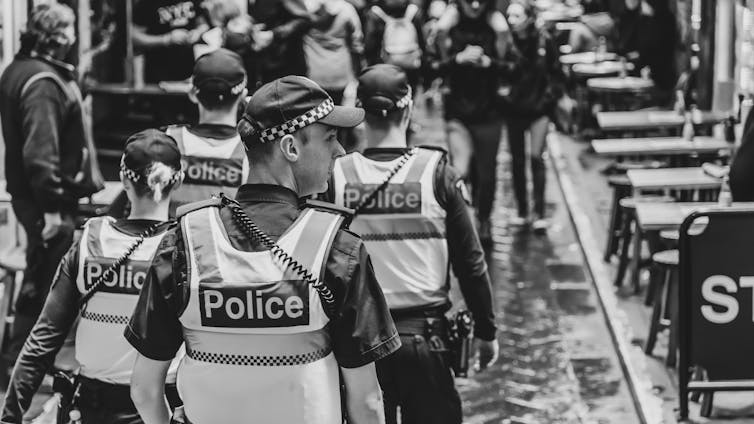 There are alternatives to making a formal report to police, but improvements to the way police handle sexual assault are also needed.
www.shutterstock.com
There are alternatives to making a formal report to police, but improvements to the way police handle sexual assault are also needed.
www.shutterstock.com
There is also independent victim legal representation in sexual assault trials, initiatives to reduce the trauma of giving evidence for victim-survivors, along with inclusion of expert testimony on the nature of sexual violence, and education for potential jury members.
Changing our broader culture
The ongoing national public conversation about sexual violence has made a further problem abundantly clear.
Too often bystanders, who had an opportunity to either intervene or provide support to a victim, do nothing.
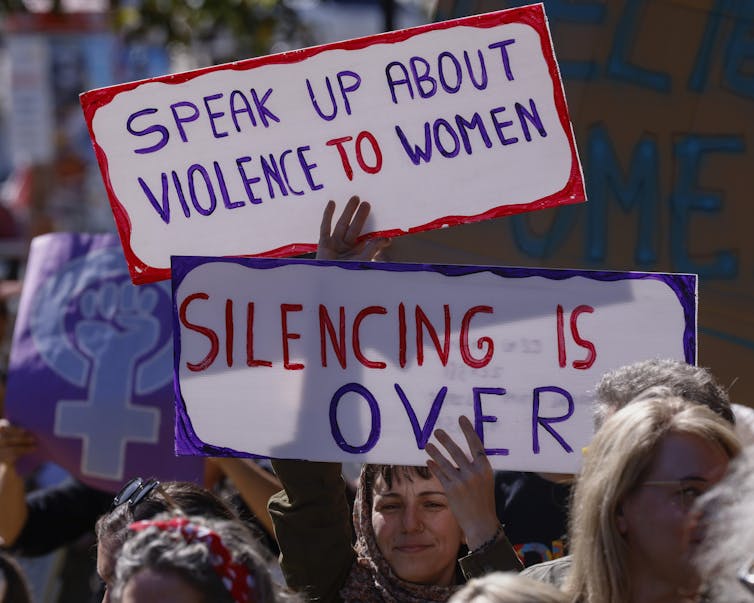 Tens of thousands of Australians marched on March 15 to call for justice for victim-survivors.
Rob Blakers/ AAP
Tens of thousands of Australians marched on March 15 to call for justice for victim-survivors.
Rob Blakers/ AAP
The National Community Attitudes Survey on Violence Against Women shows us many Australians blame victims, minimise abuse, and excuse the actions of perpetrators.
We can all do better to educate ourselves on how to respond supportively if a colleague, friend or loved one discloses that they are a victim of sexual violence. We can also speak up and challenge victim-blaming attitudes when we see them, whether it is at the office, at the sports club, at the pub, or at a family BBQ.
Read more: Rape culture: why our community attitudes to sexual violence matter
Sex and respectful relationships education needs to start early, be consistent, inclusive, positive about sex and sexuality, and promote consent as a normal practice in all our interactions with others.
Modelling respect
But if the past few months have taught us anything, it is the importance of leadership that models respect: both for victim-survivors and for women generally.
Sadly, the best laws and the best prevention education in the world may not be enough to create lasting change if our leaders and institutions don’t also step up, stop walking past sexual violence, and set a new standard for respect and justice.
If this article has raised issues for you, or if you’re concerned about someone you know, call 1800RESPECT on 1800 737 732
Authors: Anastasia Powell, Associate Professor, Criminology and Justice Studies, RMIT University


 Daily Bulletin


