

Israel elections: Netanyahu may hold on to power, but political paralysis will remain
- Written by: Ran Porat, Affiliate Researcher, The Australian Centre for Jewish Civilisation, Monash University
At the end of another round of elections, the fourth in just two years, Israel still cannot break away from debilitating political stalemate.
This means there will now be weeks of daunting coalition negotiations between parties chained to pre-election promises not to share a government with a particular party or prime minister – specifically, Israel’s longest-serving leader, Binyamin (Bibi) Netanyahu.
Depressingly for Israelis, election number five is lurking in the shadows before the end of 2021.
The pro- and no-Bibi camps
This campaign seemed like another referendum on Netanyahu. Currently on trial for corruption, the PM has been facing months of mass demonstrations against him.
With his back to the wall, Netanyahu was able to sustain his popularity within his base by personally taking credit for Israel’s world-leading coronavirus vaccine rollout, as well as the diplomatic achievement of forging ties with several Arab and Muslim states in the “Abraham Accords”.
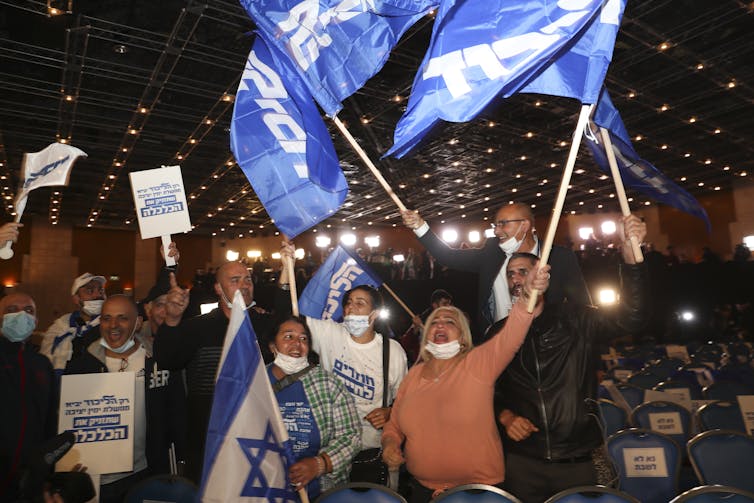 Netanyahu’s supporters celebrate after first exit poll results are released at his party’s headquarters.
Ariel Schalit/AP
Netanyahu’s supporters celebrate after first exit poll results are released at his party’s headquarters.
Ariel Schalit/AP
The coalition of right-wing and religious parties supporting the PM has captured 52 seats of the Knesset’s (parliament) 120 seats in this week’s election, short of the 61 seats needed to form a government.
With 30 seats, Netanyahu’s Likud party retains its status as the biggest in Israel. Problematically, a small but essential element of this bloc is the extreme-right racist party Otzma Yehudit (“Jewish power”) and the anti-LGBTQI faction Noam.
Naftali Bennett, the leader of the national religious party Yamina (“Rightwards”), refused to commit to support or reject Netanyahu. However, he effectively tied himself to the PM when he promised not to join a government headed by the centrist politician Yair Lapid, who leads the anti-Bibi bloc.
The anti-Netanyahu camp secured 57 seats — not enough to dethrone the PM. Moreover, no single party leader is considered a possible challenger to Netanyahu, and the parties in this group profoundly advocate contradictory policies.
This bloc includes the second-largest party in the Knesset, Yesh Atid (“There is a future”), led by Lapid, with 17 seats. There are myriad other parties on the political right, left and centre in this group, each with between six and eight seats apiece.
Read more: Stark choice for Israel as voters head to polls for fourth time in two years
Israeli Arabs’ political power
The biggest story of the election is the paradoxical shift in the political power of Israeli Arabs, who may become the grain of rice that could tip the scales.
On the one hand, internal divisions and a low voter turnout among Arab Israelis resulted in fewer seats being won by Arab-led parties in the Knesset. The main culprit for this downturn is the leader of the Islamic conservative United Arab List Ra’am party, Mansour Abbas, who gambled on running independently from the Joint List of Arab parties. As a result, the Joint List shrank to six seats, from 15.
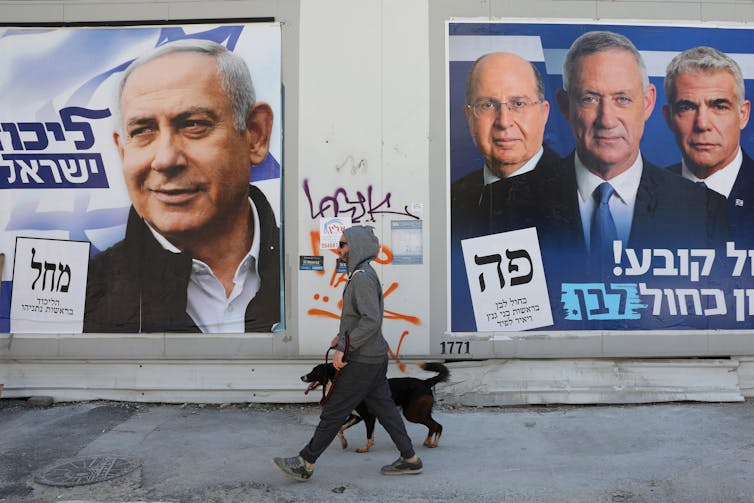 Election campaign billboards of Netanyahu and other party leaders in Tel Aviv.
Abir Sultan/EPA
Election campaign billboards of Netanyahu and other party leaders in Tel Aviv.
Abir Sultan/EPA
Indirect Arab representation came in the form of Zionist parties such as Labor and Meretz, who introduced Arab candidates in their lists in hope of capturing Arab voters.
More dramatically, the Ra’am party, which captured four seats, transformed almost overnight the political status of Arabs in Israel from unwanted to a coveted partner, wooed by both blocs.
Read more: Israel election: why is Palestine no longer an important campaign issue?
The party is now potentially a “kingmaker” that can determine the nature of Israel’s next government. Its agenda is focused on issues important to Arab Israelis, such as crime, violence and funding shortages, instead of, for example, the Palestinian question.
Abbas said he is open to joining a Zionist government or at least supporting it from the outside, even with Netanyahu as PM, if his demands for legal changes and extra funding for Arab municipalities are met.
However, Abbas seems closer to the anti-Bibi bloc, as Ra’am and the extreme-right Otzma Yehudit mutually disqualify each other as coalition partners.
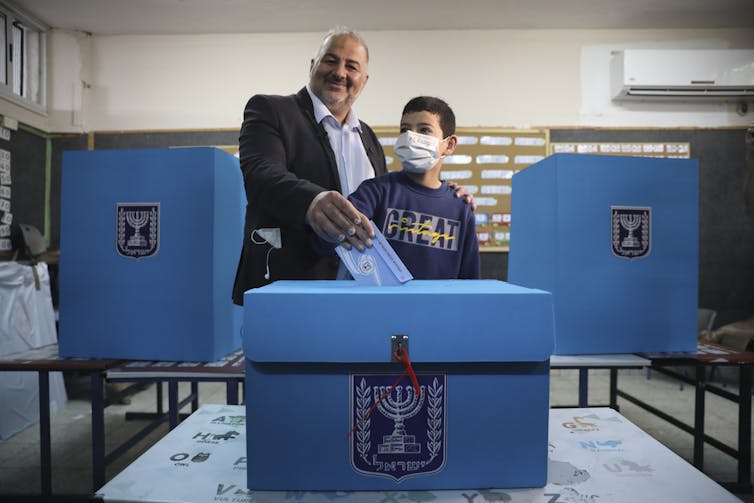 Mansour Abbas could be a ‘kingmaker’ in the formation of the next government.
Mahmoud Illean/AP
Mansour Abbas could be a ‘kingmaker’ in the formation of the next government.
Mahmoud Illean/AP
No change in international policy
Domestically, Israelis want a government that will address mounting social tensions, for example, between secular and ultra-orthodox Jews, exacerbated over the disregard among some of the latter for the government’s coronavirus guidelines.
Internationally, many yearn for a stable government in Jerusalem after two years of uncertainty. US President Joe Biden may prefer someone other than Netanyahu, given the animosity between President Barack Obama and Netanyahu when Biden was vice president.
Yet, the special alliance between the US and Israel remains strong, despite any personal antagonism.
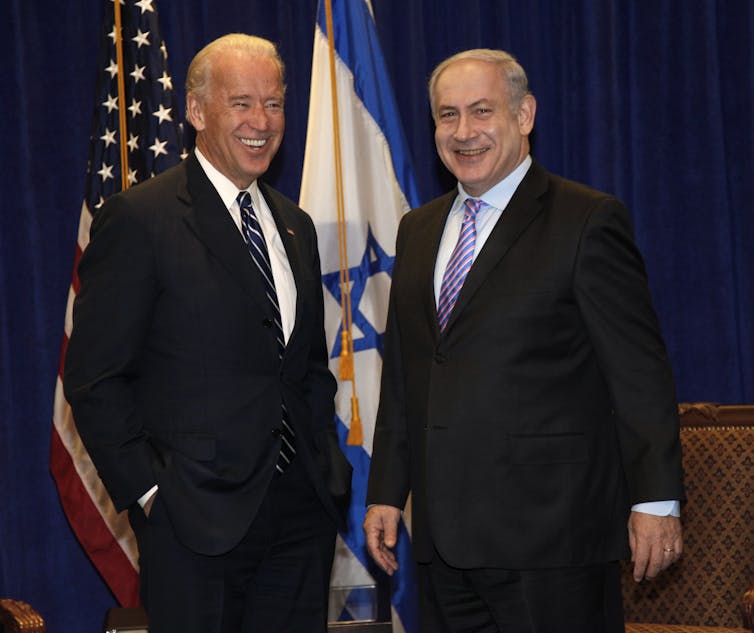 The Biden administration is a staunch supporter of the two-state solution between Israel and the Palestinians.
Gerald Herbert/AP
The Biden administration is a staunch supporter of the two-state solution between Israel and the Palestinians.
Gerald Herbert/AP
The Palestinians expressed indifference after the election and little hope for a change in Israel’s policy towards them.
They are facing their own parliamentary and presidential elections this year, which could affect the reign of 86-year-old Mahmoud Abbas, the longtime president. These elections may embolden or empower Abbas’ main opposition, Hamas, which controls the Gaza Strip and is considered a terrorist organisation by Israel and many Western countries.
Read more: Is it too soon to herald the 'dawn of a new Middle East'? It all depends what the Saudis do next
The outcome of another key Middle Eastern election, Iran’s vote in June, seems predetermined. The next Iranian president will likely be a hardline ideologue affiliated with the Iranian Revolutionary Guard Corps. Tehran’s drive to acquire nuclear weapons will continue to dominate the dynamics of the region.
Given all this, the aggressive Israeli policy set by Netanyahu of promising not to allow Iranian nuclear weapons and curbing their influence across the Middle East will continue, no matter who is the leader in Jerusalem.
Such a position vis-à-vis Tehran will also be positively welcomed by the Persian Gulf kingdoms, led by Iran’s arch-nemesis, Saudi Arabia. This will likely contribute to the tacit and open ties these countries have been forging with Israel.
Authors: Ran Porat, Affiliate Researcher, The Australian Centre for Jewish Civilisation, Monash University


 Daily Bulletin


