

5 ways fungi could change the world, from cleaning water to breaking down plastics
- Written by: Mitchell P. Jones, Postdoctoral researcher, Vienna University of Technology
Fungi — a scientific goldmine? Well, that’s what a review published today in the journal Trends in Biotechnology indicates. You may think mushrooms are a long chalk from the caped crusaders of sustainability. But think again.
Many of us have heard of fungi’s role in creating more sustainable leather substitutes. Amadou vegan leather crafted from fungal-fruiting bodies has been around for some 5,000 years.
More recently, mycelium leather substitutes have taken the stage. These are produced from the root-like structure mycelium, which snakes through dead wood or soil beneath mushrooms.
You might even know about how fungi help us make many fermented food and drinks such as beer, wine, bread, soy sauce and tempeh. Many popular vegan protein products, including Quorn, are just flavoured masses of fungal mycelium.
But what makes fungi so versatile? And what else can they do?
Show me foamy and flexible
Fungal growth offers a cheap, simple and environmentally friendly way to bind agricultural byproducts (such as rice hulls, wheat straw, sugarcane bagasse and molasses) into biodegradable and carbon-neutral foams.
Fungal foams are becoming increasingly popular as sustainable packaging materials; IKEA is one company that has indicated a commitment to using them.
Fungal foams can also be used in the construction industry for insulation, flooring and panelling. Research has revealed them to be strong competitors against commercial materials in terms of having effective sound and heat insulation properties.
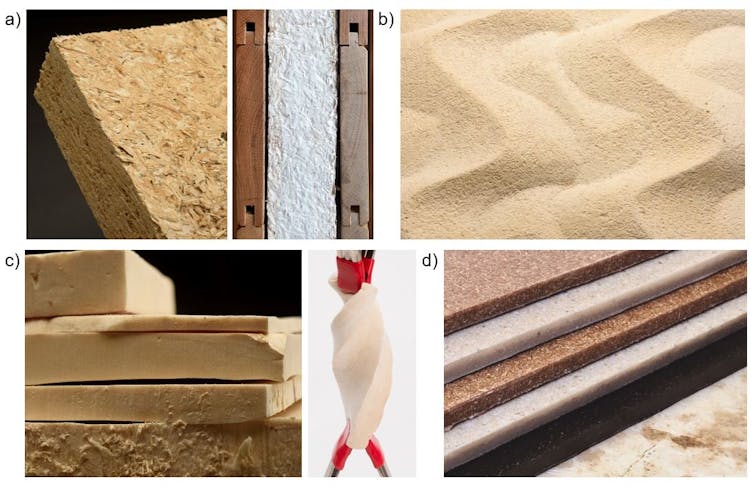 Rigid and flexible fungal foams have several construction applications including (a) particle board and insulation cores, (b) acoustic absorbers, (c) flexible foams and (d) flooring.
Jones et al
Rigid and flexible fungal foams have several construction applications including (a) particle board and insulation cores, (b) acoustic absorbers, (c) flexible foams and (d) flooring.
Jones et al
Moreover, adding in industrial wastes such as glass fines (crushed glass bits) in these foams can improve their fire resistance.
And isolating only the mycelium can produce a more flexible and spongy foam suitable for products such as facial sponges, artificial skin, ink and dye carriers, shoe insoles, lightweight insulation lofts, cushioning, soft furnishings and textiles.
Read more: Scientists create new building material out of fungus, rice and glass
Paper that doesn’t come from trees? No, chitin
For other products, it’s the composition of fungi that matters. Fungal filaments contain chitin: a remarkable polymer also found in crab shells and insect exoskeletons.
Chitin has a fibrous structure, similar to cellulose in wood. This means fungal fibre can be processed into sheets the same way paper is made.
When stretched, fungal papers are stronger than many plastics and not much weaker than some steels of the same thickness. We’ve yet to test its properties when subject to different forces.
Fungal paper’s strength can be substituted for rubbery flexibility by using specific fungal species, or a different part of the mushroom. The paper’s transparency can be customised in the same way.
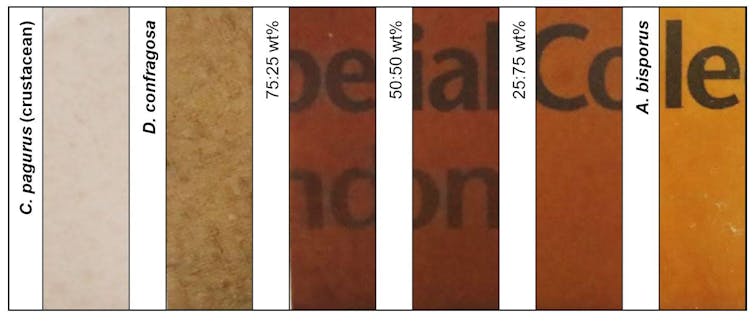 Paper sheets with varying transparency derived from the brown crab’s shell (C. pagurus) (column 1), fungi Daedaleopsis confragosa (column 2) and the mushroom Agaricus bisporus (column 6). Columns 3, 4 and 5 show fungal papers of varying transparencies based on mixtures of the two species.
Wan Nawawi et al
Paper sheets with varying transparency derived from the brown crab’s shell (C. pagurus) (column 1), fungi Daedaleopsis confragosa (column 2) and the mushroom Agaricus bisporus (column 6). Columns 3, 4 and 5 show fungal papers of varying transparencies based on mixtures of the two species.
Wan Nawawi et al
Growing fungi in mineral-rich environments results in inherent fire resistance for the fungus, as it absorbs the inflammable minerals, incorporating them into its structure. Add to this that water doesn’t wet fungal surfaces, but rolls off, and you’ve got yourself some pretty useful paper.
A clear solution to dirty water
Some might ask: what’s the point of fungal paper when we already get paper from wood? That’s where the other interesting attributes of chitin come into play — or more specifically, the attributes of its derivative, chitosan.
Chitosan is chitin that has been chemically modified through exposure to an acid or alkali. This means with a few simple steps, fungal paper can adopt a whole new range of applications.
For instance, chitosan is electrically charged and can be used to attract heavy metal ions. So what happens if you couple it with a mycelium filament network that is intricate enough to prevent solids, bacteria and even viruses (which are much smaller than bacteria) from passing through?
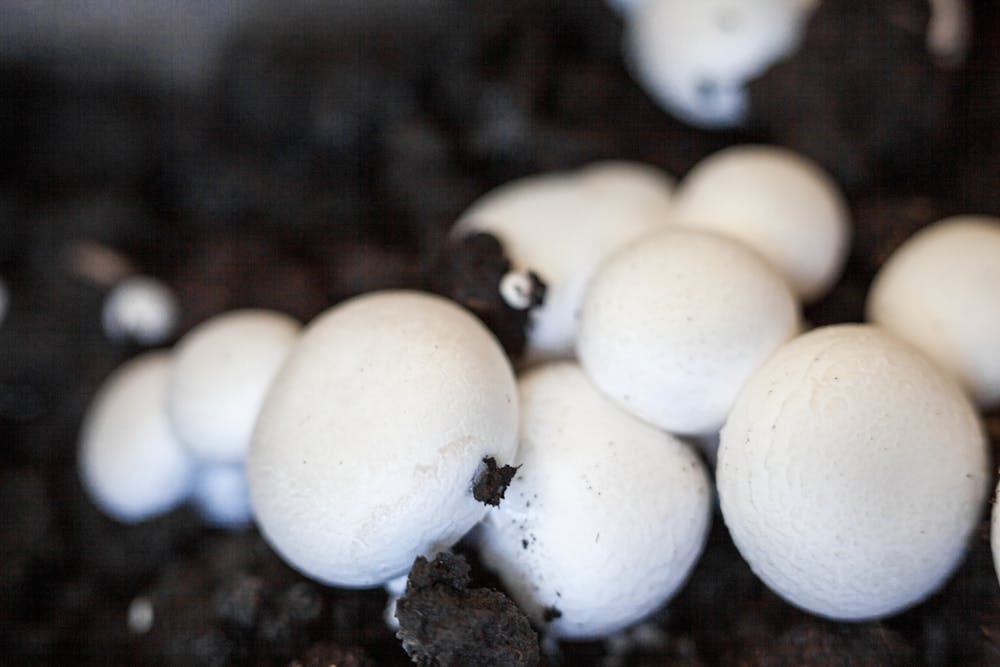 Fungal chitin paper derived from white-button mushrooms is an eco-friendly alternative to standard filter materials.
Shutterstock
Fungal chitin paper derived from white-button mushrooms is an eco-friendly alternative to standard filter materials.
Shutterstock
The result is an environmentally friendly membrane with impressive water purification properties. In our research, my colleagues and I found this material to be stable, simple to make and useful for laboratory filtration.
While the technology hasn’t yet been commercialised, it holds particular promise for reducing the environmental impact of synthetic filtration materials, and providing safer drinking water where it’s not available.
Mushrooms in modern medicine
Perhaps even more interesting is chitosan’s considerable biomedical potential. Fungal materials have been used to create dressings with active wound healing properties.
Although not currently on the market, these have been proven to have antibacterial properties, stem bleeding and support cell proliferation and attachment.
Fungal enzymes can also be used to combat bacteria active in tooth decay, enhance bleaching and destroy compounds responsible for bad breath.
Read more: Vegan leather made from mushrooms could mould the future of sustainable fashion
Then there’s the well-known role of fungi in antibiotics. Penicillin, made from the Penicillium fungi, was a scientific breakthrough that has saved millions of lives and become a staple of modern healthcare.
Many antibiotics are still produced from fungi or soil bacteria. And in an age of increasing antibiotic resistance, genome sequencing is finally enabling us to identify fungi’s untapped potential for manufacturing the antibiotics of the future.
Mushrooms mending the environment
Fungi could play a huge role in sustainability by remedying existing environmental damage.
For example, they can help clean up contaminated industrial sites through a popular technique known as mycoremediation, and can break down or absorb oils, pollutants, toxins, dyes and heavy metals.
They can also compost some synthetic plastics, such as polyurethane. In this process, the plastic is buried in regulated soil and its byproducts are digested by specific fungi as it degrades.
These incredible organisms can even help refine bio fuels. Whether or not we go as far as using fungal coffins to decompose our bodies into nutrients for plants — well, that’s a debate for another day.
But one thing is for sure: fungi have the undeniable potential to be used for a whole range of purposes we’re only beginning to grasp.
It could be the beer you drink, your next meal, antibiotics, a new faux leather bag or the packaging that delivered it to you — you never know what form the humble mushroom will take tomorrow.
Read more: The secret life of fungi: how they use ingenious strategies to forage underground
Authors: Mitchell P. Jones, Postdoctoral researcher, Vienna University of Technology


 Daily Bulletin


