

Just add (mantle) water: new research cracks the mystery of how the first continents formed
- Written by: Chris Kirkland, Professor of Geology, Curtin University
Earth is an amazing planet. As far as we know, it’s the only planet in the universe where life exists. It’s also the only planet known to have continents: the land masses on which we live and which host the minerals needed to support our complex lives.
Experts still vigorously debate how the continents formed. We do know water was an essential ingredient for this — and many geologists have proposed this water would have come from Earth’s surface via subduction zones (as is the case now).
But our new research shows this water would have actually come from deep within the planet. This suggests Earth in its youth behaved very differently to how it does today, containing more primordial water than previously thought.
How to grow a continent
The solid Earth is comprised of a series of layers including a dense iron-rich core, thick mantle and a rocky outer layer called the lithosphere.
But it wasn’t always this way. When Earth first formed about 4.5 billion years ago, it was a ball of molten rock that was regularly pummelled by meteorites.
As it cooled over a period of a billion years or so, the first continents began to emerge, made of pale-coloured granite. Exactly how they came to be has long intrigued scientists.
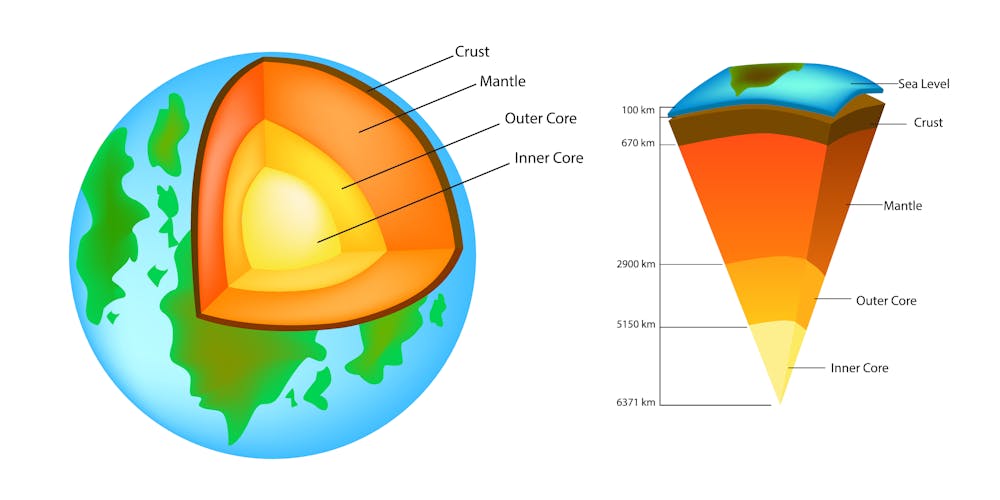 Earth comprises a core, mantle and outer crust.
Shutterstock
Earth comprises a core, mantle and outer crust.
Shutterstock
To make granitic continental crust capable of floating, dark volcanic rocks known as basalts have to be melted. Basalts, which are formed as a result of melting in the mantle, would have covered Earth when the planet was starting out.
However, to make continental crust from basalt requires another essential ingredient: water. Knowing how this water got into the rocks at enough depth is key to understanding how the first continents formed.
Read more: Earth has stayed habitable for billions of years – exactly how lucky did we get?
One mechanism of taking water to depth is through subduction. This is how most new continental crust is produced today, including the Andes mountain range in South America.
In subduction zones, rocky plates at the bottom of the ocean chill and become increasingly dense until they’re forced under the continents and back into the mantle below, taking ocean water with them.
When this water interacts with basalt in the mantle, it creates granitic crust. But Earth was much hotter billions of years ago, so many experts have argued subduction (at least in the form we currently understand) couldn’t have operated.
Long linear mountain belts such as the Andes contrast starkly with the structure of the granitic crust preserved in the Pilbara region of outback Western Australia.
This ancient crust viewed from above has a “dome-and-keel” pattern, with balloons (domes) of pale-coloured granite rising into the surrounding darker and denser basalts (the keels).
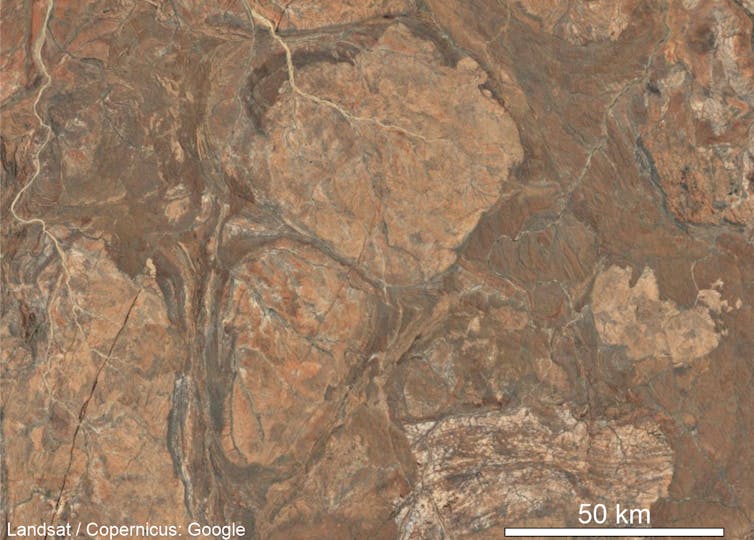 Satellite images of the Pilbara Craton, Western Australia. Pale-coloured granite domes are surrounded by dark-coloured basalts.
Google Earth
Satellite images of the Pilbara Craton, Western Australia. Pale-coloured granite domes are surrounded by dark-coloured basalts.
Google Earth
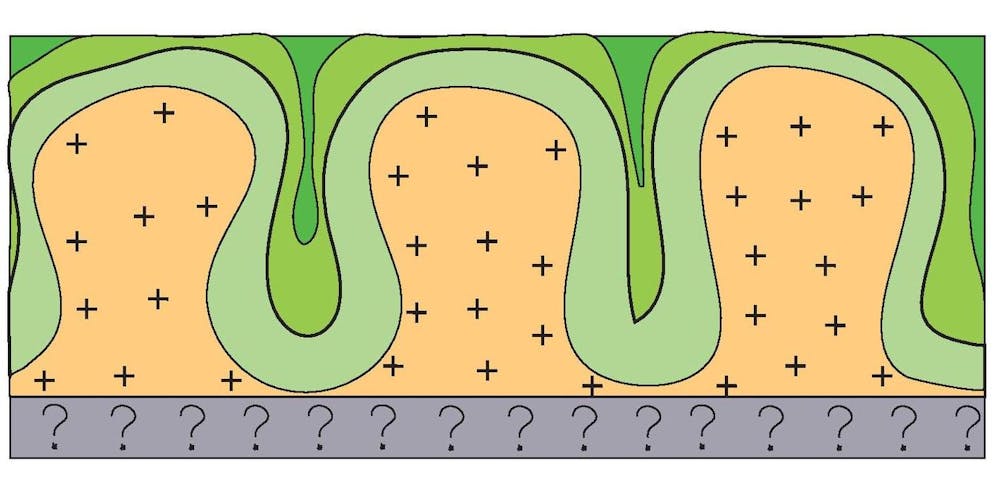 A very simplified cross section of a dome-and-keel structure.
Wikimedia Commons, CC BY-SA
A very simplified cross section of a dome-and-keel structure.
Wikimedia Commons, CC BY-SA
But where did the water needed to produce these domes come from?
Tiny crystals record Earth’s early history
Our research, led by scientists at the Geological Survey of Western Australia and Curtin University, addressed this question. We analysed tiny crystals trapped in the ancient magmas that cooled and solidified to form the Pilbara’s granite domes.
These crystals, made of a mineral called zircon, contain uranium which turns into lead over time. We know the rate of this change, and can measure the amounts of uranium and lead contained within. As such, we can obtain a record of their age.
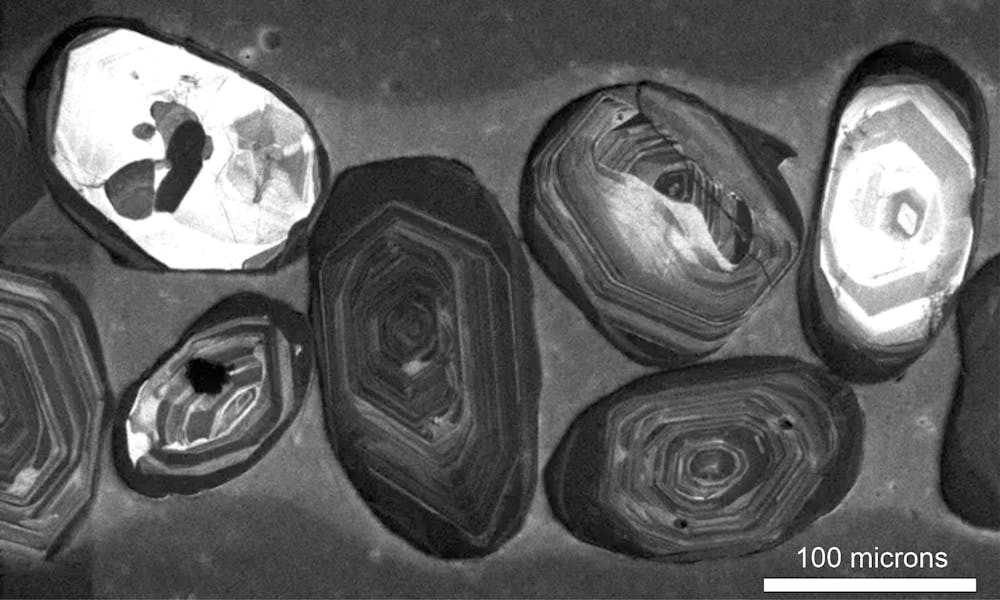 Zircon crystals grown in an ancient magma.
The crystals also contain clues to their origin, which can be unravelled by measuring their oxygen isotope composition. Importantly, zircons that crystallised in molten rocks hydrated by water from Earth’s surface have different compositions to zircons that formed deep in the mantle.
Measurements show the water required for the most primitive ancient WA granites would have come from deep within Earth’s mantle and not from the surface.
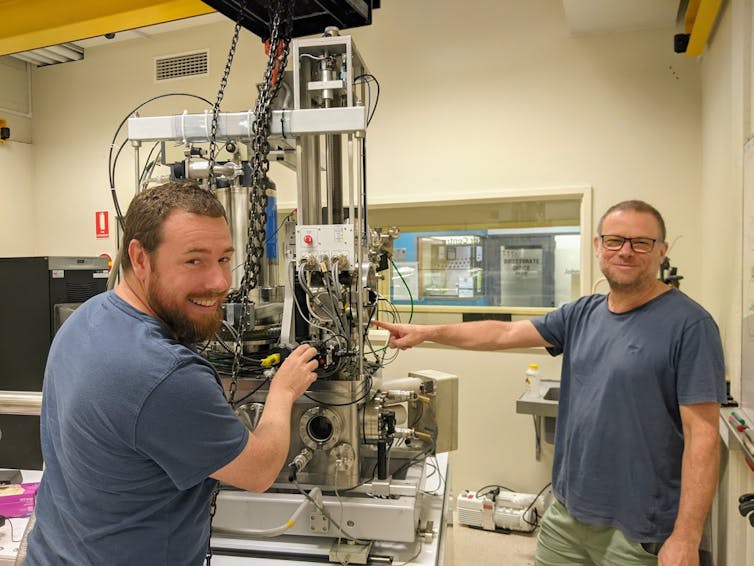 Chris Kirkland (left) and Tim Johnson loading samples into a secondary-ion mass spectrometer, which shoots a beam of ions into zircon crystals to determine their age and oxygen isotope composition.
Is the present always the key to the past?
How the first continents formed is part of a broader debate regarding one of the central tenets of the physical sciences: uniformitarianism. This is the idea that the processes which operated on Earth in the distant past are the same as those observed today.
Earth today loses heat through plate tectonics, when the ridged lithospheric plates that form the planet’s solid, outer shell move around. This helps regulate its internal temperature, stabilises atmospheric composition, and probably also facilitated the development of complex life.
Subduction is one of the most important components of this process. But several lines of evidence are inconsistent with subduction and plate tectonics on an early Earth. They indicate strongly that our planet behaved very differently in the first two billion years following its formation than it does today.
So while uniformitarianism is a useful way to think about many geological processes, the present may not always be the key to the past.
Read more: Does a planet need plate tectonics to develop life?
Authors: Chris Kirkland, Professor of Geology, Curtin University
-water-new-research-cracks-the-mystery-of-how-the-first-continents-formed&media=https://www.dailybulletin.com.au/https://images.theconversation.com/files/392176/original/file-20210329-17-1suspmd.jpg?ixlib=rb-1.1.0&q=45&auto=format&w=754&fit=clip&description=Just%20add%20(mantle)%20water:%20new%20research%20cracks%20the%20mystery%20of%20how%20the%20first%20continents%20formed "Pin It")

 Daily Bulletin


