

Vaccination alone will not provide full protection. When borders open, NZ will still be managing COVID-19
- Written by: Nikki Turner, Professor, University of Auckland
From next week, unvaccinated staff working at managed isolation and quarantine (MIQ) facilities will be moved to low-risk jobs, following a case of a worker who missed vaccination appointments and then tested positive for COVID-19.
The recently announced ban on arrivals from India underscores an important point: even once all border and health staff have been vaccinated, vaccination does not provide 100% protection.
Last month, a MIQ worker tested positive almost a week after receiving their second vaccine dose. This case shows that, occasionally, even fully vaccinated people can still carry the virus in their throats and therefore potentially spread it.
Small risk of infection remains
Clinical trials of the Pfizer/BioNTech vaccine show 90-97% efficacy which means most fully vaccinated people will not get sick, and the small number who do are very unlikely to develop serious disease.
The vaccine reduces the ability to contract and pass on the virus, but not always completely. It takes the sting out of COVID-19’s tail, because it particularly reduces its ability to cause serious illness or death.
In last month’s case, the vaccinated worker remained asymptomatic, which likely reduced the spread of the virus to others. The risk of spread is higher from sick people because they have a higher load of the virus, and therefore more to spread, and they are more likely to spread it, particularly with coughing.
Data from use in several countries suggests the vaccine has some effect in reducing an infected person’s ability to pass the virus on to others, but as this example shows, vaccinated people can still carry and spread the virus, albeit at much lower rates.
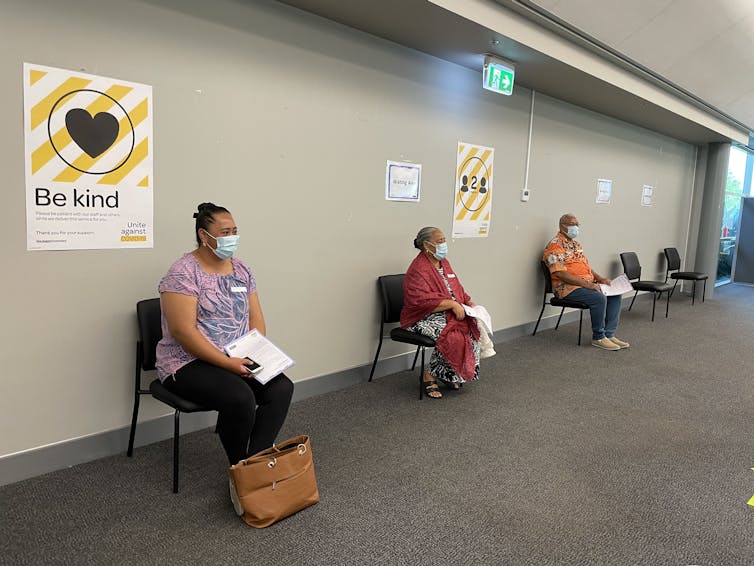 Frontline border staff and their families were the first to be vaccinated in New Zealand’s rollout of the Pfizer/BioNTech vaccine.
Ministry of Health, CC BY-ND
Frontline border staff and their families were the first to be vaccinated in New Zealand’s rollout of the Pfizer/BioNTech vaccine.
Ministry of Health, CC BY-ND
Herd immunity feasible, but challenging
The combination of a vaccine’s ability to reduce illness — and therefore spread of the disease — is good news, but it’s not fool proof. Should New Zealand consider opening its borders beyond the current travel bubble with Austalia (due to start on April 19), it’s likely this would allow people with COVID-19 into the country.
If the majority of New Zealanders are vaccinated, we can be confident that very few people will get sick. But whether this would be enough to stop spread through the community remains unclear.
New Zealand could aim for herd immunity, which would mean vaccinating enough of the population to stop the virus from spreading, should it enter a community. The ability to stop spread would depend on the proportion of the population that is immune (either following infection or through vaccination), whether immunity is spread evenly across the population, and the infectivity of the virus.
With measles, for example, a population requires up to 95% immunity before the virus can stop spreading. But measles is more highly infectious compared to COVID-19 so the level of immunity required to achieve herd immunity would likely be lower.
New variants complicate the picture
While it is possible to calculate a magic number needed for herd immunity for COVID-19, there are several variables that prevent us from doing so accurately. These include the recent more contagious mutations and the lack of data on precisely how effective the vaccine is against asymptomatic spread.
Also unhelpful in a quest for herd immunity is that we cannot yet vaccinate children under 16. Clinical trials are underway to determine the efficacy of the Pfizer/BioNTech vaccine for children and preliminary results are promising. But until trials are completed and the data scientifically reviewed, New Zealand’s vaccination programme excludes just under a quarter of New Zealand’s population.
Even with an excellent vaccination programme, vaccination is not evenly distributed. There are groups and communities with lower coverage, which means there will be gaps across the population.
We have seen this with the 2019 measles outbreak in New Zealand. Even with high vaccination rates of over 90% across most of the population, and a highly effective vaccine, the disease affected communities or age groups with lower immunisation coverage.
Disease control instead of elimination
As long as COVID-19 continues to spread internationally, further border openings would import new cases and challenge New Zealand’s ability to maintain its elimination status.
A partial response may lie in aiming for the highest possible rates of immunisation, alongside ongoing public health measures that have worked well so far, including contact tracing.
One possible option would be to only allow vaccinated people into the country, because they are less likely to be carrying disease. But are we going to wait until vaccination gets to all countries, and to all age groups, before opening our borders?
Another option is to open the borders and support the vaccination of any unvaccinated people on arrival in New Zealand. This could be a feasible strategy once children are able to be vaccinated.
Another path is to let go of the concept of elimination and focus instead on disease control. We know with great confidence that this vaccine is effective at stopping severe disease and death.
I recommend we put all our efforts into vaccinating everyone we possibly can, particularly more vulnerable individuals and communities. Then, when we do open the borders and the disease comes into New Zealand, we will see predominantly mild and asymptomatic disease. This will be manageable.
This strategy will require an effective vaccination coverage that doesn’t leave out those most in need. We must offer the vaccine equitably to everyone, with the best possible informed consent approaches, care and thought. There will still be those who choose not to vaccinate, but with a well communicated immunisation programme, this group should be a very small percentage of the population.
If we have a high rate of immunisation coverage, alongside traditional contact tracing, we can minimise the risk to these individuals and maintain an approach that relies on education and support rather that the heavy hand of mandatory vaccination.
Authors: Nikki Turner, Professor, University of Auckland


 Daily Bulletin


