

3 doses, then 1 each year: why Pfizer, not AstraZeneca, is the best bet for the long haul
- Written by: Nathan Bartlett, Associate Professor, School of Biomedical Sciences and Pharmacy, University of Newcastle
Last week, the chief executive of Pfizer said anyone who receives its COVID-19 vaccine will probably need to have a third dose within 6-12 months after being fully immunised, and then likely one dose every year going forward.
We’ll need these because it’s likely that, for many of us, immunity will begin to wane within that time frame. The vaccine will also need to be tweaked to cover new coronavirus variants as they emerge.
The advantage of mRNA vaccines like Pfizer’s is they’re much easier to update than the “viral vector” vaccines like AstraZeneca’s. We should still use AstraZeneca now for over-50s, but our best long-term strategy is to use mRNA COVID-19 vaccines, and therefore to develop the capacity to manufacture them here in Australia.
Immunity to coronaviruses doesn’t last
We know our immunity to different coronaviruses wanes over time. This is true for the four common cold (endemic) coronaviruses that circulate all the time — there are always sufficient numbers of people who have lost their immunity to ensure these viruses can persist and continue to cause respiratory illnesses.
Our immunity to SARS-CoV-2, the virus that causes COVID-19, also seems to wane quickly, although the rate at which this happens can be quite variable. Data suggest immunity acquired from the Pfizer shot is pretty robust for six months, but it isn’t clear how quickly our immunity is lost after that. However, it’s reasonable to predict that within 12 months of a population being vaccinated, a substantial number of people will have likely lost protection against SARS-CoV-2. This will particularly be the case if the prevalent SARS-CoV-2 strain circulating at that time is substantially different from the virus against which people were originally vaccinated.
This relates to the fact that some coronavirus variants have mutations that reduce the effectiveness of vaccine-induced immunity. They’ve been described as “variants of concern” and include a virus that originated in South Africa, which has reduced the efficacy of both the AstraZeneca and Pfizer vaccines. As the pandemic surges around the world, more variants will certainly crop up.
Both waning immunity and viral variants will conspire to reduce our protection over time. So we’ll need booster shots, ideally updated to deal with the viral variant that poses the greatest threat.
Using AstraZeneca is not our best long-term solution
I understand why Australia’s government originally prioritised getting the AstraZeneca vaccine. It’s easier to manufacture, store and distribute. It made sense in the early stages of the pandemic. And it’s still an effective vaccine that people, here and abroad, should be receiving as soon as possible — any immunity is better than none and you will certainly be protected from severe COVID-19.
But as time goes on, using the AstraZeneca shot isn’t the best long-term strategy.
One reason for this is what immunologists call “vector immunity”. The AstraZeneca and Johnson & Johnson vaccines use a viral vector, which is an inactivated (cannot replicate) form of a common type of virus called an “adenovirus”. They use this adenovirus as a delivery vehicle to get DNA into our cells to give them the instructions to develop immunity against the coronavirus. However, you can’t be repeatedly immunised with this type of vaccine because you’ll likely develop immunity to the adenovirus vector (the delivery vehicle) itself. When that happens your immune system interferes with the delivery vehicle getting into your cells and the effectiveness of these vaccines would erode over time.
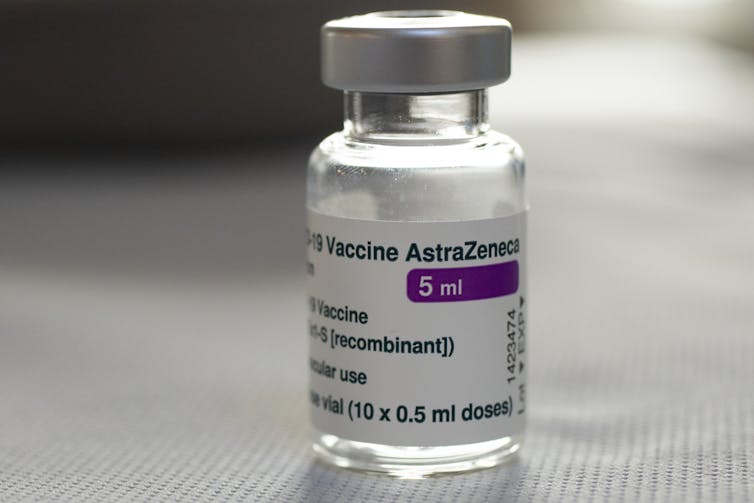 We should still use the AstraZeneca vaccine now in over-50s. But using mRNA COVID vaccines like Pfizer’s will be our best long-term strategy.
Peter Dejong/AP/AAP
We should still use the AstraZeneca vaccine now in over-50s. But using mRNA COVID vaccines like Pfizer’s will be our best long-term strategy.
Peter Dejong/AP/AAP
What’s more, in a very, very small number of people, this viral vector seems to be linked with an extremely rare but serious blood clotting syndrome. In these people, it’s thought that a consequence of the immune response to the viral vector is their immune systems make “auto-antibodies”. These are antibodies that, in addition to fighting a foreign invader (or targeting the adenovirus-based vector used in the AstraZeneca vaccine), also attack our own cells. In this case, these auto-antibodies are attacking blood cells called platelets, leading to the blood clots and low platelet counts seen in around 1 in 250,000 people vaccinated with the AstraZeneca shot.
There are also clotting concerns with the Johnson & Johnson vaccine, which is also an adenovirus-vector-based vaccine, after six women developed the condition in the United States out of 6.8 million given the shot. However, this link is yet to be proven for this vaccine.
Read more: What is thrombocytopenia, the rare blood condition possibly linked to the AstraZeneca vaccine?
By contrast, mRNA vaccines like Pfizer’s (and Moderna’s) can be updated much more quickly. Pfizer just needs to rework its RNA sequence to cover variants, which is a minor modification. Nothing changes about the delivery system of the vaccine, so reapproval will likely be much easier. Regulatory bodies have indicated there will be a quick path for approval for vaccines updated for variants.
Read more: Why we'll get COVID booster vaccines quickly and how we know they're safe
The mRNA vaccines consist of a lipid-based delivery system that protects the mRNA and gets it into cells. Then, the cells can start manufacturing the spike protein to present to your immune system. There’s no protein in the vaccine itself, so there’s no chance of developing immunity to the vaccine components.
mRNA vaccines are our best bet going forward
There’s a fear among researchers, including myself, that we’ll be chasing our tails with these new variants. We’ll identify a new variant and set out to update our vaccines against it, but by the time the formulation is updated, approved, manufactured and distributed, we may already be dealing with another variant, or many variants across different locations.
It’s absolutely vital Australia develops the ability to make mRNA vaccines onshore, particularly if new variants pop up here or in our region. This will be far more effective than waiting months to get new shots from overseas.
Read more: Australia may miss out on several COVID vaccines if it can't make mRNA ones locally
Federal health minister Greg Hunt has indicated Australia is interested in developing this capacity.
Right now, the AstraZeneca vaccine still has a role in Australia’s current vaccine strategy. We have it and we can make more of it, so let’s get it out there for over-50s as well as give those under 50 the opportunity to make an informed choice to have this vaccine.
So few Australians currently have immunity to the virus, we remain vulnerable to outbreaks. If there are new outbreaks, we would have to rely on lockdowns, masks and other strategies again, and could find ourselves back to where we were last year. And let’s not forget people will become ill and some will die. The vaccine rollout is lagging, and we really need to catch up as soon as possible.
But as time goes on, the AstraZeneca vaccine will become less attractive, and mRNA vaccines such as Pfizer’s should eventually take its place.
Authors: Nathan Bartlett, Associate Professor, School of Biomedical Sciences and Pharmacy, University of Newcastle


 Daily Bulletin


