

Jobs for men have barely grown since the COVID recession. What matters now is what we do about it
- Written by: Peter Martin, Visiting Fellow, Crawford School of Public Policy, Australian National University
Of all the weak targets ever adopted by Australian governments, one of the weakest has to have been an unemployment rate “comfortably below six per cent” in last year’s budget.
At the time the budget was delivered on October 6, the published unemployment rate had already fallen to 6.8%.
“Comfortably below six per cent” mattered because it formed part of the “fiscal strategy” required in each year’s budget as part of the Charter of Budget Honesty.
The strategy sets out the circumstances in which the government will tighten or loosen its purse strings.
The October 2020 strategy had two phases. The first required loose purse stings in order to “quickly drive down the unemployment rate”.
It would remain in place until the unemployment rate was comfortably below 6%. In the second phase the government would “shift its focus towards stabilising and then reducing debt as a share of the economy”.
The budget jobs target is comfortably weak
On the very harshest reading, the strategy requires Treasurer Josh Frydenberg to start winding back support for the economy when the unemployment rate falls to comfortably below 6%, as it arguably already has — last week’s reading was 5.6% and heading down.
But that’s probably too harsh. The words “comfortably below” might mean “way below”, and the figure of 6% mightn’t have meant much at all.
As the pandemic gathered pace the treasury was predicting an unemployment rate of 15% - the worst since the Great Depression.
It might have picked 6% as a pseudo target merely because it was something to aim for, and it might not have put much store in what was at the time a one-off result of 5.8% because unemployment rates can bounce around.
We’re about to get an update
Frydenberg says he’ll update the target in a speech to be delivered soon.
Disturbingly, he has defined the present strategy of comfortably below 6% as meaning “around 5.25% or around 5.5%”, which is pretty close to where we are. If he wants to go further, he’ll have to adopt a more ambitious target.
The difference between 6% and 5% is 138,000 unemployed Australians. The difference between 6% and 4% is 277,000 unemployed Australians.
Read more: Josh Frydenberg has the opportunity to transform Australia, permanently lowering unemployment
That’s an extra 138,000 to 277,000 Australians working for us and paying tax; and 138,000 to 277,000 fewer people claiming JobSeeker.
The Reserve Bank governor believes Australia can “achieve and sustain an unemployment rate in the low 4s”.
A good target would approach 4%
The governor makes the point that over the past decade, the estimate of the unemployment rate associated with full employment has been “repeatedly lowered”. The target Frydenberg adopts will tell us a lot.
Because it’s been a year since COVID-19 took off in Australia, it’s possible to get an idea of who’s suffered the most in terms of jobs by comparing March 2021 with March 2020.
The broad-brush Australian Bureau of Statistics labour force survey turns up the surprising result that, in terms of jobs, women have done better than men.
So far, the recovery has been pink-tinged
It’s a surprising outcome because of what was said midway through last year about a pink-tinged recession.
At the time women had indeed suffered more than men. In May, in the depths of the downturn, women were down 471,000 jobs and men down 401,000. But from then on, as things improved, the gap narrowed.
By August women were no worse off than men. By March this year women were 74,940 jobs better off than before the recession, men 650 jobs worse off.
Male versus female employment, March 2020 to March 2021
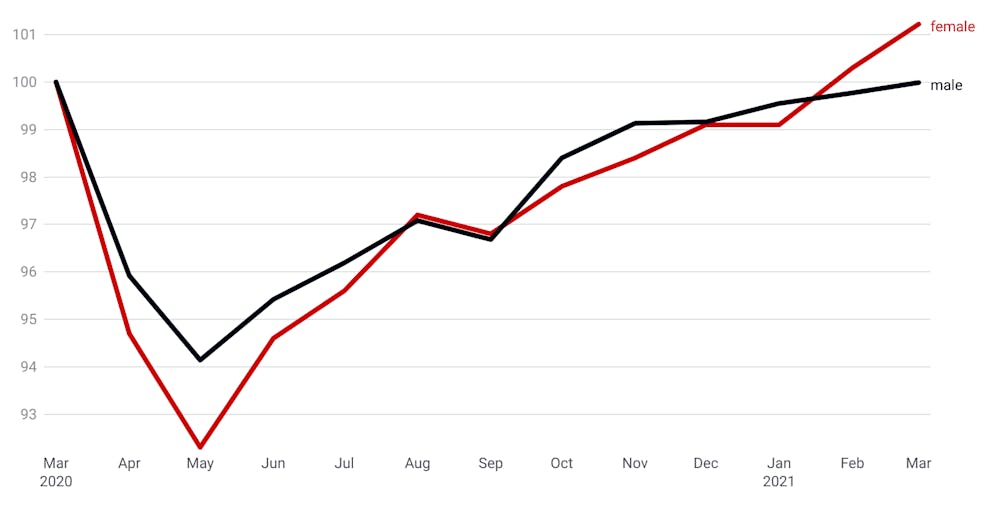 Index numbers, March 2020 = 100.
ABS Labour Force, Australia
Index numbers, March 2020 = 100.
ABS Labour Force, Australia
For full-time jobs, the divide is starker. Men are 47,420 full-time jobs worse off, and women 44,870 full-time jobs better off.
We can get much more detail (than ever before) by examining the newly available payroll data extracted from real-time records of more than 10 million Australians, as opposed to the answers of the 50,000 who take part in the labour force survey.
Women have proved more adaptable
Amongst women, the biggest gains are in the “public administration and safety” industries, where the number of women employed is 13% higher than before the pandemic.
 Women have moved out of hospitality into public administration.
fizkes/Shutterstock
Women have moved out of hospitality into public administration.
fizkes/Shutterstock
The biggest losses for women are in “accommodation and food services” (which means hospitality and tourism) where female employment remains down 14% on the start of the pandemic.
For men, the biggest — although much smaller — gains have also been in “public administration and safety”, where male employment is up 8% since the start of the pandemic, and in “financial and insurance services”, where male employment is up 6%.
For men, employment in “accommodation and food services” remains down 15%.
The data paint a picture of women being more adaptable than men — having suffered worse than men in the early months of the recession and then refashioning themselves into different types of workers.
Among women it is only the youngest ten-year age bands that remain worse off.
Every age band above the age of 30 is ahead.
Read more: The successor to JobKeeper can't do its job. We'll need JobMaker II
For men the damage is more widespread, and perhaps longer lasting. Only in the age bands above 50 are men better rather than worse off.
There’s an awful lot we need to do, and we have discovered during the pandemic we are more than capable of doing it.
We’ll know soon whether the government’s ambition is high or low.
Authors: Peter Martin, Visiting Fellow, Crawford School of Public Policy, Australian National University


 Daily Bulletin


