

If Papua New Guinea really is part of Australia's 'family', we'd do well to remember our shared history
- Written by: Patricia A. O'Brien, Visiting Fellow in the School of History, Australian National University, and Adjunct Professor in the Asian Studies Program, Georgetown University
Prime Minister Scott Morrison is fond of describing Papua New Guinea as “family”. He did so recently when announcing Australia’s assistance with PNG’s COVID-19 outbreak. The urgent support for PNG in the form of vaccines, testing kits, medical personnel and training was “in Australia’s interests”, Morrison said, because it threatens the health of Australians, “but equally our PNG family who are so dear to us”.
These familial bonds are “born of history and geography”. PNG is Australia’s closest neighbour. Only 4 kilometres separate the two countries in the Torres Strait, a fluid border that has been redefined numerous times (most recently in 1985). It is currently closed due to the COVID outbreak.
But what about the long histories Australia and PNG’s share? The fluid border acknowledges ancient, unbroken Indigenous connections. This history is deep, fraught, complex and the very foundation for the present relationship. This past needs considered attention now to strengthen ties at this pivotal time and in the future.
As early as the 1850s, nationalists envisioned “the great island of New Guinea […] will naturally […] fall into the hands” of Australia, forming part of an Australian Pacific empire. These ideas gained traction in the 1860s with the commencement of the Queensland labour trade, which controversially supplied the colony’s plantations with islander labourers.
In 1878, a Queensland gold-seeking expedition attempted to establish a colony near Port Moresby. Though Britain disallowed the venture, Queensland persisted, securing the Torres Strait Islands in 1879 and extending its border to virtually New Guinea’s shoreline, as it is today.
Politicians began championing “Australia’s Monroe Doctrine” that, like the US’s 1823 declaration for the Americas, held that Australia exclusively presided in its region. Britain relented to Australian colonial pressures in 1883. Despite Australia’s rhetorical muscle-flexing, New Guinea was partitioned three ways in 1884 into German New Guinea (the north-east and surrounding archipelagoes), British New Guinea (the south-east) and Dutch New Guinea (in the west, the present-day troubled provinces of Indonesia).
Read more: 'A dam has been breached': a COVID crisis on our doorstep shows how little we pay attention to PNG
Despite its name, British New Guinea was administered and funded by Australia. From the outset, a pattern of harsh colonial rule took root, exemplified by infamous episodes of collective punishment known today as massacres. Goaribari Islanders suffered three in as many years, with more than 150 dead according to contemporary accounts and inquiries.
Following Federation, Australia assumed control over this territory, renamed Papua, in 1906. Politicians debated how to govern Papua more “gently” to better reflect Australia’s modern national image. Yet Papuans were barred from entering under the White Australia policy even though some politicians argued New Guinea belonged to Australia as much as Tasmania. Even today, Australian population figures reflect New Guineans’ continuing exclusion.
Read more: Australian politics explainer: the White Australia policy
In 1908, Hubert Murray was permanently appointed lieutenant-governor of the territory to implement a more benevolent colonial rule. Though violence and exploitation reduced in Papua during Murray’s long tenure (1908-1940), the “Murray Method”, as it became known throughout the empire, was replete with paternalistic attitudes. Most damning was his belief Papuans need only be educated to elementary levels and employed in menial jobs.
In 1914, Australia’s presence in New Guinea dramatically expanded when Australian forces captured German New Guinea in the nation’s first action of the first world war. The seven-year rule (1914-1921) of the Australian Naval and Military Expeditionary Force (ANMEF) became notorious for flogging and labour recruitment practices. Murray, blaming unchecked settler colonial attitudes, was the ANMEF’s loudest critic.
Prime Minister Billy Hughes argued at the 1919 Paris Peace Conference that Australia was owed New Guinea as compensation for blood and treasure expended in the first world war. Securing it was also vital for national defences, as Australia now had a new foe: Japan.
In May 1921, the ANMEF was disbanded, when the League of Nations mandates system commenced. This meant Australia could now enact its own laws, but with international oversight. It was governed separately, and differently, from Papua until the eve of the Pacific War.
The discovery of gold in the mandate in 1926 triggered an unprecedented flood of Australians, also into back-country areas. Cycles of violence, often sparked by violations of women, escalated. A punitive expedition to avenge the killings of four prospectors (who were war veterans), known as the Nakanai Massacre, was launched. So great was the outcry, not least because a machinegun was used against people armed with spears, that many feared Australia would lose New Guinea to Germany.
Murray was again vocal in his criticism of the mandate. The mistreatment of local people was not only inhumane, it was detrimental to Australia’s interests, because New Guineans were “dying out”.
Mistreatment only accelerated this demise. Murray (and many others) were convinced “industrial races of Asia” would take their place and “menace the Commonwealth”. New Guineans did not die out, the mandate remained shadowed by colonial violence, and the predictions of New Guinea being a defence buffer for Australia came to fruition from 1942. The ensuing second world war history is the most remembered of Australia’s New Guinea past.
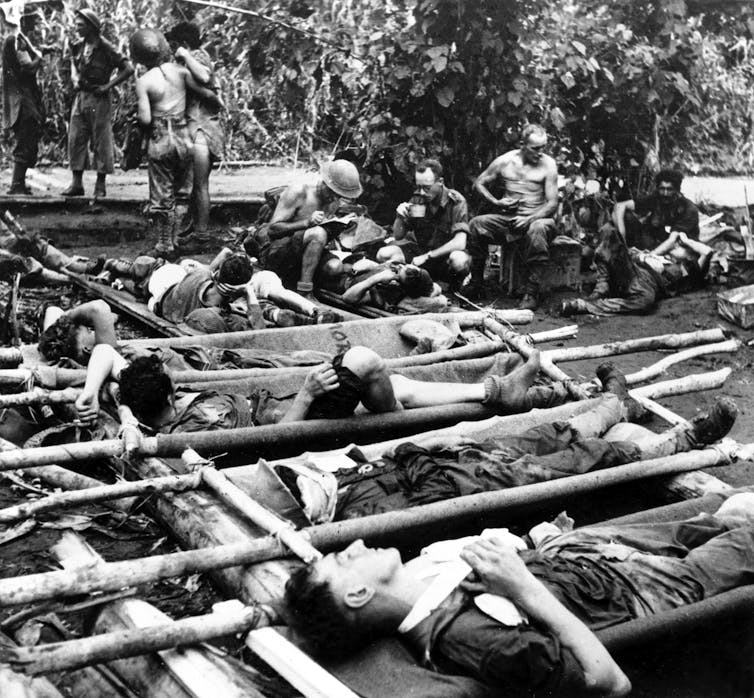 Australian troops in Gona, New Guinea, in the second world war.
AAP/AP
Australian troops in Gona, New Guinea, in the second world war.
AAP/AP
In 2018, Morrison made a landmark speech called “Australia and the Pacific: A New Chapter”. In it, he talked of “family” and the Pacific as “our patch” in his reworking of the 150-year-old imperial idea in the time of China’s rise. The speech was delivered in Townsville, the epicentre of the Pacific labour trade, though it or other defining histories were not mentioned. Australia’s historical debt went unacknowledged.
With PNG’s COVID crisis, Australia is commendably acting on this rhetoric. But if a truly equitable new “chapter” in the relationship is to be forged, Australia must – urgently and aggressively – confront the Pacific’s needs, especially its highest-priority concern: climate change.
Authors: Patricia A. O'Brien, Visiting Fellow in the School of History, Australian National University, and Adjunct Professor in the Asian Studies Program, Georgetown University


 Daily Bulletin


