

Albanese's $10bn pledge pushes housing needs back into the limelight
- Written by: Hal Pawson, Professor of Housing Research and Policy, and Associate Director, City Futures Research Centre, UNSW
Opposition Leader Anthony Albanese’s budget reply speech last night highlighted Australia’s huge unnmet need for social and affordable housing. It’s once again shaping up as a major election issue. Labor is proposing a A$10 billion program to build 30,000 social and affordable homes over five years.
The immediate backdrop for the pledge is a post-COVID house price boom, and a continuing dearth of Commonwealth investment in new non-market housing. That is, rentals affordable to low-income Australians and provided by government agencies or non-profit community housing organisations.
Amid the many new spending plans revealed in Tuesday’s budget, Treasurer Josh Frydenberg maintained the government’s resistance to an ever-wider coalition of voices calling for social housing stimulus.
Read more: Why more housing stimulus will be needed to sustain recovery
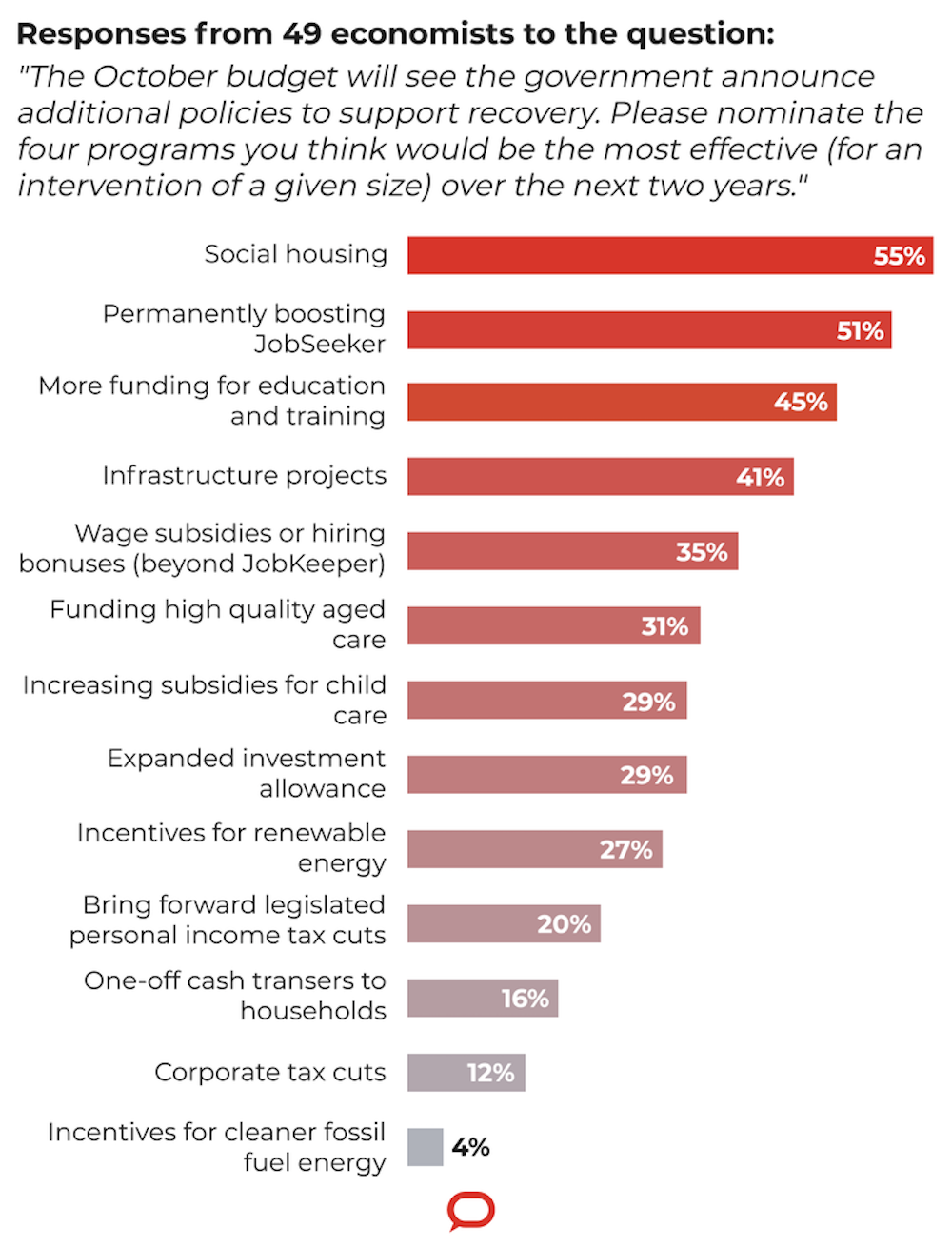 Conversation Economic Society of Australia survey, September 2020
Just how big is the problem?
With borders largely closed since March last year, it’s true that sharply reduced migration has temporarily dampened rental housing demand over the past 15 months. That in turn has generally subdued increases in rents. However, that national norm masks the rapidly rising rents seen in many regional markets during 2020-21.
And despite some local price reductions, Anglicare’s recent survey of 74,000 “lease ready” property listings identified only three (0.004%) affordable to a single person on the JobSeeker payment. More strikingly, for every household income type included in the survey, Anglicare found the availability of affordable lets even lower in early 2021 than a year earlier.
The broader and longer-term picture in the private rental market has been one of shrinking numbers of tenancies that low-income Australians can afford to rent. Specifically, we saw a 50% increase in the national deficit in private lets affordable to low-income renters (in the bottom 20% of incomes) in the decade to 2016.
A decade of negligible investment in social housing construction has only made this situation worse. The result has been a continued decline in availability as public and community housing has dwindled from 6% to only 4% of all housing since the 1990s. In fact, proportionate to population, social rental lettings have halved over this period.
A clear point of difference, but not a game-changer
Tuesday’s budget marked a continuation of the Morrison government’s near-exclusive housing focus on efforts to assist aspirational first-home buyers. Most significantly, this policy stance inspired the $2.1 billion HomeBuilder program as an economic recovery measure during 2020-21.
Read more:
Why the focus of stimulus plans has to be construction that puts social housing first
The ALP has pointedly backed both HomeBuilder and the smaller measures to assist first-home buyers announced on Tuesday. But Albanese’s new announcement seemingly extends Labor’s housing pitch beyond the Coalition’s comfort zone.
Anthony Albanese pledges $10 billion to build social housing in budget reply speech.So is this the “major initiative” hailed by some headline writers? A “fix for house prices” it certainly is not. If unwisely attempted purely through public spending, the funding required to get into that territory would need to be many times as great.
Opposition housing spokesperson Jason Clare more defensibly describes the ALP pitch as “a significant start” in tackling Australia’s “housing crisis”.
The current national stock of social and affordable rental housing totals just over 400,000. In recent years annual additions have amounted to only 2,000-3,000. That’s barely enough even to offset continuing sales and demolitions. In these terms, Albanese’s pledge to expand the supply by 6,000 a year would indeed be significant.
At the same time, as our previous research has shown, a net increase of 15,000 units a year is needed just to keep pace with “normal” population growth – that is, to halt the decline in social rental as a share of all housing. Even under a post-pandemic scenario where migration rules are tightened as far as imaginable, that figure would not be substantially smaller.
So, like the Victorian government’s recently launched social housing stimulus, the ALP’s proposed national program would mark a promising break with the recent past, and a platform for further measures. But it would be hard to describe it as a game-changer.
Read more:
Victoria's $5.4bn Big Housing Build: it is big, but the social housing challenge is even bigger
While greatly expanded social housing provision would be an essential part of any credible package to seriously address Australia’s housing affordability challenge, a far wider program of action is needed. Most importantly, such a program must also tackle our grossly unbalanced housing tax settings, boost renters’ rights and diversify the available choice of housing.
What the country needs above all is a Commonwealth commitment to assembling the national housing strategy that is so long overdue.
Read more:
Australia's housing system needs a big shake-up: here's how we can crack this
Conversation Economic Society of Australia survey, September 2020
Just how big is the problem?
With borders largely closed since March last year, it’s true that sharply reduced migration has temporarily dampened rental housing demand over the past 15 months. That in turn has generally subdued increases in rents. However, that national norm masks the rapidly rising rents seen in many regional markets during 2020-21.
And despite some local price reductions, Anglicare’s recent survey of 74,000 “lease ready” property listings identified only three (0.004%) affordable to a single person on the JobSeeker payment. More strikingly, for every household income type included in the survey, Anglicare found the availability of affordable lets even lower in early 2021 than a year earlier.
The broader and longer-term picture in the private rental market has been one of shrinking numbers of tenancies that low-income Australians can afford to rent. Specifically, we saw a 50% increase in the national deficit in private lets affordable to low-income renters (in the bottom 20% of incomes) in the decade to 2016.
A decade of negligible investment in social housing construction has only made this situation worse. The result has been a continued decline in availability as public and community housing has dwindled from 6% to only 4% of all housing since the 1990s. In fact, proportionate to population, social rental lettings have halved over this period.
A clear point of difference, but not a game-changer
Tuesday’s budget marked a continuation of the Morrison government’s near-exclusive housing focus on efforts to assist aspirational first-home buyers. Most significantly, this policy stance inspired the $2.1 billion HomeBuilder program as an economic recovery measure during 2020-21.
Read more:
Why the focus of stimulus plans has to be construction that puts social housing first
The ALP has pointedly backed both HomeBuilder and the smaller measures to assist first-home buyers announced on Tuesday. But Albanese’s new announcement seemingly extends Labor’s housing pitch beyond the Coalition’s comfort zone.
Anthony Albanese pledges $10 billion to build social housing in budget reply speech.So is this the “major initiative” hailed by some headline writers? A “fix for house prices” it certainly is not. If unwisely attempted purely through public spending, the funding required to get into that territory would need to be many times as great.
Opposition housing spokesperson Jason Clare more defensibly describes the ALP pitch as “a significant start” in tackling Australia’s “housing crisis”.
The current national stock of social and affordable rental housing totals just over 400,000. In recent years annual additions have amounted to only 2,000-3,000. That’s barely enough even to offset continuing sales and demolitions. In these terms, Albanese’s pledge to expand the supply by 6,000 a year would indeed be significant.
At the same time, as our previous research has shown, a net increase of 15,000 units a year is needed just to keep pace with “normal” population growth – that is, to halt the decline in social rental as a share of all housing. Even under a post-pandemic scenario where migration rules are tightened as far as imaginable, that figure would not be substantially smaller.
So, like the Victorian government’s recently launched social housing stimulus, the ALP’s proposed national program would mark a promising break with the recent past, and a platform for further measures. But it would be hard to describe it as a game-changer.
Read more:
Victoria's $5.4bn Big Housing Build: it is big, but the social housing challenge is even bigger
While greatly expanded social housing provision would be an essential part of any credible package to seriously address Australia’s housing affordability challenge, a far wider program of action is needed. Most importantly, such a program must also tackle our grossly unbalanced housing tax settings, boost renters’ rights and diversify the available choice of housing.
What the country needs above all is a Commonwealth commitment to assembling the national housing strategy that is so long overdue.
Read more:
Australia's housing system needs a big shake-up: here's how we can crack this
Authors: Hal Pawson, Professor of Housing Research and Policy, and Associate Director, City Futures Research Centre, UNSW


 Daily Bulletin


