

At last, health, aged care and quarantine workers get the right masks to protect against airborne coronavirus
- Written by: C Raina MacIntyre, Professor of Global Biosecurity, NHMRC Principal Research Fellow, Head, Biosecurity Program, Kirby Institute, UNSW
Almost a year ago, in July 2020, our calls for the government to urgently upgrade the guidelines to protect health workers from airborne SARS-CoV-2 fell on deaf ears.
The existing guidelines said health providers working around COVID-19 patients should wear a surgical mask. It restricted use of the more protective P2 or N95 masks, which stop airborne particles getting through, to very limited scenarios. These involved “aerosol-generating procedures”, such as inserting a breathing tube. This was expanded slightly in August 2020 but still left most health workers without access to P2/N95 masks.
More than 4,000 Australian health workers were infected by COVID-19 during the Victorian second wave. Health authorities denied the importance of airborne transmission and blamed clinical staff for “poor habits” and “apathy”. Health workers expressed despair and a sense of abandonment, cataloguing the opposition they faced to get adequate protection against COVID-19.
Last week, 15 months after the COVID-19 pandemic was declared, the Australian guidelines on personal protective equipment (PPE) for health workers, including masks, were finally revised.
What do the new guidelines say?
The new guidelines expand the range of situations in which P2/N95 masks should be available to staff – essentially anywhere where COVID-19-infected people are expected to be – and remove all references to “aerosol-generating procedures”.
This recognises that breathing, speaking, sneezing and coughing all generate aerosols which can accumulate in indoor spaces, posing a higher risk than “aerosol-generating procedures”.
Read more: Which mask works best? We filmed people coughing and sneezing to find out
“Fit testing” is an annual procedure that should be done for all workers wearing a P2/N95 mask or higher grade respirator, to ensure air can’t leak around the edges.
But this was previously denied to many Australian health workers.
The new guidelines unequivocally state fit-tested P2/N95 masks are required for all staff managing patients with suspected or confirmed COVID-19. This means health workers can finally receive similar levels of respiratory protection to workers on mining and construction sites.
The new guidelines leave ambiguity around which workplaces are within the scope by stating that health care:
may include hospitals, non-inpatient settings, managed quarantine, residential care facilities, COVID-19 testing clinics, in-home care and other environments where clinical care is provided.
The guidelines also allow employers to decide what comprises a high risk and what doesn’t, allowing more wiggle room to deny workers a P2/N95 mask.
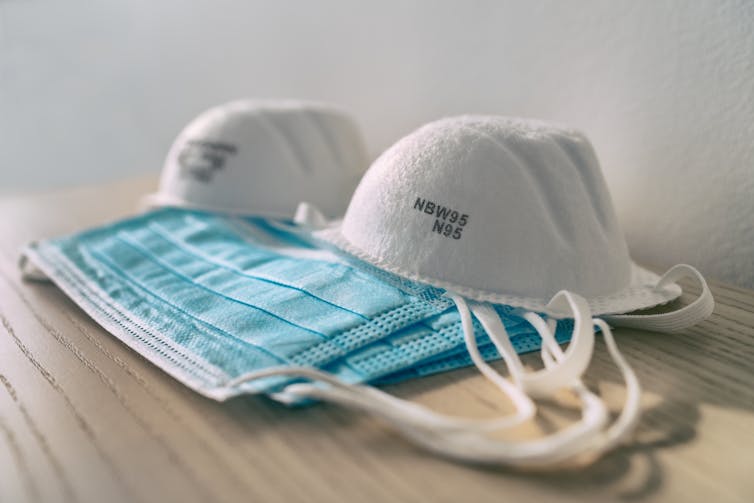 N95 masks (top) protect against airborne transmission, while surgical masks (bottom) don’t.
Shutterstock
N95 masks (top) protect against airborne transmission, while surgical masks (bottom) don’t.
Shutterstock
The guidelines say when a suitable P2/N95 mask can’t be used, a re-usable respirator (powered air purifying respirators, or PAPRs) should be considered.
But the guideline’s claim that a PAPR may not provide any additional protection compared to a “well-sealed” disposable P2/N95 mask, is not accurate. In fact, re-usable respirators such as PAPRs afford a higher level of protection than disposable N95 masks.
The new guidelines should also apply to workers in hotel quarantine – both health care and non-clinical staff. This will help strengthen our biosecurity, as long as they’re interpreted in the most precautionary way.
That means not using the wiggle room that allows workplaces to deem a situation lower risk than it actually is or that their workplace is exempt. When working around a suspected or confirmed COVID-19 case, all workers must be provided with a fit-tested P2/N95 mask. Otherwise they are not protected from inhaling SARS-CoV-2 from the air.
In aged care and health care, where cases linked to quarantine breaches can be amplified and re-seeded to the community, the new guidelines go some way towards better protecting our essential first responders and their patients.
Guidelines miss the mark on ventilation
The guidelines fail to explicitly acknowledge COVID-19 spreads through air but nonetheless recommend the use of airborne precautions for staff.
Airborne particles are usually less than 100 microns in diameter and can accumulate indoors, which means they’re an inhalation risk.
The old guidelines focused on “large droplets”, which were thought to fall quickly to the ground and didn’t pose a risk in breathed air. This was based on debunked theories about airborne versus droplet transmission.
The new guidelines fail to comprehensively address ventilation, which is only mentioned in passing with a reference to separate guidelines for health-care facilities. This may not cover aged care or hotel quarantine.
We must ensure institutions such as hospitals, hotel quarantine facilities, residential care, schools, businesses and public transport have plans to mitigate the airborne risk of COVID-19 and other pandemic viruses through improved ventilation and air filtration.
Australia could follow Germany, which has invested €500 million (A$787 million) in improving ventilation in indoor spaces.
Meanwhile, Belgium is mandating the use of carbon dioxide monitors in public spaces such as restaurants and gyms so customers can assess whether the ventilation is adequate.
Cleaning shared air would add an additional layer of protection beyond vaccination and mask-wearing. Secondary benefits include decreased transmission of other respiratory viruses and improved productivity due to higher attention and concentration levels.
No updated advice on hand-washing
The United States Centers for Disease Control and Prevention (CDC) now acknowledges exposure to SARS-CoV-2 occurs through “very fine respiratory droplets and aerosol particles” and states the risk of transmission through touching surfaces is “low”.
Yet this is not acknowledged in the latest Australian health-care guidelines.
Australians have been repeatedly reminded to wash or sanitise their hands, wipe down surfaces and stand behind near-useless plexiglass barriers.
The promotion of hand hygiene and cleaning surfaces is not based on science, which shows it is the air we breathe that matters most.
Revised public messaging is needed for Australians to understand shared air is the most important risk for COVID-19.
Authors: C Raina MacIntyre, Professor of Global Biosecurity, NHMRC Principal Research Fellow, Head, Biosecurity Program, Kirby Institute, UNSW


 Daily Bulletin


