

How Andrei Sakharov went from Soviet hero to dissident — and forced the world to pay attention to human rights
- Written by: Robert Horvath, Senior lecturer, La Trobe University
This piece is part of a new series in collaboration with the ABC’s Saturday Extra program. Each week, the show will have a “who am I” quiz for listeners about influential figures who helped shape the 20th century, and we will publish profiles for each one.
Andrei Sakharov was one of the most brilliant scientists of the nuclear age.
In the field of theoretical physics, he made an enduring contribution to our understanding of the universe. He also played a pivotal role in the creation of the first Soviet hydrogen bomb in 1953. A decade later, he helped instigate a move towards limiting these weapons – the atmospheric Test Ban Treaty.
Despite these achievements, Sakharov is best remembered today for another reason: his years as the Soviet Union’s most famous dissident and outspoken human rights defender.
No other individual rivals Sakharov’s contribution to the global human rights “boom” of the 1970s. When he began to discuss human rights in the late 1960s, the term was so esoteric that Western journalists often mistranslated it as “rights of man”.
His ideas about the link between human rights and international peace won him the Nobel Peace Prize in 1975 and helped to make human rights a central issue in superpower relations.
When Mikhail Gorbachev, then secretary general of the Communist Party, liberalised the Soviet system in the late 1980s, Sakharov became first a leader and then a symbol of Russia’s democratic movement.
A call to protect dissidents
Sakharov’s transformation from a pillar of the Soviet scientific establishment to persecuted dissident began in 1968 with his essay “Reflections on Progress, Peaceful Coexistence and Intellectual Freedom”.
In it, Sakharov argued the world could avoid nuclear apocalypse and ecological disaster through the “convergence” of the socialist and capitalist systems, which would each adopt the most humane features of the other.
What was needed to accomplish this historic transformation, Sakharov wrote, was intellectual freedom and an end to the crackdown unleashed in the USSR by the 1966 trial of the writers Andrei Sinyavsky and Yuli Daniel.
Two years later, Sakharov joined a human rights committee created by the dissident Valery Chalidze. At Chaldize’s prompting, Sakharov started attending political trials and collaborating with others in the Moscow dissident milieu. He also began giving interviews to Western journalists and meeting visiting Western politicians.
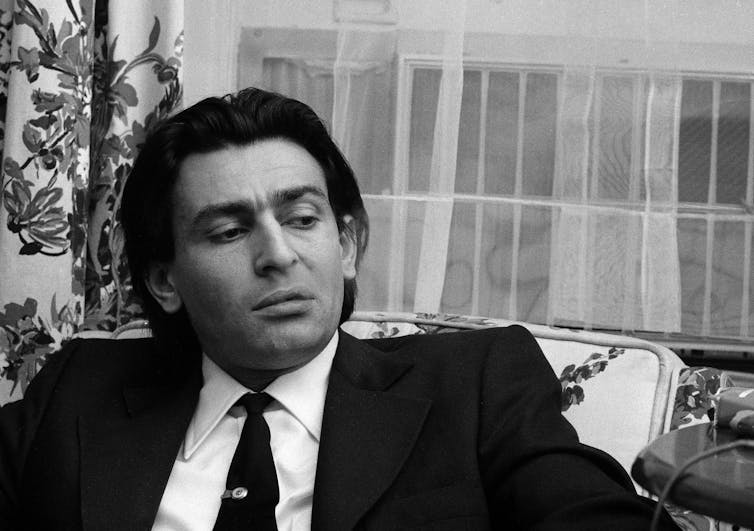 Valery Chalidze, speaking to reporters at his hotel in New York in 1972.
Ron Frehm/AP
Valery Chalidze, speaking to reporters at his hotel in New York in 1972.
Ron Frehm/AP
The Soviet authorities retaliated in the summer of 1973. They unleashed a propaganda campaign against him that was reminiscent — in its virulence and scale — of the Stalin era.
Pushing the US to make human rights a priority
Undaunted by the intensifying harassment, Sakharov threw down the gauntlet to the Kremlin by addressing an open letter to the US Congress in support of a bold human rights initiative.
Under the terms of a proposed amendment to the 1974 Trade Act (called the Jackson-Vanik amendment), a US-Soviet trade agreement would be made conditional on the lifting of restrictions on Jewish emigration from the USSR.
This legislation, which was only repealed in 2012, was fiercely resisted by then-US Secretary of State Henry Kissinger, who regarded criticism of Soviet totalitarianism as a threat to improving US-Soviet relations.
In his letter, Sakharov argued that restricting emigration made the Soviet Union a closed society that was a danger to the world. This was a historic intervention.
As Kissinger later admitted, Sakharov’s letter “opened the floodgates.” The adoption of the amendment by Congress in 1974 became a turning point in the incorporation of human rights into US foreign policy.
It was no coincidence that Jimmy Carter, the first president to embrace human rights as a diplomatic priority, began his tenure in the White House in 1977 by exchanging letters with Sakharov.
Read more: Jimmy Carter's lasting Cold War legacy
Sakharov and the Helsinki Process
No less important was Sakharov’s influence on the Helsinki Process, a series of East-West conferences on security and cooperation in Europe.
Launched by the signing of the Helsinki Final Act in 1975, the Helsinki Process was widely perceived as a Western defeat because it appeared to recognise Soviet domination of Eastern Europe. Sakharov, however, saw it as an opportunity. In his acceptance speech for the Nobel Peace Prize that year, he drew attention to the fact the agreement contained
far-reaching declarations on the relationship between international security and the preservation of human rights.
This insight inspired a group of dissidents, including Sakharov’s wife Yelena Bonner, to establish the Moscow Helsinki Group (MHG), an organisation dedicated to monitoring the Soviet regime’s implementation of the human rights provisions of the Final Act.
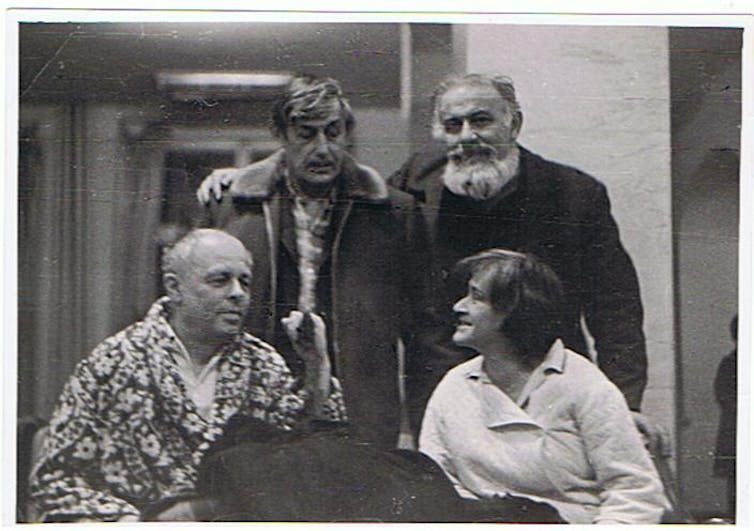 Andrei Sakharov (left) with fellow dissidents and intellectuals in Moscow in 1973. Yelena Bonner is on the bottom right.
Wikimedia Commons
Andrei Sakharov (left) with fellow dissidents and intellectuals in Moscow in 1973. Yelena Bonner is on the bottom right.
Wikimedia Commons
For nearly eight years, the MHG sent meticulous reports about Soviet violations to the follow-up conferences of the signatory states, but its most compelling evidence was the brutal repression inflicted on its own members.
Thanks to these dissidents, the Helsinki Process became what one US diplomat called “a court trial in continuous session” of the USSR and its East European satellites.
Much of this contest focused on the fate of Sakharov himself after the Soviet regime finally moved to silence him in 1980. For speaking out against the Soviet invasion of Afghanistan, he was arrested and banished to internal exile.
‘Our duty is to Sakharov’s name’
During his seven-year ordeal in the closed city of Gorky, Sakharov spoke to the world more often through hunger strikes than by words. His treatment cast a vast shadow over Soviet relations with both the US and Western Europe.
In response to the mounting pressure, Gorbachev astonished the world in 1986 by personally telephoning Sakharov and requesting he resume his “patriotic work”.
Read more: World politics explainer: the Russian revolution
Two and a half years later, Sakharov dominated the debates of the first Congress of People’s Deputies, the Soviet Union’s first serious parliamentary experiment.
With a persistence that infuriated the Congress’ “aggressively obedient majority”, Sakharov challenged the constitutional supremacy of the Communist Party and urged his reformist colleagues to embark on the path of opposition.
They took that step in the aftermath of Sakharov’s death on December 14 1989. One day later, the future Russian president Boris Yeltsin declared:
We must come to the end of the path that Sakharov began. Our duty is to Sakharov’s name, to the persecution he suffered.
How Sakharov is remembered today
Each year, the European Parliament’s prestigious Sakharov Prize reminds rights defenders around the world of Sakharov’s tireless efforts to protect human rights.
In Russia, however, his legacy remains contested. The Putin regime marked the centenary of Sakharov’s birth this May with a commemorative coin and a statement that praised Sakharov’s contribution to national security, but ignored his years as a dissident. A public exhibition that was intended to draw attention to Sakharov’s activism was blocked by the Moscow authorities.
This obstructionism is a tribute to Sakharov’s enduring importance for many anti-Putin democrats, like the twice-poisoned Vladimir Kara-Murza, who honour Sakharov as the embodiment of Russia’s democratic tradition.
Authors: Robert Horvath, Senior lecturer, La Trobe University


 Daily Bulletin


