

To find out how galaxies grow, we're zooming in on the night sky and capturing cosmic explosions
- Written by: Rebecca Allen, Coordinator Swinburne Astronomy Online | Program Lead of Microgravity Experimentation, Space Technology and Industry Institute, Swinburne University of Technology
Scientists see flora, fauna and phenomena the rest of us rarely do. In this series, we’ve invited them to share their unique photos.
Across Australia, astronomers are using cutting-edge technologies to capture the night sky, hoping to eventually tackle some of our biggest questions about the universe.
As we and our colleagues delve deeper into the cosmos, looking for cosmic explosions, our observations are helping shed light on longstanding mysteries — and making way for entirely new paths of inquiry.
Cosmic eruptions fill the sky
Swinburne’s Deeper, Wider, Faster (DWF) program — which one of us (Sara Webb) worked on throughout her PhD — was developed to hunt for the fastest and most mysterious explosions in the universe.
But to understand what causes cosmic explosions, we must “look” at these events with multiple eyes, through different telescopes around the world. Today we’ll take you on a journey using data from one of these telescopes, the Blanco 4m, at Chile’s Cerro Tololo Inter-American Observatory.
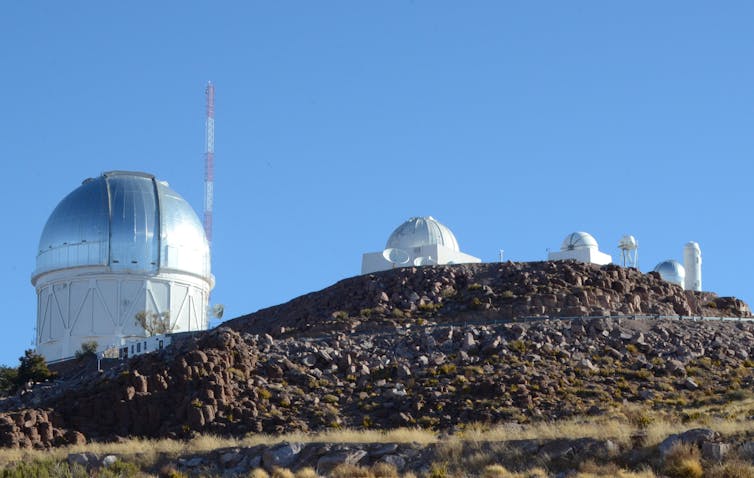 The Blanco 4m telescope in Chile. This telescope has a dark energy camera attached to it.
Rebecca Allen
The Blanco 4m telescope in Chile. This telescope has a dark energy camera attached to it.
Rebecca Allen
First, all 60+ individual images taken of the field of view from this telescope are combined into a mosaic. Within them we see the thousands of bright sources.
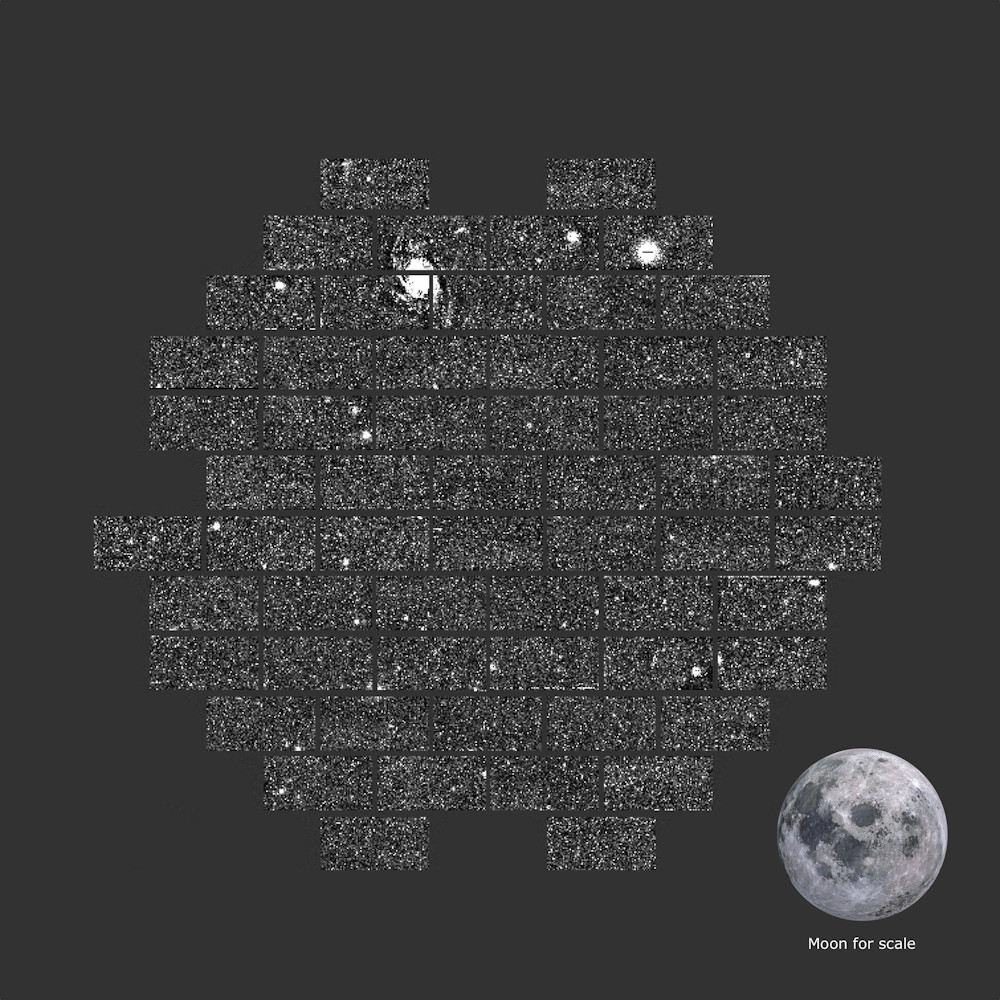 This is an example of dark energy camera data taken by the DWF program. This image is of an enormous section of the sky.
Sara Webb
This is an example of dark energy camera data taken by the DWF program. This image is of an enormous section of the sky.
Sara Webb
These images are transferred across the Pacific to be processed on Swinburne’s OzStar supercomputer — which is more powerful than 10,000 personal laptops and can handle thousands of different jobs at once.
Once uploaded, the images are broken down into smaller chunks. This is when we start to see details.
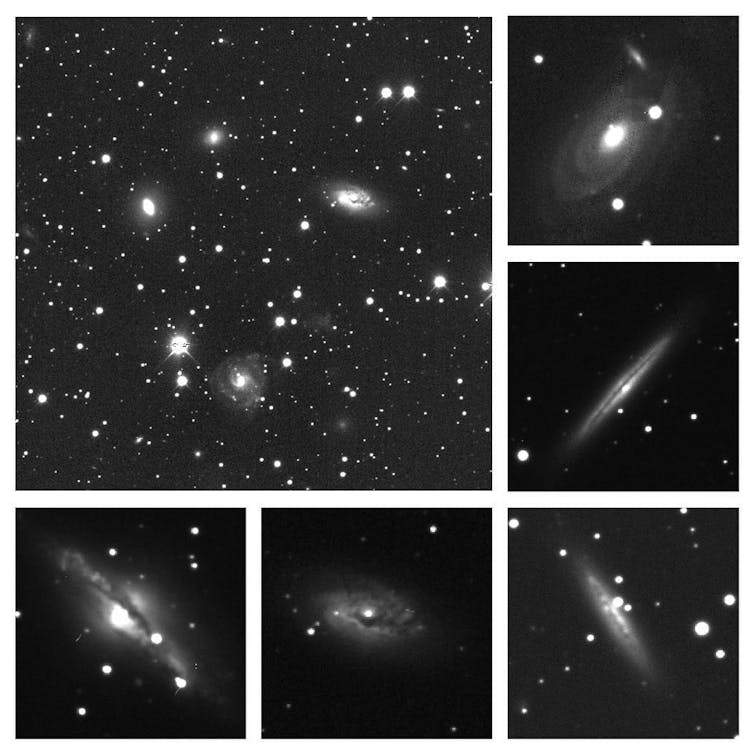 Pictured are some of the galaxies visible within smaller cutouts of data sent to the DWF program from the Blanco 4m.
Sara Webb
Pictured are some of the galaxies visible within smaller cutouts of data sent to the DWF program from the Blanco 4m.
Sara Webb
But the galaxies above, spectacular as they are, still aren’t what we’re looking for. We want to capture new “sources” resulting from dying stars and cosmic explosions, which we can identify by having our computers search for light in places it wasn’t previously detected.
A source could be many different things including a flaring star, a dying star or an asteroid. To find out we have to collect continuous information about its brightness and the different wavelengths of light it emits, such as radio, x-ray, gamma-ray and so forth.
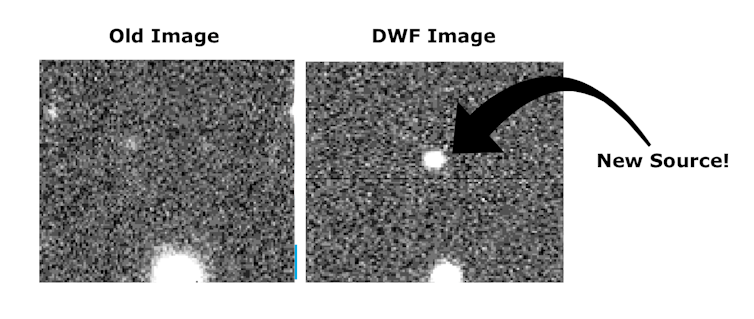 To the left is an old image of a patch of sky and to the right is a updated image with a new source having just occurred. This one is likely a flare star or an asteroid.
Sara Webb
To the left is an old image of a patch of sky and to the right is a updated image with a new source having just occurred. This one is likely a flare star or an asteroid.
Sara Webb
Once we spot a source, we monitor changes in its brightness over the coming hours and days. If we think it may represent a rare cosmic explosions, we trigger other telescopes to collect additional data.
Peering into the distant past
Galaxies are vast collections of stars, gas, dust and dark matter. They vary in shape, size and colour, but the two main types we see in the universe today are blue spirals and red ellipticals. But how do they form? And why are there different types?
Astronomers know the shapes and colours of a galaxy are linked to its evolution, but they’re still trying figure out exactly which shapes and colours are linked to specific growth pathways.
We think galaxies grow in size and mass through two main channels. They produce stars when their vast hydrogen clouds collapse under gravity. As more gas is transformed into stars, they grow in size.
Thanks to space-based technology such as the Hubble Space Telescope and powerful on-ground telescopes, astronomers can now peer back in time to study galaxy growth over the history of the universe.
This is possible since the further away a galaxy is, the longer its light travelled to reach us. Because the speed of light is constant, we can determine when the light was emitted — as long as we know the galaxy’s distance from Earth (called its “redshift”).
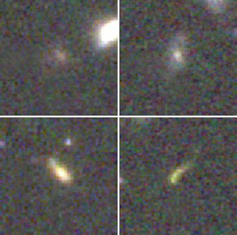 A selection of distant galaxies spotted in my study of galaxy growth over time. These appear very different to nearby galaxies.
Rebecca Allen
A selection of distant galaxies spotted in my study of galaxy growth over time. These appear very different to nearby galaxies.
Rebecca Allen
I measured this growth as part of my PhD, by taking images of galaxies that exist at different redshifts from as far back as when the universe was only one billion years old, and comparing their sizes.
When galaxies merge
Looking around the universe today, we mostly see galaxies clustered together. Astronomers believe the nature of a galaxy’s surroundings or its environment can affect its growth pathways, similar to how people in large cities can access more resources than those in rural areas.
When many galaxies are grouped together they may interact. And this interaction can stimulate bursts of star formation within a particular galaxy.
That said, this growth spurt may be short-lived, as gas and stars can be stripped away through the gravitational interaction between multiple galaxies, thereby limiting future star formation and growth in a single galaxy.
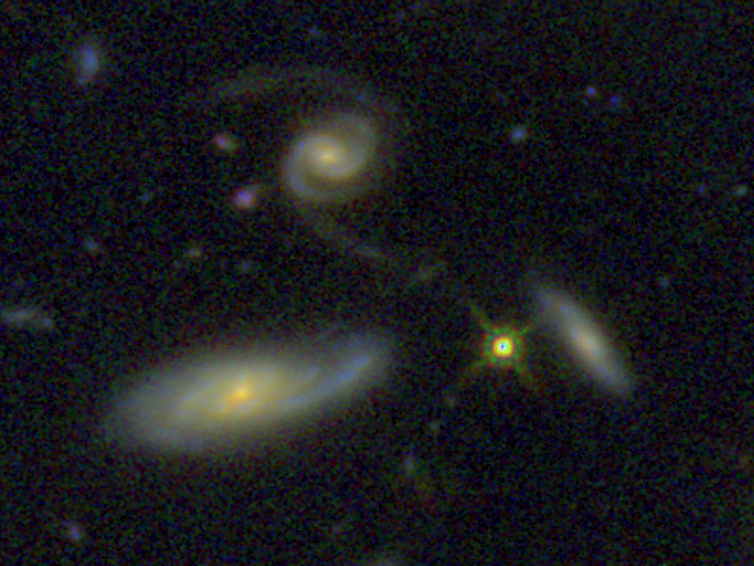 This image was captured using the Hubble Space Telescope. It shows a group of spiral galaxies, which astronomers can clearly determine due to the high resolution of the image.
Rebecca Allen
This image was captured using the Hubble Space Telescope. It shows a group of spiral galaxies, which astronomers can clearly determine due to the high resolution of the image.
Rebecca Allen
But even if a galaxy can’t form stars, it can still grow by merging with or consuming smaller galaxies. For example, the Milky Way will one day consume the smaller Magellanic clouds, which are dwarf galaxies. It will also merge with the slightly larger Andromeda galaxy one day, to form one giant galaxy.Yet, while many studies have been conducted unpack galaxy evolution, we still can’t say all our questions have been answered.
It took billions of years for the galaxy clusters we observe today to form. But if astronomers can leverage the latest technologies and peer further into the distance than ever before, we will hopefully gain clues about how a galaxy’s environment can impact its growth.
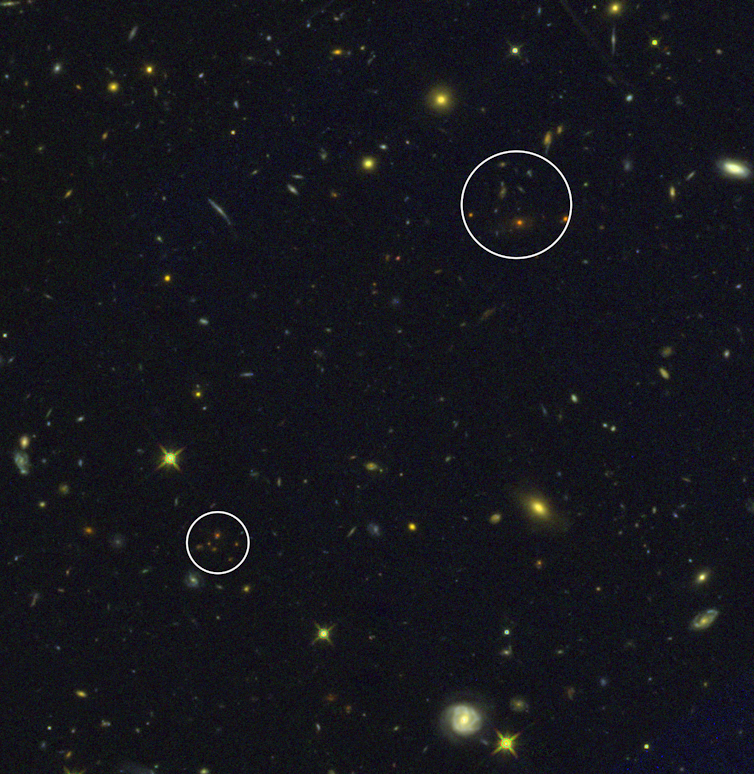 Pictured are two groups of distant galaxies that existed when the universe was one-quarter of its current age. These galaxy groups will eventually come together and form a structure similar to the Virgo cluster. I have studied them both to learn more about how the galaxies within them are growing.
Rebecca Allen
Pictured are two groups of distant galaxies that existed when the universe was one-quarter of its current age. These galaxy groups will eventually come together and form a structure similar to the Virgo cluster. I have studied them both to learn more about how the galaxies within them are growing.
Rebecca Allen
The bending of spacetime reveals secrets
With decades of observations and millions of galaxies captured in surveys, experts have many theories regarding how galaxies form, and how the universe evolves. This field is called cosmology.
Thanks to Albert Einstein, we know the gravitational force of massive objects in space causes space to bend. This has been observed through a phenomena known as “lensing”, where vast amounts of matter are concentrated in one area within objects such as black holes, galaxies or galaxy clusters.
Their gravity distorts spacetime, acting as a giant lens to reveal warped images of more distant objects behind them. Using lensing, astronomers have developed ways to find and study distant galaxies that would otherwise be hidden from view.
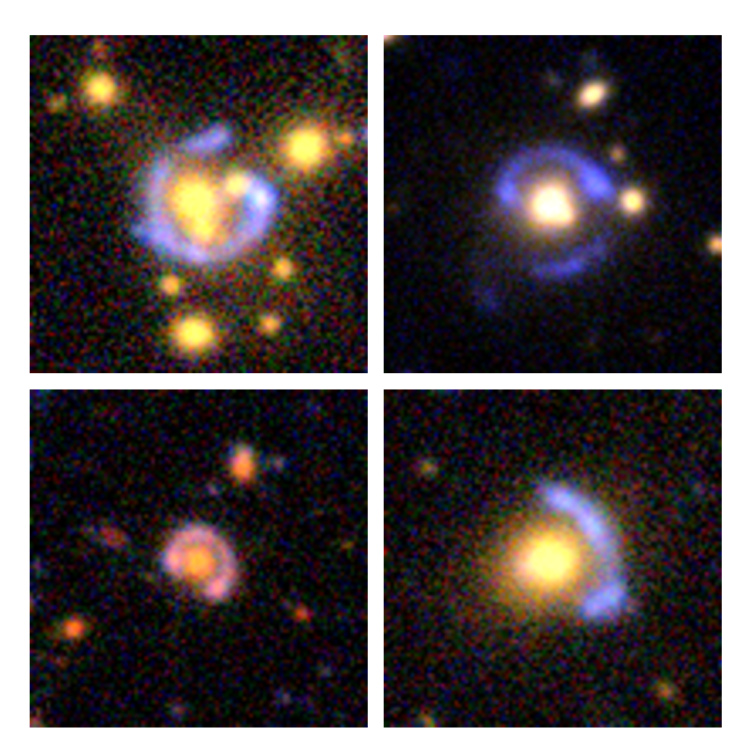 A set of galaxy-galaxy lenses. The massive foreground galaxy’s gravity distorts spacetime, acting as a lens that reveals a warped image of a distant background galaxy.
Rebecca Allen
A set of galaxy-galaxy lenses. The massive foreground galaxy’s gravity distorts spacetime, acting as a lens that reveals a warped image of a distant background galaxy.
Rebecca Allen
These observations continue to drive our understanding of galaxy evolution. They’re challenging our theories of when and how galaxies form and grow.
One 2018 discovery made by a group of researchers, including myself, revealed a set of massive and already evolved galaxies from when the universe was only about one-sixth of its current age. They would have had to form and grow at an extremely rapidly to fit our current models of galaxy growth.
In a upcoming investigation, Swinburne Professor Karl Glazebrook will lead my team and I to become some of the first astronomers granted access to Nasa’s James Webb Space Telescope to study these early galaxies.
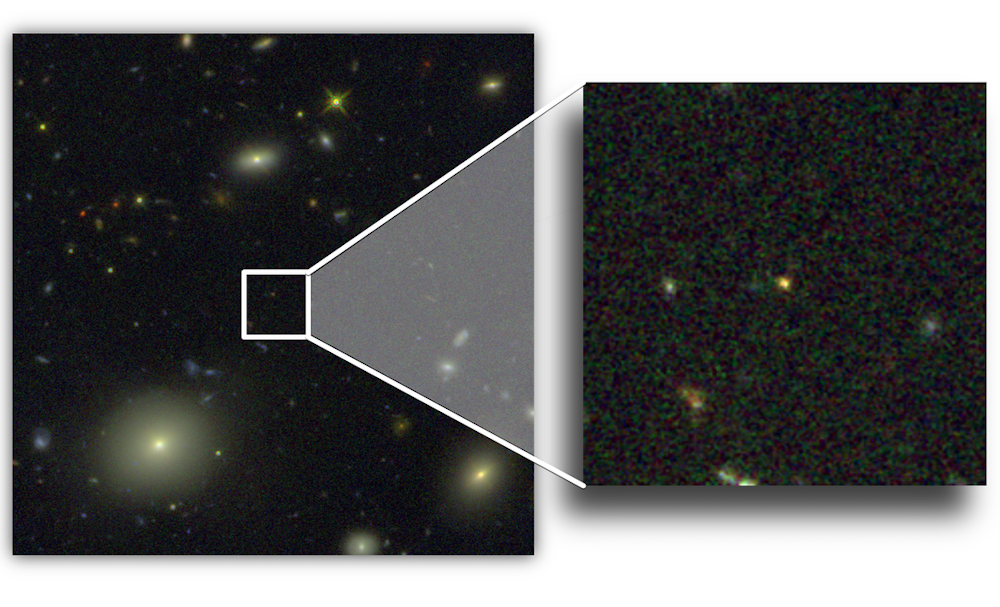 One of the massive quiescent galaxies which our team will investigate. While extremely large, its older stars and distance make it appear as a tiny red nugget among the much brighter and closer galaxies.
Rebecca Allen, Author provided
One of the massive quiescent galaxies which our team will investigate. While extremely large, its older stars and distance make it appear as a tiny red nugget among the much brighter and closer galaxies.
Rebecca Allen, Author provided
Authors: Rebecca Allen, Coordinator Swinburne Astronomy Online | Program Lead of Microgravity Experimentation, Space Technology and Industry Institute, Swinburne University of Technology


 Daily Bulletin


