

How a bee sees: tiny bumps on flower petals give them their intense colour — and help them survive
- Written by: Adrian Dyer, Associate Professor, RMIT University
The intense colours of flowers have inspired us for centuries. They are celebrated through poems and songs praising the red of roses and blue of violets, and have inspired iconic pieces of art such as Vincent Van Gogh’s sunflowers.
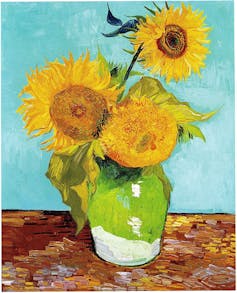 Vase with Three Sunflowers by Vincent Van Gogh.
But flowers did not evolve their colour for our pleasure. They did so to attract pollinators. Therefore, to understand why flowers produce such vibrant colours, we have to consider how pollinators such as bees perceive colour.
When observed under a powerful microscope, most flower petals show a textured surface made up of crests or “bumps”. Our research, published in the Journal of Pollination Ecology, shows that these structures have frequently evolved to interact with light, to enhance the colour produced by the pigments under the textured surface.
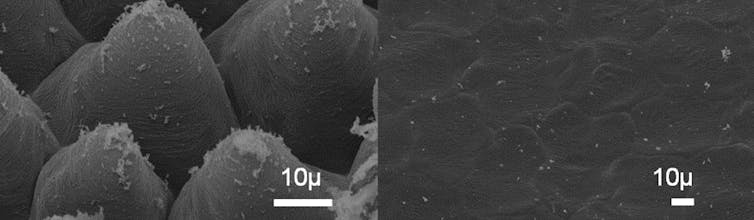 A flower of Tibouchina urvilleana observed under a powerful scanning electron microscope shows a typical bumpy petal surface (left). In comparison, the opposite (abaxial) petal side, rarely seen by an approaching pollinator, shows a less textured surface (right).
Author provided
A flower of Tibouchina urvilleana observed under a powerful scanning electron microscope shows a typical bumpy petal surface (left). In comparison, the opposite (abaxial) petal side, rarely seen by an approaching pollinator, shows a less textured surface (right).
Author provided
Sunshiney daze
Bees such as honeybees and bumblebees can perceive flower colours that are invisible to us — such as those produced by reflected ultraviolet radiation.
Plants must invest in producing reliable and noticeable colours to stand out among other plant species. Flowers that do this have a better chance of being visited by bees and pollinating successfully.
However, one problem with flower colours is sunlight may directly reflect off a petal’s surface. This can potentially reduce the quality of the pigment colour, depending on the viewing angle.
You may have experienced this when looking at a smooth coloured surface on a sunny day, where the intensity of the colour is affected by the direction of light striking the surface. We can solve this problem by changing our viewing position, or by taking the object to a more suitable place. Bees, on the other hand, have to view flowers in the place they bloom.
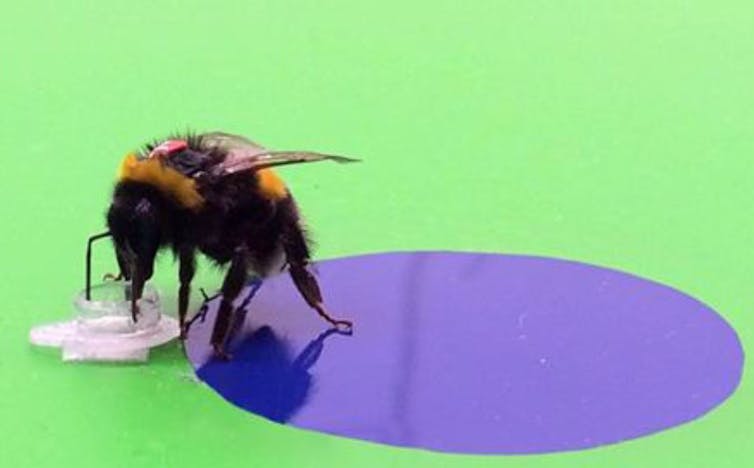 Bumblebee on a smooth blue surface, where the colour is affected by light reflection.
We were interested in whether this visual problem also existed for bees, and if plants have evolved special tricks to help bees find them more easily.
Read more: Our 'bee-eye camera' helps us support bees, grow food and protect the environment
How bees use flower surfaces
It has been known for some time that flowering plants most often have conical-shaped cell structures within the texture of their petal surfaces, and that flat petal surfaces are relatively rare. A single plant gene can manipulate whether a flower has conical-shaped cells within the surface of a petal — but the reason why this evolved has remained unclear.
Past research suggested the conical petal surface acted as a signal to attract pollinators. But experiments with bees have shown this isn’t the case. Other explanations relate to hydrophobicity (the ability to repel water). But again, experiments have revealed this can’t be the only reason.
We investigated how bumblebees use flower surfaces with or without conical petal shapes. Bees are a useful animal for research as they can be trained to collect a reward, and tested to see how they perceive their environment.
Bumblebees can also be housed and tested indoors, where it is easier to precisely mimic a complex flower environment as it might work in nature.
Flowers cater to a bee’s needs
Our colleague in Germany, Saskia Wilmsen, first measured the petal surfaces of a large number of plants and identified the most common conical surfaces.
She then selected some relatively smooth petal or leaf surfaces reflecting light from an artificial source as a comparison. Finally, blue casts were made from these samples, and subsequently displayed to free-flying bees.
In the experiment, conducted with bumblebees in Germany, a sugar solution reward could be collected by bees flying to any of the artificial flowers. They had to choose between flying either towards “sunlight” — which could result in light reflections affecting the flower’s coloration — or with the light source behind the bee.
The experiment found when light came from behind the bees, there was no preference for flower type. But for bees flying towards the light, there was a significant preference for choosing the flower with a more “bumpy” conical surface. This bumpy surface served to diffuse the incoming light, improving the colour signal of the flower.
The results indicate flowers most likely evolved bumpy surfaces to minimise light reflections, and maintain the colour saturation and intensity needed to entice pollinators. Humans are probably just lucky beneficiaries of this solution biology has evolved. We also get to see intense flower colours. And for that, we have pollinators to thank.
Read more: Plants use advertising-like strategies to attract bees with colour and scent
Authors: Adrian Dyer, Associate Professor, RMIT University


 Daily Bulletin


