

How the Groundhog Day grind of lockdown scrambles your memory and sense of time
- Written by: Adam Osth, Senior Lecturer, The University of Melbourne
With roughly half of Australia in lockdown at the moment, a common experience is a warped sense of time and poor memory. What day is it? What week is it? Did I go to the supermarket yesterday, or was it the day before? Am I actually in the movie Groundhog Day and experiencing the same day over and over?
While lockdown can have a range of impacts such as anxiety and depression — both of which can impair memory — these aren’t the whole picture. There is increasing theoretical and experimental evidence that suggests both memory and time perception are based on the same underlying principle: a change in your physical and/or mental state.
So it follows that when there is less change, it becomes harder to determine how much time has passed, or to remember what happened and when.
Cognitive scientists are increasingly embracing an elegant theory of memory with profound implications, known as contextual-binding theory. According to this theory, memories are formed by linking what you experience to the context in which it occurred.
Read more: Here's why memories come flooding back when you visit places from your past
But what is context? Well, everything!
Let’s say an event happens to me: a strange cat walks into my house. I form a memory of this event by linking the cat to the context — in this case, the context includes the physical surroundings (my house) and my mental state (surprise and excitement, because I love cats).
Because my memory has linked all the various aspects of this event together, when I experience a piece of that event (being in the room where I saw the cat, or feeling excited when seeing another cat), it prompts my memory to recall all the other aspects of the event too, triggering a reconstruction in my head of that time a strange cat walked into my house.
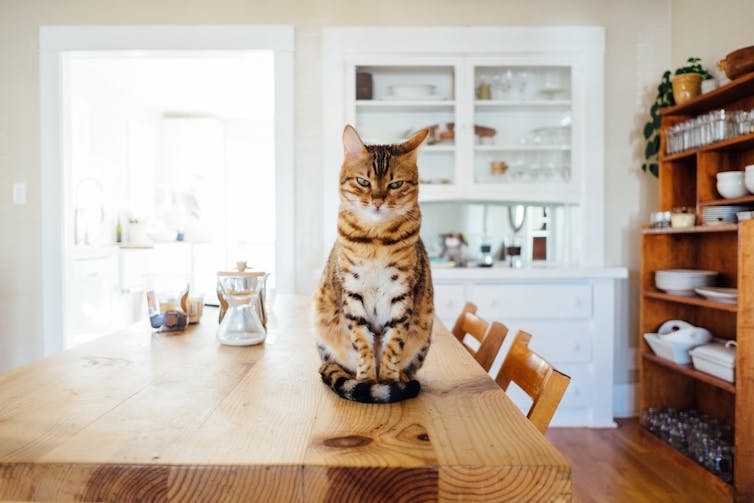 Remind you of anything?
Paul Hanaoka/Unsplash, CC BY
Remind you of anything?
Paul Hanaoka/Unsplash, CC BY
But there’s a catch. As we link more and more memories to the same cues, it becomes harder to find a memory with those cues. This is like a Google search – it’s easiest to find what you’re looking for if your search term is unique to that particular thing.
That’s why we often have the best memory for events that occur in different contexts. Imagine you go on holiday and spend an amazing week in the Caribbean. Among your entire lifetime’s memories, relatively few of them happened in the Caribbean, so it’s easy to remember what you did on your holiday.
Lockdown is the exact opposite of this. In lockdown, the events we experience all have more or less the same context. If you’re spending almost all your time in your house, it’s harder to pinpoint individual memories of the things that happened there. It’s like doing a Google search where everything matches your search terms.
Read more: Ah, memories of 2020. Why it's important to remember our COVID holidays, good or bad
Time isn’t something our minds can measure directly. We don’t have clocks or hourglasses in our brains.
Fortunately for us, our minds are very good at constructing concepts we can’t directly measure. Our eyes can’t measure depth directly — instead, we estimate it with the help of cues in our surrounding environment.
So how can we measure how much time has elapsed? We approximate it by evaluating how much has changed between a remembered event and the present moment. When I remember an event, there are things that might be different from the present moment. Was I in a different place? Did I feel different, or look different? The sum total of these changes can produce an estimate of how much time has elapsed between then and now.
This was demonstrated in an intriguing experiment by US psychology researchers Lili Sahakyan and James Smith. Participants learned words in three different lists. Some participants experienced mental context change between each list, whereby they were instructed to think about other things than the previous list. Another group did not experience mental context change, and were instructed simply to keep the previous list in mind.
When there was more context change, memory was better for the words learned in the most recent list. Interestingly, when participants were asked how much time had elapsed since the beginning of the five-minute-long experiment, the “context change” group estimated that the experience was about a minute longer than the group who experienced no context change between lists.
When there was less context change between episodes, which is similar to the conditions of lockdown, subjects had worse memory for the most recent event, and reported that less time had elapsed. Other experiments have demonstrated similar results with changes in physical location..
Read more: Don't know what day it is or who said what at the last meeting? Blame the coronavirus
So how do we get around this problem and improve our memories? The obvious solution is to create change. Mix up your physical surroundings, or try different exercises or routines on different days to make them more distinct.
And rest assured, your lockdown memory fog is almost certainly temporary. Once lockdown lifts and go back to experiencing events in different places, we will start remembering what day it is again.
Read more: What Groundhog Day (and my time in a monastery) taught me about lockdown
Authors: Adam Osth, Senior Lecturer, The University of Melbourne


 Daily Bulletin


