

There's a strong case to be made for constitutional monarchies. But there's no case for one in Australia
- Written by: Dennis Altman, Professorial Fellow in Human Security, La Trobe University
The basic defence of constitutional monarchies came from the British writer Walter Bagehot 150 ago. He argued for a separation between the ceremonial and the actual holders of power. It is summed up in the expression “the Queen reigns but does not rule”.
Where the roles of head of state and head of government are combined, as in the United States, there are fewer restraints on the pretensions of political leaders.
Many of the countries we think of as most progressive are constitutional monarchies – the Scandinavian and Benelux countries, for example – and have hereditary monarchs. In Spain, the role of King Juan Carlos was crucial in the post-Franco transition to democracy, although he is now living in exile, accused of major corruption. In Japan, the decision of the Allies to retain the emperor was important in creating a liberal democratic system after the second world war, and the emperor continues to play an important ceremonial role.
Read more: The Oprah interview is a royal PR nightmare, but republicans shouldn't get their hopes up just yet
The old dominions of the British Empire – Canada, New Zealand, Australia –basically accepted the British sovereign as head of state, with a governor-general acting as effective head of state. This is a very peculiar constitutional arrangement. Australian passports are issued by the governor-general as “the representative of Her Majesty”, but on arrival at Heathrow airport we queue in the same line as other foreign nationals. Some small Pacific and Caribbean countries, including Papua New Guinea, have preserved the same system, and in several cases have rejected proposals for change.
Of course, the same balance between ceremonial and real power can be achieved through an elected head of state, as in Ireland, or one appointed through the legislature, as in Germany. Defenders of constitutional monarchy claim the hereditary principle removes the political element and provides a sense of historical continuity that promotes greater faith in the political system.
Constitutional monarchies are supported by a combination of nostalgia, national pride and deep distrust of politicians. In both European and Asian monarchies, the royal family stands as a symbol of national pride and a prop of existing social hierarchies.
For the British, the monarchy symbolises a sense of greatness that has long passed, but allows for largely harmless nostalgia. Thinking of Australia as part of the imperial family might have made sense when the predominantly Anglo colonies federated in 1901. It is patently absurd today.
Since John Kerr’s dismissal of Whitlam in 1975, it is difficult to imagine a governor-general, whether with or without the support of Buckingham Palace, doing anything similar. The larger problem is the prime minister is nominally accountable to a governor-general whom he or she has appointed.
The British prime minister has no such power, although the constitutional conventions would require the monarch to stand down should parliament so decree. The simplest solution to the Australian conundrum, as Donald Horne posited some decades ago, is to retain our current system but elect the governor-general.
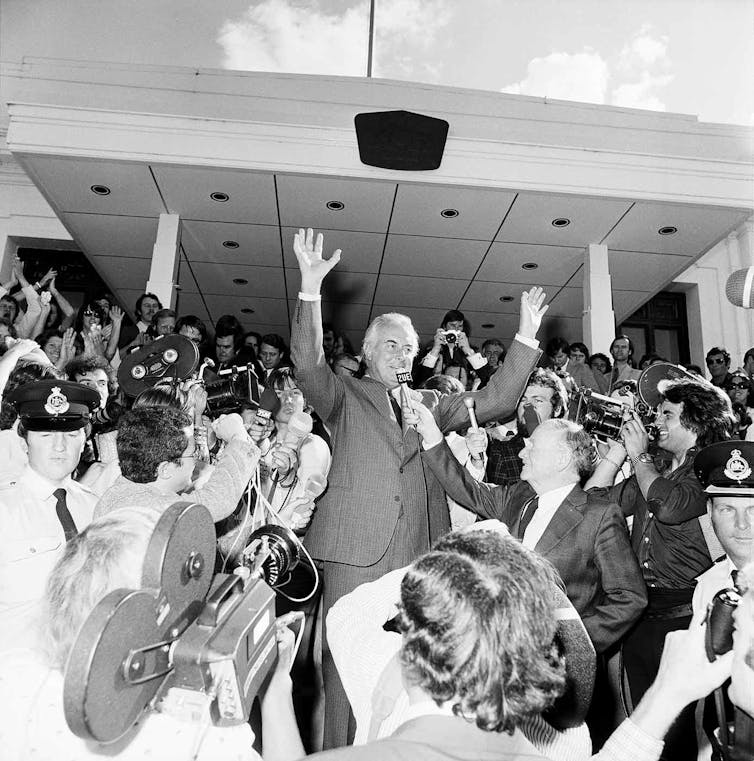 Since the dismissal of Gough Whitlam in 1975, it is difficult to imagine another governor-general behaving in the same way as Sir John Kerr.
National Museum of Australia
Since the dismissal of Gough Whitlam in 1975, it is difficult to imagine another governor-general behaving in the same way as Sir John Kerr.
National Museum of Australia
At this point in our history, the resistance to constitutional change acts to perpetuate the status quo. Most politicians fear direct election would create a powerful challenge to parliamentary authority. Many populists are unwilling to trust politicians to choose a head of state.
This is not a feeling confined to Australia. A few years ago, one left-wing Dutch commentator lamented:
There has been a political crisis in the Netherlands for years, as most Dutch people have lost confidence in the main political parties. In the 21st century, more Dutch people trust the monarchy than the main political parties.
If anything, I suspect this distrust is greater today than it was when the Australian electorate rejected the republic in the 1999 referendum. That referendum came two years after the death of Princess Diana, which was a greater blow to the British monarchy than the recent Oprah interview with Harry and Meghan. Diana, after all, had been a future queen and the mother of a future king.
Read more: After Oprah: what will it take to revive an Australian republic?
There are more pressing problems with our Constitution, above all the need to recognise the dispossession of the original inhabitants of what we now call Australia. But no-one writing an Australian constitution today would argue for a head of state living on the other side of the world who is effectively represented by a governor general, hand-picked by the head of government.
Had our monarchists been more far-sighted in 1901 they might have invited one of Queen Victoria’s surplus children to establish an Australian dynasty. At least we would then have our own constitutional monarchy to argue over.
Dennis Altman’s new book is God Save The Queen: The strange Persistence of Monarchies.
Authors: Dennis Altman, Professorial Fellow in Human Security, La Trobe University


 Daily Bulletin


