

Young Australians are supposedly 'turning their backs' on democracy, but are they any different from older voters?
- Written by: Intifar Chowdhury, PhD Candidate/Data Archivist, Australian National University
The 2019 federal election saw the lowest voter turnout since compulsory voting was introduced in 1924. Only 91% of Australians voted, amid reports young people “turned their back on democracy”.
In some seats, less than three-quarters of those entitled to vote cast a legitimate ballot. The biggest falls were in some inner-city electorates with high proportions of young voters. This comes off the back of a decline in electoral participation in advanced democracies, which has been disproportionately concentrated among young people.
Beyond the election, survey research has also suggested young Australians harbour more negative attitudes towards democracy than older people. A 2013 Lowy Institute poll found 48% of millennials did not believe democracy is superior to its alternatives.
So, are young Australians really turning away from democracy? My new research cautions against the idea that young Australians are disengaging from the principles and processes of our political system.
How should we think about youth and politics?
The idea that young people don’t care about politics is a highly contested one among researchers. There are three ways of thinking about how youth affects political attitudes and behaviours.
The first is young people are not interested in politics because of the “age effect”. There is a large body of literature arguing younger people have different attitudes towards politics than older people because of where they are in their lives. Politics may seem irrelevant because they are less likely to have things like a mortgage or kids.
 When we talk about ‘young people’ we need to be careful about what we mean by this.
James Ross/AAP
When we talk about ‘young people’ we need to be careful about what we mean by this.
James Ross/AAP
The second is young people may have different attitudes due to a “generation effect”. That is, values about democracy do not vary with age rather, values formed during our formative years persist throughout people’s lives. For example, baby boomers (born between 1946 and 1960) — who saw unprecedented material growth from the construction, manufacturing and mining boon in their youth — may be more committed to democracy than the next generations.
The third is what’s known as “period effects”. Political and economic crises are considered contextual factors which shape the political outlook and behaviour of all citizens, irrespective of their age and generational memberships. For example, we may all be shaped by the COVID pandemic, regardless of how old we are.
These three factors — age, cohort and period, respectively — can influence people’s attitude and behaviour simultaneously, making it harder to attribute disengagement to any one factor.
What’s happening in Australia?
In Australia, some studies show engagement in democracy is dependent on age — that is, younger people in every generation have almost the same likelihood to be uninterested in their 20s. Other studies have argued for generational explanations: compared to their predecessors, today’s young people are more critical of and more readily express their grievances against politicians.
Read more: Millennials are not the only 'burnout generation' (just ask the rest of us)
But these conclusions are hasty — as well as marginalising — for two reasons.
First, electoral disengagement does not necessarily mean rejection of democratic values. Young Australians’ overwhelming involvement in single-issue movements, such as the same-sex plebiscite, nation-wide climate and women’s rights protests, proves young people deeply care about politics. They just may not show it in the same way their parents or grandparents do.
Second, weak support for democracy may not be exclusive to young people and may temporarily apply to the entire electorate depending on the time period in question.
Analysing the data
Using survey data from the Australian Election Study from 2001 to 2019, I tested whether young Australians are any different from older Australians in their commitment to democracy.
Using statistical methods, I isolated “generation” and “age effects”. I then looked at people’s support for democratic principles, as well as their engagement with both offline (traditional) and online democratic processes.
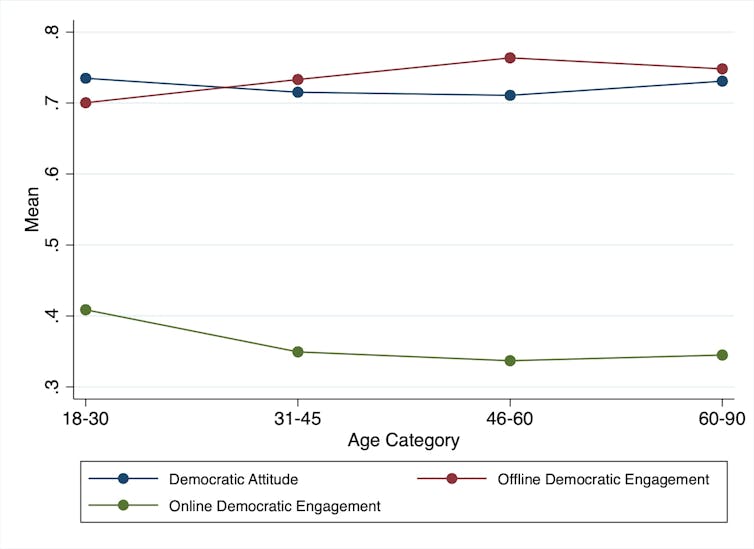 Democratic attitudes and behaviours across age groups.
Author/Australian Election Study
Democratic attitudes and behaviours across age groups.
Author/Australian Election Study
Defying international trends, my analysis found young Australians are not significantly different from older age groups or older generations in their attitudes towards democratic principles (such as believing in the power of their vote) and offline traditional processes (such as discussing politics and persuading others to vote for a party/candidate and contributing money to a campaign).
When it comes to online processes (such as following a campaign or election on social networking sites), young people are in fact more engaged than their older counterparts.
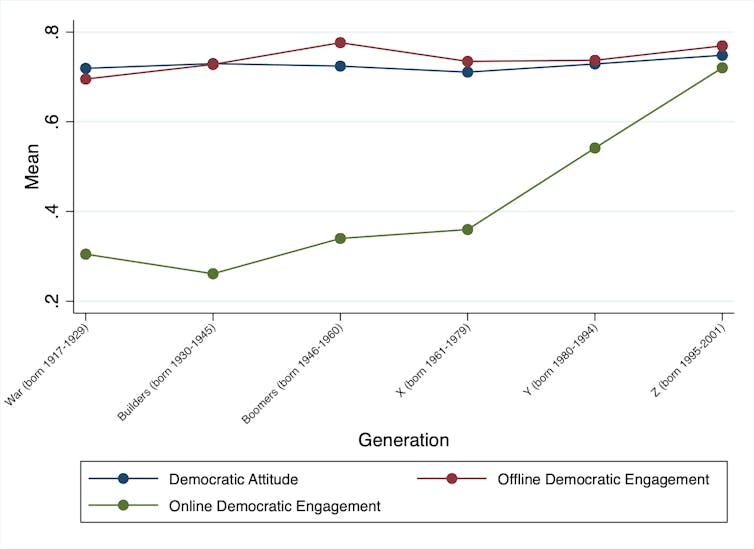 Democratic attitudes and behaviours across generations.
Author/Australian Election Study
Democratic attitudes and behaviours across generations.
Author/Australian Election Study
Therefore, reading the 2019 decline in youth electoral turnout as an overall rejection of democracy, is not a satisfactory conclusion.
Among the three ways of thinking about young people and democratic engagement, I found that “period effects” best explain the situation. That is, something has changed in recent years to influence individuals across all ages and cohorts.
Compulsory voting might tie citizens to the Australian political system, but there has also been a significant decline in trust in politicians and political parties and a lack of confidence in the government’s capacity to meet people’s concerns. This means Australians are wary of the performance of key political actors and institutions — and may be less enthused about casting their vote.
Blaming young people won’t work
Disengagement at election time is by no means a good sign for democracy. Despite an increase in contemporary methods of engaging in democracy, traditional channels continue to be important for translating citizens’ wishes to policies. Brexit is a classic example of what happens when we discard those channels.
Read more: Young people are anxious about coronavirus. Political leaders need to talk with them, not at them
But pointing fingers at any one group — such as young people — will make the issue worse, not better. The blame will further push young people away from traditional forms of participation, which is the case in other advanced democracies.
Rather than criticising young people, it is important to focus on how political institutions are falling short in catering for their needs. The best way to figure this out is to ask them and make room for their voices in key policy-making institutions, including the federal parliament.
Authors: Intifar Chowdhury, PhD Candidate/Data Archivist, Australian National University


 Daily Bulletin


