

How long does immunity last after COVID vaccination? Do we need booster shots? 2 immunology experts explain
- Written by: Vasso Apostolopoulos, Professor of Immunology and Associate Provost, Research Partnerships, Victoria University
An important factor in achieving herd immunity against SARS-CoV-2 (the virus that causes COVID-19) is is how long the vaccines protect you.
If a vaccine continues to work well over a long period, it becomes easier to have a significant proportion of the population optimally protected, and in turn suppress or eliminate the disease entirely.
As the rollout of COVID-19 vaccines continues, public attention is increasingly turning to booster shots, which aim to top up immunity if it wanes. But is a third dose needed? And if so, when?
Let’s take a look at what the data tell us so far about how long immunity from COVID-19 vaccines might last.
First, what about immunity following COVID-19 infection?
The presence of antibodies against SARS-CoV-2 is used as an indicator of immunity, with higher levels indicating greater protection. Once antibody levels drop below a particular threshold, or vanish completely, the person is at risk of reinfection.
Initially, scientists observed people’s antibody levels rapidly decreased shortly after recovery from COVID-19.
However, more recently, we’ve seen positive signs of long-lasting immunity, with antibody-producing cells in the bone marrow identified seven to eight months following infection with COVID-19. In addition, scientists have observed evidence of memory T cells (a type of immune cells) more than six months following infection.
A study of over 9,000 recovered COVID-19 patients in the United States up to November 2020 showed a reinfection rate of only 0.7%. These findings closely align with a slightly more recent study suggesting reinfection after COVID-19 is very uncommon, at least in the short term.
Read more: 5 ways our immune responses to COVID vaccines are unique
While it seems likely there’s some level of lasting protection following COVID-19 infection, if you’ve had COVID, getting vaccinated is still worthwhile.
There’s some evidence vaccination after recovery leads to a stronger level of immunity compared to “natural” immunity from infection, or immunity from vaccination alone. People with so-called “hybrid immunity” appear to exhibit a more diverse range of antibodies.
How long does immunity from vaccines last?
The vaccines deployed against COVID-19 in Australia and most of the western world come from two classes.
Those produced by AstraZeneca and Johnson & Johnson are viral vector vaccines. They use an adenovirus (which causes the common cold) to prime the immune system to respond to SARS-CoV-2.
The vaccines developed by Pfizer and Moderna use mRNA-based technology. The messenger RNA gives your cells temporary instructions to make the coronavirus’ spike protein, teaching your immune system to protect you if you encounter the virus.
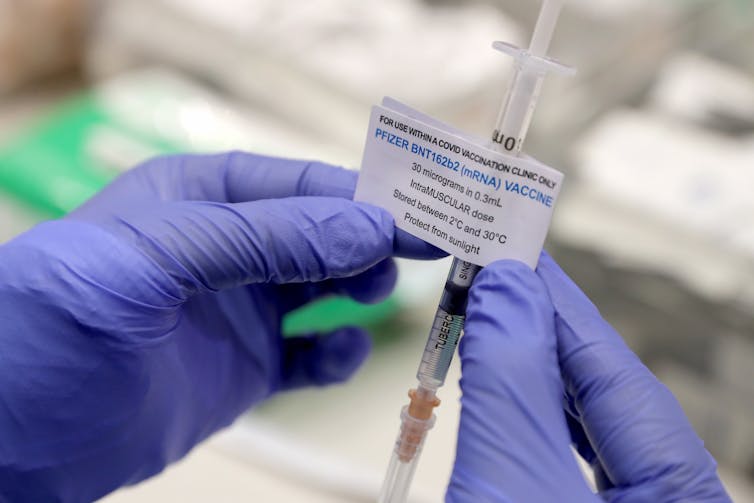 There’s a lot we still don’t know about how long immunity from COVID vaccines last.
Richard Wainwright/AAP
There’s a lot we still don’t know about how long immunity from COVID vaccines last.
Richard Wainwright/AAP
For the viral vector vaccines, despite ongoing trials, there’s little data available on the duration of the antibody response. The original studies showed efficacy for one to two months, however the duration of protection, and whether a booster will be needed, require further evaluation.
Notably, a vaccine similar to AstraZeneca against a related coronavirus (Middle East respiratory syndrome, or MERS) showed stable antibody levels over a 12-month follow-up period. This gives hope for lasting protection against similar coronaviruses.
Read more: How well do COVID vaccines work in the real world?
The Pfizer and Moderna COVID-19 vaccines are the first vaccines based on mRNA technology to be approved for human use. So there’s still significant research required to evaluate the nature and duration of immunity they induce.
Interestingly, “germinal centers” have been identified in the lymph nodes of people vaccinated with the Pfizer vaccine. These act as training sites for immune cells, teaching them to recognise SARS-CoV-2, indicating a potential for long-lasting protection.
Initial studies only evaluated short-term efficacy, however recent research has found strong antibody activity at six months.
What about Delta?
Variants such as Delta, which are more transmissible and potentially more dangerous, are likely to increase interest in booster programs.
All vaccines show modestly reduced efficacy against Delta, so any decrease in protection over time could be more problematic than with the original SARS-CoV-2 virus, or other variants.
A recent preprint (a study yet to undergo peer review) found protection against the Delta variant waned within three months with both the Pfizer and AstraZeneca vaccines.
This research from the United Kingdom showed the Pfizer vaccine was 92% effective at preventing people from developing a high viral load at 14 days after the second dose, but this dropped to 78% at 90 days. AstraZeneca was 69% effective against the same measure at 14 days, dropping to 61% after 90 days.
This study shows vaccinated people who become infected with Delta still carry high amounts of virus (viral load). Third booster doses will be important to reduce these breakthrough infections and subsequent transmission.
Read more: Why do we need booster shots, and could we mix and match different COVID vaccines?
Although the UK study looked at infections rather than hospitalisations or deaths, data from around the world continue to show the unvaccinated are making up the vast majority of patients who develop serious illness.
Nonetheless, scientists are continuing to investigate how waning immunity could affect protection against the more serious outcomes of COVID-19.
OK, so what now?
Pfizer has reported positive results from trials of a third dose to boost immunity, and the company is seeking formal approval for a booster from the United States Food and Drugs Administration.
The United States has announced it will begin distributing third doses next month to people who received an mRNA vaccine eight months ago or more.
Other countries, such as Israel, have already begun rolling out boosters. The move to offer third doses in some high-income countries has raised ethical concerns, with many people around the world still unable to access a first or second dose.
A number of countries have authorised booster doses for at-risk populations in response to the rise of the Delta variant.
This includes older adults and those with compromised immune systems, to combat the increased risk of severe disease and diminished vaccine protection in these people.
In Australia, there is likely to be a booster program in the future. But given the current issues surrounding supply, it’s unlikely to be for some months.
Authors: Vasso Apostolopoulos, Professor of Immunology and Associate Provost, Research Partnerships, Victoria University


 Daily Bulletin


