

Why is a third COVID-19 vaccine dose important for people who are immunocompromised?
- Written by: Emily Edwards, Research fellow, Allergy and Clinical Immunology Laboratory, Monash University
A number of countries including the United States and the United Kingdom are moving to make a third dose of COVID-19 vaccine available to people who are immunocompromised.
But why are people with weaker immune systems at the front of the queue for a third dose?
As we continue to roll out COVID-19 vaccines around the world, emerging data is showing those who are immunocompromised aren’t necessarily as well protected by the first two doses.
So for these people, a third dose, sooner rather than later, could be particularly beneficial.
First, who is ‘immunocompromised’?
People who are immunocompromised have conditions called immunodeficiencies, where part of their immune system is missing or not functioning as well as it should.
Around 2.8% of adults in the US are immunocompromised. We expect the rate is similar in Australia.
Immunodeficiencies are broadly divided into two categories:
primary immunodeficiencies are very rare, often inherited conditions caused by mutations in our DNA
secondary immunodeficiencies are more common and are acquired after birth. Factors that can cause secondary immunodeficiency include malnutrition, certain infections, cancer, and some drug treatments.
Read more: Why do we need booster shots, and could we mix and match different COVID vaccines?
Immunodeficiencies vary in severity, depending on what part of the immune system is missing or the degree of function lost.
The moderate to severe end of the spectrum includes serious forms of primary immunodeficiencies, untreated human immunodeficiency virus (HIV) infection, organ or bone marrow transplant recipients, and people treated with chemotherapy or high doses of immunosuppressive drugs.
We know severely immunocompromised people are susceptible to more severe and prolonged illness with COVID-19.
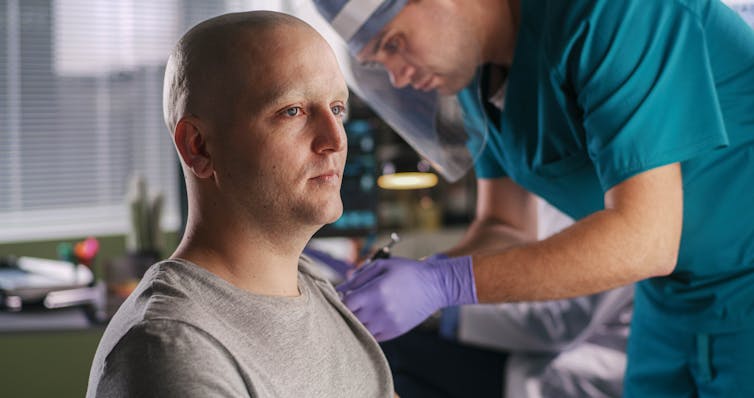 A person undergoing cancer treatment could be immunocompromised.
Shutterstock
A person undergoing cancer treatment could be immunocompromised.
Shutterstock
How well do COVID-19 vaccines work in immunocompromised people?
A preprint (a study yet to undergo peer review) from the UK shows the Pfizer and AstraZeneca vaccines are 73% and 74.6% effective in preventing symptomatic COVID-19 in immunocompromised people respectively.
However, several published and emerging studies are reporting that people who are severely immunocompromised have very high rates of “breakthrough” infections (where people become infected despite being fully vaccinated). This clearly signals COVID-19 vaccines aren’t working optimally in this group.
Some people with primary immunodeficiencies can generate immune responses to COVID-19 vaccines, but these responses tend to be lower than what we’re seeing in healthy people. This decreased immunity could lead to increased breakthrough infections.
Normally, after one dose of the Pfizer vaccine, nearly 100% of healthy people will make detectable levels of antibodies against the virus.
But in a trial with organ transplant recipients, only 4% of people generated a detectable immune response after one dose, increasing to 40% after two doses and 68% after three doses.
So a third dose is likely to provide significant benefit to severely immunocompromised patients.
Notably, immunocompromised people are already given additional doses of some vaccines.
For example, it’s recommended people who have received a bone marrow transplant receive two doses of the influenza vaccine in the first year after the transplant, instead of the usual single dose.
What about third doses in other people?
In addition to classic immunodeficiencies, ageing can lead to a modest immune deficit. In turn, older people are more susceptible to some infections, including COVID-19.
Studies with the Pfizer vaccine show immune responses are lower in older people compared to younger people. Pfizer has shared early data showing a third dose of their vaccine can increase immunity in 65 to 85-year-olds.
Some countries are starting to offer third doses to older people. For example, Israel started delivering third doses to people over 60 in late July (before opening boosters up to younger age groups during August).
However, double and even single doses of the Pfizer or AstraZeneca vaccines very effectively protect against severe disease with COVID-19 among older people. So it’s still unclear whether this is urgently needed.
A third dose for all ages could ultimately be used to generate optimal immunity against COVID-19. Some preprint studies suggest immunity can modestly decline by about three months after the second dose.
Pfizer has shared preliminary data showing a third dose can boost immunity in healthy people.
But the rollout of third doses to a broader range of people in higher-income countries has implications for vaccine equity. The World Health Organization Director General, Tedros Adhanom Ghebreyesus, has led calls to pause third doses until more people in lower and middle income countries are able to access vaccines.
However, he specified immunocompromised people should have access to a third dose.
When might third doses be offered in Australia?
In Australia, a third dose of a vaccine may be offered to immunocompromised people, and possibly eventually to everyone. Some media reports have suggested this may be months away. Health Minister Greg Hunt has indicated current vaccine agreements have factored in the possibility of boosting.
A shift to third doses would need approval from the Australian regulatory and vaccine advisory bodies, and would probably focus on immunocompromised and other high-risk people initially.
A third dose of a variant-specific vaccine could also be an option in the future. These vaccines can deliver an updated version of the virus “antigen” — the target our immune system learns to recognise on the surface of the virus — to refocus our immune system on new strains like Delta.
This approach would be similar to our yearly update of the flu vaccine. Pfizer, Moderna and other vaccine manufacturers have variant-specific COVID-19 vaccines in clinical testing.
Even with a third dose, other measures will continue to be important in protecting immunocompromised people from COVID-19. These include “shielding” (staying at home and minimising face-to-face contact with others), immunoglobulin replacement treatment (which replaces antibodies needed to fight disease), and high vaccine uptake among the rest of the community.
But it’s clear a third dose would be uniquely beneficial for this group.
Authors: Emily Edwards, Research fellow, Allergy and Clinical Immunology Laboratory, Monash University


 Daily Bulletin


