

Albanese's small-target strategy may give Labor a remarkable victory — or yet more heartbreak
- Written by: Shaun Carney, Vice-Chancellor's professorial fellow, Monash University
The history of the Australian Labor Party is both proud and miserable. At the federal level, it has spent considerably more time in opposition than in office, holding government for just 26 of the 66 years since the end of the second world war.
It has been a party of debilitating, long-running splits. One was over conscription during the first world war. Another was over how to respond to the Great Depression. The worst split, over the influence of communists within the ALP and the Catholic groups that fought against it, extended from the 1950s to the 1970s.
It was so deep, so enduring, that it came to be known simply as The Split and kept Labor in opposition for 23 years straight.
That’s the miserable part. What about the pride? The ALP has, through the decades, survived the disruptions and eventually found its way back to office, even if only for brief periods as was the case under the leadership of Jim Scullin (1929-32), Gough Whitlam (1972-75), Kevin Rudd (2007-10; June-September 2013) and Julia Gillard (2010-13).
Since Federation, the ALP has enjoyed just two decent runs in office, under arguably the party’s four best leaders. John Curtin and then Ben Chifley headed a Labor government from 1941 to 1949. And the Labor government led first by Bob Hawke and later by Paul Keating governed for five terms in 1983-96.
In keeping with its remit as a standard-bearer of social democracy, Labor has habitually been the party of ideas, change and legislative ambition. This internal dynamism, drawing from the party’s members and its affiliated unions, which themselves have millions of members, has been what has helped Labor overcome its disappointments and blunders.
Read more: With the government on the ropes, Anthony Albanese has a fighting chance
On the three occasions in the past 50 years that voters have decided to elect Labor to government from opposition, the party has gone to them with an established, well-articulated, wide-ranging set of policy proposals. It has never just fallen into office.
Whitlam came to power with an extensive reform agenda dubbed The Program – another Labor product that attracted capitalisation. He sought to implement it with an unyielding determination so fierce that it ultimately weakened his tenure.
Hawke offered a wide-ranging economic and social policy accord with the union movement as well as a formal consensus approach that included the corporate sector.
Rudd’s program in 2007 was less coherent and far-ranging but it did encompass a new workplace relations regime, a carbon emissions trading scheme and ambitious policies on education, broadband and manufacturing.
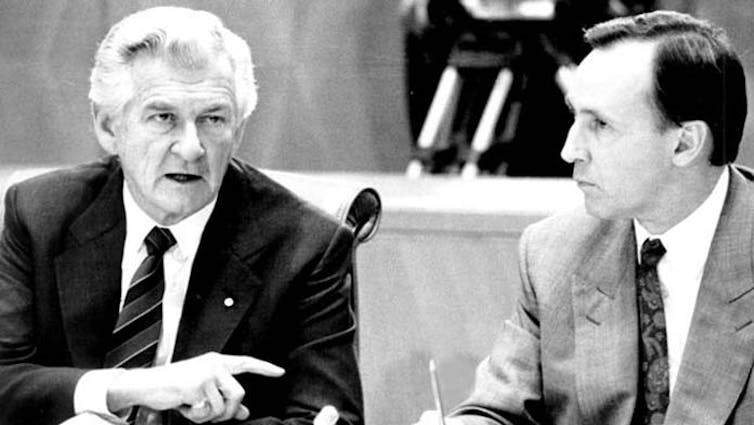 On the few occasions since the second world war when Labor has won office from opposition, it has done so with a bold reform agenda. This included Bob Hawke’s win in 1983.
solidarity.net.au
On the few occasions since the second world war when Labor has won office from opposition, it has done so with a bold reform agenda. This included Bob Hawke’s win in 1983.
solidarity.net.au
Each time, Labor took office after voters bought its message that there were substantial problems in Australian society that needed fixing.
The personalities and capabilities of the party’s leaders have counted for a great deal. But, above all, policy and ideology have been decisive factors in Labor’s triumphs and troubles throughout its long history.
How times have changed. More than two years into Anthony Albanese’s leadership, and with an election likely to be called less than six months from now, the Labor Party has offered few real signs of its plans for the nation.
Albanese’s approach so far has been to emphasise what he won’t do. He has overseen the stripping back of the party’s platform and junked proposals deemed to have hurt Labor at the last election, covering franking credits, capital gains tax and negative gearing.
On climate change, voters have been told to wait until closer to the election to be told how Labor would reach zero net carbon emissions by 2050. Policy pronouncements in most key areas are being pushed off into that nebulous “closer to the election” timeframe.
Read more: Labor is set to have itself a nervy little Christmas. It's not too late to make 2021 sing
Essentially, Albanese has asked himself “what would Bill Shorten do?” and then done the opposite. As leader, Shorten saw off two Liberal prime ministers in Tony Abbott and Malcolm Turnbull. He did this by going in hard against them – a strategy he continued against the third Liberal leader he faced, Scott Morrison – while also releasing a torrent of challenging policy ideas.
At the 2016 election, this approach almost got Shorten across the line. In 2019, he failed again even though the opinion polls had suggested he would win.
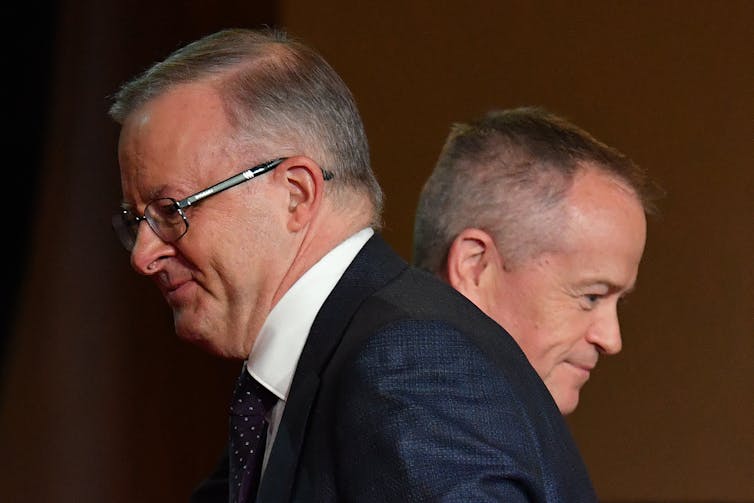 Anthony Albanese’s strategy so far has been to ask himself ‘what would Bill Shorten do?’ and then do the opposite.
Mick Tsikas/AAP
Anthony Albanese’s strategy so far has been to ask himself ‘what would Bill Shorten do?’ and then do the opposite.
Mick Tsikas/AAP
Shorten’s approach of setting the political agenda did not produce electoral success, so Albanese has dedicated himself to not reproducing it. Judging that in 2019 Labor had too many policies, a confusing set of messages and a deeply unpopular chief salesman, he has backed himself in as a considerably better salesman who cannot be tripped up because he is in no danger of offering too much, too soon.
Nowhere was this better demonstrated than in Albanese’s budget reply speech in May. The government had thrown out its entire budget strategy, the nation was roiled by the pandemic, and the vaccine rollout was a shambles. Albanese used this nationally televised prime time appearance to talk about social housing – a worthy policy area, for sure, but an exceedingly strange choice for that moment.
The Labor leader’s risk-averse strategy seems to rest on an assumption that there is a natural equilibrium in national electoral politics – that an open-minded public approaches each election as a contest between evenly matched contenders. History suggests, however, that when it comes to electing Labor to power that is not true.
Clearly, Shorten was not popular enough among voters to get Labor over the line. There appears to be less antagonism and disdain towards Albanese in the community, but is he sufficiently more popular to make a difference? Here, we are left to rely on opinion polls, a fraught enterprise after their failures at the 2019 election.
On personal measures such as satisfaction and preferred prime minister, Albanese rates higher than Shorten but still scores a negative approval rating and lags behind Morrison in Newspoll and the Nine papers’ Resolve Political Monitor. To put it crudely, while Albanese is not as unpopular as Shorten, he could not be said to be popular; he is certainly not more popular personally than Morrison, his direct opponent.
Albanese’s supporters, mindful that the prime minister is expected to call an election less than five months from now, point to the latest Newspoll, which shows Labor ahead of the government 54-46 on a two-party preferred basis, as a sign that his strategy is working.
Read more: Coalition slumps but Morrison gains in Newspoll; electoral changes to curb micro parties
Shorten’s backers did the same thing at the end of 2018. In November and December of that year, just five months before the election, Newspoll had Labor with an even bigger lead, 55-45. Come the election, Labor’s two-party preferred vote was 48.5%.
It’s true political leaders live to create history rather than follow it, but it’s also the case that a Labor leader who pursues a strategy of keeping out of trouble in the hope that his opponent will fall over is taking a bold and unprecedented course. The result will be either the ALP’s most remarkable victory, or yet more heartbreak.
Authors: Shaun Carney, Vice-Chancellor's professorial fellow, Monash University


 Daily Bulletin


