

Read The Times Australia

Daily Bulletin

Book Review: Country is an urgent call to learn from Indigenous knowledges to care for the land

  • Written by: Taylor Coyne, Doctoral Candidate, UNSW
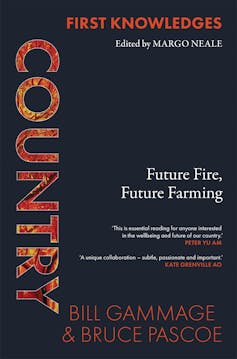
A black book cover with the words

“We know we can do better than this, don’t we?”

This line sits towards the concluding paragraphs of Country: Future Fire, Future Farming, by Yuin, Bunurong and Tasmanian activist and author Bruce Pascoe and non-Indigenous historian Bill Gammage.

The book is part of the wider six-part “First Knowledges” series published by Thames and Hudson in collaboration with the National Library of Australia. It focuses on a collection of topics, including astronomy, design, law and, in the case of this book, Country.

As stated by editor Margo Neale in the introduction, the overarching series is designed to “stimulate and provoke you to enlarge your mind and expand your worldview to encompass limitless other possibilities, including ways in which you can learn from the Aboriginal archive of knowledge embodied in Country.”

For many, the book will be a timely invitation to be a part of constructive dialogue and a call to take action, especially in light of the lacklustre resolutions from COP26 and following the Black Summer bushfires.

For myself, a non-Indigenous scholar researching waters throughout Eora Country, I humbly come to this review with deep awareness of my position, and firmly take up the invitation to be part of this dialogue and follow through with action.

Read more: How the Dark Emu debate limits representation of Aboriginal people in Australia

A conversation between experts

Country: Future Fire, Future Farming is crafted to present the two authors’ own personal perspectives, while drawing on rich evidence to support their claims.

After their co-written opening chapter, Pascoe starts off the book’s first three solo-written chapters. Then, Gammage takes over with the next four, before they round off their thoughts in two distinctly separate but ideologically similar concluding chapters.

A black book cover with the words
Thames & Hudson Australia At the core of their book, Pascoe and Gammage affirm in varying ways that Aboriginal people were - and are - farmers and agriculturalists. Pascoe expands on this in his chapters by describing the ways Aboriginal peoples have made use of the plants and animals across Australia. According to Pascoe, using and understanding these knowledges can make farming in Australia better. Gammage’s chapters focuses almost entirely on fire – its use by Aboriginal people as a tool to farm the land, and the detrimental misunderstandings of Aboriginal fire practices appropriated by non-Indigenous people. Consistently throughout the book, there is a subtle dialogue that emerges between the two authors. The dialogue could at times be more pressing, especially when contrasting perspectives arise, such as their differences in dating Aboriginal people’s presence on the continent or their interpretations of particular terms. On their own, the wonderfully detailed chapters provide ample room to reflect on key ideas (farming and fire) which both authors have become known for. That said, at times, I craved a more emphatic conversation between the two. Two Aborginal Aunties digging for honey ants.
Shutterstock Payment where payment is due In both subject and in tone, Country: Future Fire, Future Farming feels like a polite conversation, with any arguments quite restrained. Pascoe writes with urgency and an enthusiasm as vibrant as the landscapes he describes. He opens the book’s first chapter with an unequivocal call to arms – what is happening across Australia with land care (as well as the many other issues relating to Indigenous affairs) is not good enough anymore. Quite consistently throughout, Pascoe reaffirms the idea that Aboriginal land care is done with the aim to better the “common wealth”, in contrast to the damaging practices of non-Indigenous settlers. He asserts Aboriginal people should be the primary beneficiaries of wealth generated by land care practices that are environmentally and economically productive. Similarly, Gammage directs non-Indigenous peoples not to “commandeer traditional expertise” – a hard-pressed claim to refute. This tension of wanting to celebrate Indigenous knowledges while also ensuring it is not appropriated by non-Indigenous people for economic gain has been articulated as “bio-piracy.” The scholars Dr Daniel Robinson and Dr Miri Raven focus on this issue extensively in their work. Read more: Australia's agriculture sector sorely needs more insights from First Nations people. Here's how we get there We know we can do better than this The bulk of the book outlines the many intricate knowledges that Indigenous people across Australia have maintained. Pascoe works tirelessly to address the misconception surrounding “hunter-gatherering” - the idea that Indigenous peoples were only ever nomadic hunter-gatherers – which is also at the core of Pascoe’s acclaimed work, Dark Emu. In addition, Pascoe’s witty, sharp, and conversational chapters on plants and animals are what many have come to expect of him. Gammage presents a pragmatic recount of the importance of fire to people in Australia – both Indigenous and non-Indigenous, now and in the past. It is detailed and logical. In places, the practicality of Gammage’s writing overwhelms the reflexive narrative I was craving, especially when read against the works of Victor Steffensen or Vanessa Cavanagh. That said, both the breadth of materials the two authors engage with, and the depth with which they are analysed, is impeccable. Recent critiques of Pascoe’s engagement with evidence in relation to Dark Emu have brightened the discussions in this space. Quite pleasantly, Pascoe makes some effort to respond to these critiques, stating, Hunting and gathering is a sustainable and healthy lifestyle but it is not the only thing that Aboriginal and Torres Strait Islander people did. The book’s interpretation of historical material, such as Pascoe’s commentary on the Melbourne Museum’s recent Indigenous Bread research, or Gammage’s interrogation of historical archives, is invigorating, contemplative and lush. Reading the book excites me to want to act to care for land, and respectfully celebrate Indigenous knowledges. If you have a desire to be part of the action, then this book is for you. Country: Future Fire, Future Farming opens space for dialogue, but readers need to want to be part of this conversation to begin with. Authors: Taylor Coyne, Doctoral Candidate, UNSW

Read more https://theconversation.com/book-review-country-is-an-urgent-call-to-learn-from-indigenous-knowledges-to-care-for-the-land-172142

Business News

Why Choosing the Right Bollard Supplier Matters for Australian Businesses and Public Spaces

From busy CBD streetscapes to sprawling warehouse loading docks, bollards have become one of the most essential safety and security fixtures across Australia. Whether protecting pedestrians from veh...

Daily Bulletin - avatar Daily Bulletin

Why Modular Content Is Transforming Modern Marketing Teams

Modern marketing teams are expected to produce more content than ever before. They need to support websites, landing pages, email campaigns, social channels, product pages, sales enablement material...

Daily Bulletin - avatar Daily Bulletin

Everything You Need to Know About Getting Support from Optus

Whether you've been an Optus customer for years or you've just switched over, at some point you'll probably need to contact their support team. Maybe your bill looks different from what you expected. ...

Daily Bulletin - avatar Daily Bulletin

The Marketing Strategy That’s Quietly Draining Sydney Business Owners’ Bank Accounts

Sydney businesses are investing more in digital marketing than ever before. The intention is clear. More visibility should mean more leads, more customers, and steady growth. However, many business ...

Daily Bulletin - avatar Daily Bulletin

Why Mining Hose Solutions Are Essential For High-Performance Industrial Operations

In environments where the ground itself is constantly shifting, breaking, and being reshaped, every component must be built to endure. Mining operations are among the most demanding in the industria...

Daily Bulletin - avatar Daily Bulletin

The Reason Talented Teams Underperform

If you’re in business, you might have seen it before. A team of capable and smart people just suddenly slows down, and things start spiraling out of control. On paper, everything looks perfect, but ...

Daily Bulletin - avatar Daily Bulletin

Why More Aussie Tradies Are Moving Away From Paid Ads

Across Australia, a lot of tradies are busy. There’s no shortage of demand in industries like plumbing, electrical, landscaping, and building. But being busy doesn’t always mean running a smooth or...

Daily Bulletin - avatar Daily Bulletin

Why Careers In The Defence Industry Are Growing Rapidly

The defence sector has evolved far beyond traditional roles, opening doors to a wide range of opportunities across technology, engineering, intelligence, and operations. This is where defense industry...

Daily Bulletin - avatar Daily Bulletin

Strategic partnerships to enable global acceleration for Aussie fashion brands: SHEIN Xcelerator launches

SHEIN Xcelerator is introducing a more agile, demand-led operating model, allowing brands to scale while retaining control over creative direction and identity. For fashion brands, the pressure t...

Daily Bulletin - avatar Daily Bulletin

The Daily Magazine

Australia’s Best Walking Trails and the Shoes You Need to Tackle Them

Australia is not short on spectacular walks. You can follow ocean cliffs in Victoria, cross ancien...

Why Pre-Purchase Building Inspections Are Essential Before Buying a Home in Australia

source Have you ever walked through an open home and started picturing your furniture, family d...

5 Signs Your Car Needs Immediate Attention Before It Breaks Down

Car problems rarely appear without warning. In most cases, your vehicle gives clear signals before...

Ensuring Safety and Efficiency with Professional Electrical Solutions

For businesses in Newcastle, a safe and fully functioning workplace remains a key part of day-to-d...

Choosing The Right Bin Hire Solution For Hassle-Free Waste Management

When it comes to managing waste efficiently, finding the right solution can save both time and eff...

Why Cleanliness Is Critical In Childcare Environments

Children explore the world with curiosity, often touching surfaces, sharing toys, and interacting ...

What to Look for in a Reliable Australian Engineering Partner

Choosing an engineering partner is rarely just about technical capability. Most businesses can fin...

How to Choose a Funeral Home That Supports Families with Care

Choosing a funeral home is rarely something families do under ideal circumstances. It often happen...

Why Premium Coffee Matters in Modern Hospitality Venues

In hospitality, details shape perception long before a guest consciously evaluates them.  Lightin...