

Read The Times Australia

Daily Bulletin

Oceans are better at storing carbon than trees. In a warmer future, ocean carbon sinks could help stabilise our planet

  • Written by: Rupert Sutherland, Professor of tectonics and geophysics, Te Herenga Waka — Victoria University of Wellington
Oceans are better at storing carbon than trees. In a warmer future, ocean carbon sinks could help stabilise our planet

We think of trees and soil as carbon sinks, but the world’s oceans hold far larger carbon stocks and are more effective at storing carbon permanently.

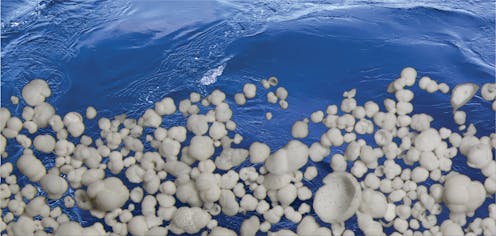
In new research published today, we investigate the long-term rate of permanent carbon removal by seashells of plankton in the ocean near New Zealand.

We show that seashells have drawn down about the same amount of carbon as regional emissions of carbon dioxide, and this process was even higher during ancient periods of climate warming.

Humans are taking carbon out of the ground by burning fossil fuels deposited millions of years ago and putting it into the atmosphere as carbon dioxide. The current rate of new fossil fuel formation is very low. Instead, the main geological (long-term) mechanism of carbon storage today is the formation of seashells that become preserved as sediment on the ocean floor.

The continent of Zealandia is mostly submerged beneath the southwest Pacific Ocean but includes the islands of New Zealand and New Caledonia.

A map of the Zealandia continent, southwest Pacific
The continent of Zealandia is about twice the size of India, but most of it lies more than 1000m deep in the southwest Pacific Ocean. Author provided, CC BY-ND

Carbon dioxide emissions from burning fossil fuels on the continent add up to about 45 million tonnes per year, which is 0.12% of the global total.

Our work documents a project that was part of the International Ocean Discovery Program (IODP). Expedition 371 drilled into the seabed of Zealandia to investigate how the continent formed and to analyse ancient environmental changes recorded in its sediments.

Drawing carbon to the ocean floor

Organic carbon in the form of dead plants, algae and animals is mostly eaten by other creatures, mainly bacteria, in both the ocean and in forest soils. Most organisms in the ocean are so small (less than 1mm in size) they remain invisible, but as they die and sink, they transport carbon to the deep ocean. Their shells can accumulate on the seabed to make vast deposits of chalk and limestone.

Read more: Tiny plankton drive processes in the ocean that capture twice as much carbon as scientists thought

The sediments we cored were many hundreds of metres thick and formed during warmer climates that might resemble the decades and centuries to come. We know the past environments from analysis of fossils.

Seashells, which are made of calcium carbonate, sequester significant amounts of carbon. The accumulation rate of shells averaged over the last million years was about 20 tonnes per square kilometre per year.

Two researchers working on sediment cores.
Researchers Xiaoli Zhou (US) and Yu-Hyeon Park (Republic of Korea) take samples of water from sediment cores during IODP Expedition 371. Laia Alegret, IODP, CC BY-ND

The total area of the Zealandia continent is about 6 million square kilometres, so the average rate of calcium carbonate storage was about 120 million tonnes per year, which is equivalent to 53 million tonnes of carbon dioxide per year.

This is about the same as emissions from burning fossil fuels on the continent today, within errors of calculation. However, a much larger area than just Zealandia is accumulating microscopic seashells.

A map of ocean currents and regions of shell accumulation.
This map shows global ocean surface currents and regions of seabed (shaded) where calcium carbonate shells are accumulating. Rupert Sutherland, CC BY-ND

The planetary carbon cycle

Earth naturally expels carbon dioxide from mineral springs and volcanoes, as rocks are cooked at depth. This is unlikely to be affected by climate change. The Earth stores carbon dioxide when rocks are altered at the surface and as seashells accumulate on the seabed. Both these mechanisms might be affected by climate change.

The biosphere and oceans also hold significant carbon stocks that are sure to change. It is a complex system and many scientists are trying to understand how it will respond to human activities.

Different parts of the carbon system will respond in different ways and at different rates. Our work provides clues as to what might happen in the ocean.

This cartoon illustrates how carbon moves through the Earth system.
This cartoon illustrates how carbon moves through the Earth system. Rupert Sutherland, CC BY-ND

About 4-8 million years ago, the climate was warmer, carbon dioxide levels were similar or even higher than today, and the ocean was more acidic. However, we found the average accumulation rate of seashells on Zealandia was more than double that of the most recent million years.

This is a pattern seen elsewhere around the world. Warmer climates during this period had oceans that produced more seashells, but these data are average accumulation rates over million-year time scales.

The mechanism by which these ancient warmer oceans produced more seashells remains a subject of ongoing research (including ours).

Rivers and the wind deliver nutrients to the ocean, especially during extreme weather events, and changes can occur over short time scales. At the other extreme, fully integrated climate models show that large-scale reorganisation of ocean currents to enhance the supply of nutrients from deep waters could take centuries or even millennia.

Read more: The ocean is essential to tackling climate change. So why has it been neglected in global climate talks?

Our work highlights and quantifies the important role the ocean, and particularly the microscopic life within it, will eventually play in restoring balance to our planet. The rate at which dead plankton draw carbon to the deep ocean and small seashells permanently store it on the seabed is a significant proportion of human carbon dioxide emissions and it is likely to increase in the future.

Palaeontologist Laia Alegret (Spain) and co-chief scientist Gerald Dickens (US) discuss a sediment core at the sampling table during IODP Expedition 371.
Palaeontologist Laia Alegret (Spain) and co-chief scientist Gerald Dickens (US) discuss a sediment core at the sampling table during IODP Expedition 371. Tim Fulton, IODP/JRSO, CC BY-ND

Our work reveals that a warmer ocean may eventually produce more calcium carbonate shells than today’s ocean does, even though ocean acidification will almost certainly occur.

How quickly natural carbon sequestration in the ocean might change remains highly uncertain. It will take many centuries before we reach an ocean state similar to that found 4-8 million years ago.

More work is needed to understand how this transition might occur and whether it is possible and sensible to enhance biological productivity in our oceans to mitigate climate change and maintain or increase biodiversity.

Authors: Rupert Sutherland, Professor of tectonics and geophysics, Te Herenga Waka — Victoria University of Wellington

Read more https://theconversation.com/oceans-are-better-at-storing-carbon-than-trees-in-a-warmer-future-ocean-carbon-sinks-could-help-stabilise-our-planet-176154

Business News

How Telematics Helps Australian Companies Improve Productivity

Operating a commercial fleet in Australia is a uniquely demanding endeavour. Between the sprawling urban sprawl of cities like Sydney and Melbourne and the immense, unforgiving stretches of the Outb...

Daily Bulletin - avatar Daily Bulletin

Inside the Icon: The BridgeMuseum Officially Opens at the Sydney Harbour Bridge

A bold new way to experience one of Australia’s most recognisable landmarks has arrived, with BridgeClimb Sydney officially opening the all-new BridgeMuseum.  Located inside the Sydney Harbour Brid...

Daily Bulletin - avatar Daily Bulletin

Is Your Brand Showing Up in AI Search? Most Melbourne Brands Aren't.

The New Front Door Nobody Told You About Something changed. Quietly. Without a press release. The way buyers find businesses in Australia has been rewired. Not replaced, rewired. Google isn't dead...

Daily Bulletin - avatar Daily Bulletin

How Australian Businesses Can Measure SEO ROI

SEO can feel vague when you are staring at a dashboard full of numbers that do not clearly connect to revenue. The key is to measure the right signals in the right order, then tie them back to outcome...

Daily Bulletin - avatar Daily Bulletin

How Commercial Roller Shutters Improve Site Security Without Slowing Operations

Security upgrades can be frustrating when they make everyday work harder. A door that takes too long to open, creates bottlenecks at shift change, or fails at the worst time can turn “better protectio...

Daily Bulletin - avatar Daily Bulletin

Why a Document Destruction Service Still Matters for Modern Businesses

Businesses generate large volumes of information every day, from staff records and contracts to invoices, reports and customer files. While attention often focuses on how documents are stored, the way...

Daily Bulletin - avatar Daily Bulletin

Bicycle Rack Safety and Space-Smart Storage

Bike storage problems usually show up as small annoyances first: tangled handlebars, scratched frames, and bikes that topple when you pull one out. Over time, those issues become safety risks, especia...

Daily Bulletin - avatar Daily Bulletin

How to Tell if a Childcare Centre Is a Good Fit for Your Child

Choosing childcare can feel like you’re making a huge decision with limited information. Tours are short, centres are often on their best behaviour, and your child might act differently in a new space...

Daily Bulletin - avatar Daily Bulletin

Car Import Timeline: What Usually Happens at Each Stage

Importing a car into Australia can feel confusing because multiple agencies and checkpoints are involved, and the timeline is shaped as much by paperwork quality as it is by shipping speed. The most u...

Daily Bulletin - avatar Daily Bulletin

The Daily Magazine

Gold Migration Lawyers in Liquidation: How the Closure Affects Your ART Appeal

If your appeal was with Gold Migration Lawyers, a recent change to how the Tribunal decides cases ...

The pressure cooker: life in urban Australia in 2026

Australian cities have always been demanding. Long commutes, rising housing costs, busy schedules a...

What Actually Makes a Good Criminal Lawyer in Melbourne

Most people only think about this question once. That is usually too late. Most people charged wi...

Why Working With A Chatswood Tutor Can Improve Academic Performance

Academic expectations continue increasing for students across primary school, high school, and senio...

Is It Worth Getting Solar Panels in Melbourne?

The real question is not whether solar works in Melbourne. It works. The question is what it is co...

How A Diploma Of Project Management Builds Practical Skills For Modern Work Environments

Developing the ability to plan, execute, and deliver outcomes efficiently is a key requirement in to...

How to Choose the Right Football for Every Level

Choosing a football may seem straightforward, but the right option depends on who will be using it a...

What to Ask a Wedding Photographer Before You Book

Booking a wedding photographer can feel deceptively simple: you like the photos, you like the vibe...

Why Stress Relief For Dogs Is Essential For Emotional Balance And Long-Term Wellbeing

Managing emotional health is just as important as physical care when it comes to pets, which is why ...