

As New Zealand relaxes restrictions, here’s what we can still do to limit COVID infections
- Written by: Michael Plank, Professor in Applied Mathematics, University of Canterbury
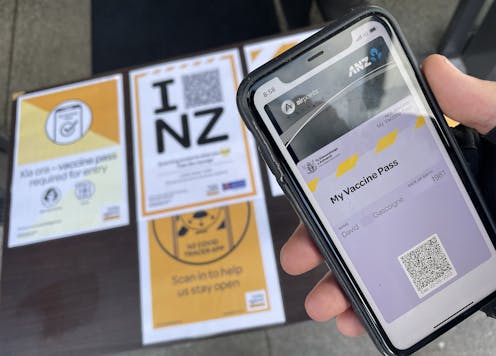
New Zealanders are about to enjoy cautiously relaxed COVID restrictions under the country’s COVID-19 Protection Framework, starting from this weekend.
Prime Minister Jacinda Ardern announced the relaxations today, signalling the end “for now” of vaccine passes, QR codes and vaccine mandates in the education, police and defence sectors from April 4.
Mandates will still apply for health, aged-care, corrections and border control workers, pending more official advice. Settings within the traffic light system have also been revised, but the country remains at the red level and indoor mask use is still required.
New Zealand’s vaccine pass system was designed when we were in the middle of the vaccine rollout, only about one in 400 New Zealanders had had COVID-19, and nobody had even heard of Omicron.
At that time, unvaccinated people had a much higher risk of catching the virus and spreading it to others.
For this reason, vaccine passes were an important part of safely relaxing the Auckland lockdown. They helped us enjoy a summer with very low case numbers and minimal restrictions. Crucially, this meant we avoided the dual Delta-Omicron epidemic that significantly added to the health burden in places such as New South Wales.
The situation we face today is very different. Vaccines remain highly effective at preventing severe illness but aren’t as good at stopping people catching Omicron. And the protection they do provide against infection wanes fairly quickly.
At the same time, increasing numbers of people have some temporary immunity as a result of having had the virus. This means vaccine passes are far less effective as a public health intervention now than they were a few months ago.
But as vaccine passes are phased out, it is important to consider what measures we can use to reduce transmission.
Vaccines still work
Vaccines are still highly effective at preventing severe illness and death from COVID-19. Like New Zealand, Hong Kong is now experiencing a major Omicron wave after initially following an elimination strategy. But in the last two months, Hong Kong has had close to 4,000 deaths per five million people compared to New Zealand’s 130.
Why such a big difference? Vaccines. Hong Kong has much lower vaccine coverage in older groups than New Zealand does.
But it’s clear vaccines are less effective at preventing infection with Omicron. The UK Health Security Agency estimates the effectiveness of two doses of the Pfizer vaccine against symptomatic COVID-19 drops to just 10% after about 25 weeks following the second dose. This jumps to 65% after a booster but also wanes quite quickly to around 40% 15 weeks later.
The proportion of unvaccinated people testing positive is not that different from fully vaccinated people. So if you go to a cafe, a hairdressers or a bar, whether or not there are unvaccinated people there makes little difference to your risk of catching the virus.
Other risk factors are more important: are people wearing masks, is it crowded, is the venue well ventilated or outdoors, are people staying away if they have symptoms?
We still need public health measures to mitigate COVID
The limitations the vaccine pass system has placed on people’s freedoms are much harder to justify now. But that doesn’t mean we can end all vaccination requirements or remove all public health measures.
COVID-19 is an airborne disease but a comparison with diseases spread through contaminated water is useful. The spread of cholera from contaminated water is one of the earliest examples of an effective public health response to an infectious disease.
The first response was a “boil water” notice, the equivalent of mask wearing to prevent the spread of infections. Longer-term measures involve systemic changes, such as infrastructure for clean water or, in the case of COVID, infrastructure for clean air through ventilation and filtration.
Read more: No, catching Omicron is not 'inevitable' – here's why we should all still avoid the virus
The time to remove boil-water notices is not when case numbers are peaking, or even when they are back at half of their peak level. It is when there are sufficient systemic changes in place to keep people safe.
Similarly, isolation periods are intended to stop people from infecting others. For Omicron, studies suggest half of all cases were still infectious on day five and the infectious period may be as long as ten days. Given wider availability of rapid antigen tests, we could introduce a test-to-return policy to require a negative test before people leave isolation.
Some vaccine mandates remain
People working in specific high-risk situations, like healthcare and aged residential care, will still be required to be up to date with their vaccinations to protect the vulnerable people they work with.
We are currently in the middle of a major Omicron wave, with hospitalisations and deaths at record levels. At least as many people will get infected on the way down from the peak as on the way up.
And even when this wave subsides, COVID-19 isn’t going to go away. It’s likely we will continue to see daily case numbers in the thousands for some time. Added to other respiratory illnesses like influenza and RSV, this could cause significant strain on healthcare over the winter months.
Altogether, this means we still need a set of sustainable mitigations to reduce transmission and the health impacts of the virus. This includes strategies to address vaccine inequity and increase booster uptake, mask use when cases are high, better ventilation and adequate financial support for people to take time off work when they are sick.
COVID vaccine passes have outlived their usefulness at least for now. But COVID-19 is going to be with us for the forseeable future.
Authors: Michael Plank, Professor in Applied Mathematics, University of Canterbury


 Daily Bulletin


