

Terra nullius has been overturned. Now we must reverse aqua nullius and return water rights to First Nations people
- Written by: Melissa Kennedy, Research Fellow - Participatory research and engagement, The University of Melbourne
Terra nullius has been overturned. Now we must reverse aqua nullius and return water rights to Traditional Owners.
In recent decades, important progress has been made on land rights for Traditional Owners, with more than 50% of Australia under some form of Indigenous title (including non-exclusive native title). But until now, we’ve had much less progress on water rights.
For millennia, Indigenous Australians maintained all water in Australia. After European colonisation, the rights to water were stolen. Almost none of it has come back. Where did the rest of the water go? Overwhelmingly, to settlers who used them to expand their agricultural interests.
Victoria has now begun to return water to Traditional Owners. Last week, the government returned 2.5 gigalitres (GL) to Gunditj Mirring in Victoria’s south-west. Earlier this year, 1.36GL was set aside for Traditional Owners in northern Victoria, and in late 2020, 2GL from the Mitchell River was returned to Gurnaikurnai in Gippsland. While welcome, this is only a start.
Victoria’s recent returns make it the leader in the eastern states, but competition is scarce. To date, there have been no tangible water handbacks in New South Wales and Queensland.
Why are water rights so important?
Water rights go well beyond commercial and economic gains. For First Nations people, water and the health of waterways are fundamental to health and well-being, including reviving cultural flows, improving physical health, restoring connection to spirit and culture, aiding self-determination, and making it possible to care for Country.
Land is important. But Australia is a dry country, and without water, there is no life. For instance, before colonisation, Gunditjmara in south-western Victoria created one of the world’s oldest and most extensive aquaculture systems to farm short-finned eels. The Budj Bim complex is now UNESCO-listed.
Most Australians are aware of terra nullius, the legal fiction that Australia belonged to no one before European settlement.
But very few know about aqua nullius, a similar fiction suggesting Traditional Owners had no rights to the water they had used for millennia.
To challenge this, First Nations people have long called for redistribution of water, particularly in the Murray-Darling Basin.
Since European colonisation, there have been vanishingly few opportunities for Indigenous communities in Australia to advance and strengthen their economies. It is vital that we recognise the central role played by aqua nullius and the long history of colonial resource rationing in stymieing Indigenous enterprise.
Read more: Australia, it's time to talk about our water emergency
These first allocations are welcome. But they cannot be an afterthought. Without more, the Victorian government could recreate the water version of the rations regime of government-controlled food distribution Indigenous Australians lived with until the 1960s.
For decades, Indigenous Australians were not permitted to have a voice in how our nation’s water is allocated and used.
While these recent water returns in Victoria are vital first steps, the volumes of water are still too small to underpin the restorative justice approach needed for the environment and Aboriginal peoples.
Tinkering around the edges
In the Murray-Darling Basin, Australia’s most important agricultural catchment, just 0.2% of all surface water entitlements are owned by Aboriginal organisations, and 0.02% of all available groundwater.
Of this tiny fraction, the majority is low reliability. That means Aboriginal people are unlikely to get access to their water at all unless it has been a particularly wet year.
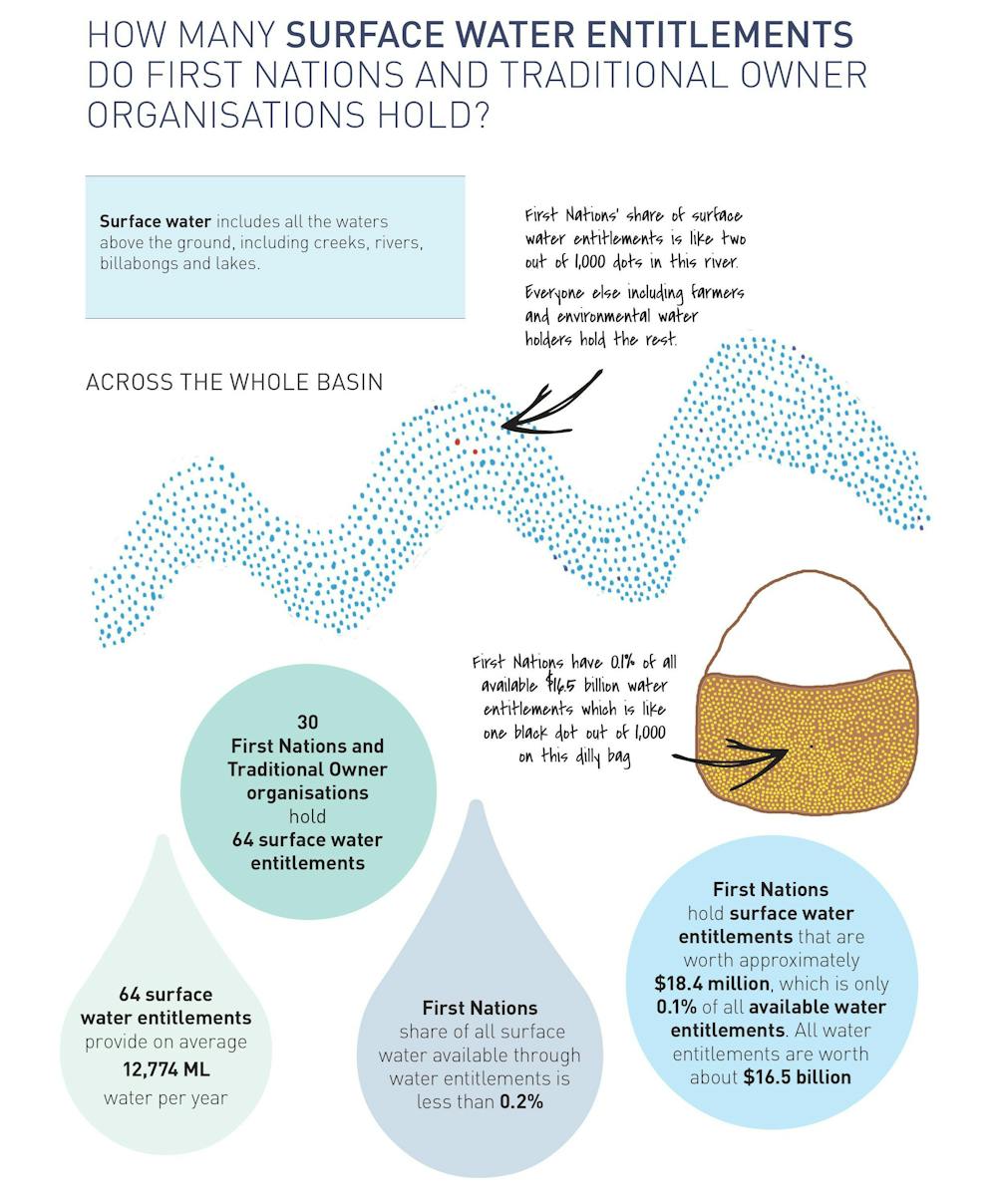 Murray-Darling Basin surface water entitlements held by First Nations and Traditional Owners.
MLDRIN and NBAN
Murray-Darling Basin surface water entitlements held by First Nations and Traditional Owners.
MLDRIN and NBAN
Four years ago, the federal government announced A$40 million to buy water rights for Traditional Owners in the Murray-Darling Basin. Not a dollar has been spent.
In New South Wales, unused water rights across 55 different sources have recently been listed for sale. Not one of these was returned to Traditional Owners.
In the Northern Territory, delays in water allocation planning processes continue to limit access to the Aboriginal Water Reserve – the policy that is supposed to provide Aboriginal people in the NT access to water resources and opportunities for economic development. New laws could make this problem even worse.
Handing out water rights: a new form of rations?
Colonisation of Australia resulted in Europeans gaining control over Aboriginal populations and the resources they relied on. This had a devastating effect on Aboriginal access to traditional resources. From the 19th century until the mid-20th century, Europeans introduced a regime of government distributed rations for Indigenous Australians.
As a result, First Nations peoples were rewritten, both in law and in society, as landless people trespassing on Country once their own.
Given this history, you can see why First Nations groups might be sceptical about these recent handbacks. While the announcements sound good, they represent a very small volume of overall water flows.
Take the recent announcement of 1.36GL set aside for Traditional Owners in Northern Victoria. Where did this water come from? From an extra 4GL of water recovered from the Connections irrigation modernisation project. While that sounds laudable, the allocation for Indigenous use represents just 0.5% of the total volume of water (433GL) recovered from this 12-year project.
 Breakdown of how recovered water has been shared in Victoria’s irrigation modernisation Connection Project.
Author supplied
Breakdown of how recovered water has been shared in Victoria’s irrigation modernisation Connection Project.
Author supplied
What would real progress look like? Over in Western Australia, a major 2020 Indigenous land use agreement in the Geraldton region included rights to around 17% of the available water.
So while Victoria’s recent announcements are a step in the right direction, we cannot help but point out that they reinforce longstanding inequality by giving agricultural interests, who already hold vast land and water entitlements, even more water. By contrast, Victoria’s Aboriginal nations, who have barely any land and water, must divide up these miniscule offerings.
Overturning aqua nullius requires much more
We now have clear pathways for the return of water in ways which adequately tackle the staggering and ongoing injustice of aqua nullius.
To achieve water justice, we would have to see significant transfers of power and agency in water governance.
There are positive signs. The Victoria government is working with Traditional Owners on a new roadmap for Indigenous access to water. Advocacy groups are helping tailor the shift of water management functions to each Indigenous nation to match their capacity.
These recent handbacks are only the start of what’s needed. In the ongoing quest for self-determination, water is key. If governments are serious about tackling the harm caused by the forced takeover of Indigenous waters and lands, we need more significant transfers of power, agency, and water.
Authors: Melissa Kennedy, Research Fellow - Participatory research and engagement, The University of Melbourne


 Daily Bulletin


