

As horrific evidence of massacres is uncovered in Ukraine, Russian propaganda gathers pace
- Written by: Matthew Sussex, Fellow, Strategic and Defence Studies Centre, Australian National University
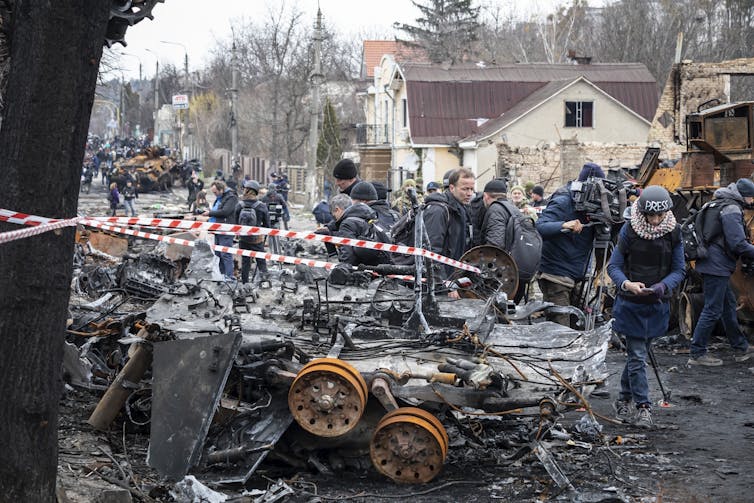
Warning: this article contains distressing details.
The appalling crimes against humanity allegedly committed by Russian soldiers against Ukrainians are a sobering reminder that the most brutal behaviour can be cynically weaponised for political and strategic purposes.
Shortly after images of dead bodies littering the streets of Bucha on Kyiv’s outskirts – some with their hands bound – went viral, the Russian propaganda machine kicked into overdrive with a predictable series of spurious “false flag” claims.
For example: the deaths couldn’t have been caused by Russians because its forces had already left. Clearly, it was a British psychological operation. Or it was Ukrainian fascists linked to the infamous Azov Battalion. Or maybe both. In any event, the whole thing was staged.
In doing so, they recalled the maxim, often loosely attributed to Josef Goebbels, that accusing others of acts for which you are responsible can be one of the most effective uses of propaganda.
Official Russian channels have quickly repeated the lines pushed by state media, starting with President Vladimir Putin’s spokesman Dmitry Peskov, Russia’s UN Ambassador, and numerous Russian embassies worldwide, including in Australia.
Russia even attempted to convene the UN Security Council to discuss atrocities – which its forces were clearly responsible for – that it alleged were committed by Ukraine.
Read more: The West owes Ukraine much more than just arms and admiration
Revealing Russia’s lies
A range of logical arguments reveal Russia’s claims, echoed by the Kremlin’s diminished online army of Putinversteher, to be ludicrous.
How is it that Western intelligence agencies are so capable as to organise massacres whenever Russian forces are in the vicinity? How can so-called “Ukrainian fascists” maintain such tight operational security that they prevent evidence of their culpability from leaking out? Where are all the storehouses of crisis actors able to deploy quickly to war zones and film fake videos?
But even more compelling is the clear empirical evidence that the Kremlin’s claims are a total sham: satellite images showing bodies in Bucha lying in the streets for days, well before Russian troops withdrew.
As Ukrainian forces regain territory previously occupied by Russian troops, more tales of atrocities are emerging. Human Rights Watch has detailed reports of summary executions in numerous villages, echoing the zachistki (“clean-up” or, more accurately, “cleansing”) operations conducted against Chechens from 1999-2005.
Other reports suggest Russian forces used a children’s hospital as a torture chamber. Mass graves in Ukraine are visible from space. Ukrainian sources claim the bodies of naked women, some partially burned, have been found dumped by roadsides. The bound corpses of the mayor of Motyzhyn and her family were uncovered, partly buried, outside their village.
Then there is the mounting evidence of systematic humiliation and rape. One incident, shared by Ukraine’s ambassador to Estonia, involved a three-year-old girl. Others include tales of mothers repeatedly sexually assaulted in front of their own children. Yet another report from Der Spiegel claimed that Russian soldiers occupying the town of Trostyanets had defecated on the bodies of dead Ukrainians.
Russian propaganda in the digital age
The tactics by which official narratives seek to explain acts like these are not new, and have been tools of propaganda and psychological warfare for centuries.
But one of the truisms of the digital age is that online ecosystems give contemporary propagandists new opportunities to shape perceptions through size, scope and veracity.
First, the amount of information available to consumers makes it impossible to process it all. That encourages individuals to self-select into information belief systems, constructing their own “truths”.
Second, the ability to reach new audiences allows malign ideas to be seeded in groups that typically would not seek out such information.
Third, as COVID conspiracies and the Deep State movement have shown, the internet is a great leveller in terms of authoritative and false information.
Read more: Guns, tanks and Twitter: how Russia and Ukraine are using social media as the war drags on
Russian disinformation is adept at using these enablers. Its messaging follows the golden rules of effective propaganda: it is simplistic, didactic, and gives its target audiences someone else to blame. This means its interpretation of atrocities has both international and domestic effects.
Internally, the claim Ukrainian fascists and the West were behind alleged war crimes to justify sanctions and provide Kyiv with aid reinforces the Kremlin narrative that the war is really an “existential crisis” for Russia, in which its very survival is at stake.
Internationally, it seeks to tap into the pathologies of Western publics that have grown cynical and mistrustful of their own governments, raising doubt and deepening the fragmentation of societies.
And even if Russia’s own public doesn’t believe the Kremlin line, the likely result is not anger and resistance, but apathy – a sense that all governments are lying to them.
This is deeply worrying, because it raises the spectre that the events in Ukraine will be disbelieved or ignored by one of the few constituencies that might be able to alter their course. Having been conditioned by Putin’s deliberate promotion of a militaristic culture celebrating violence as honourable, many in Russia have met news of the conduct of their forces with a shrug at best, or vehement approval at worst.
Read more: Putin is on a personal mission to rewrite Cold War history, making the risks in Ukraine far graver
Seeking justice: the weakness of international humanitarian law
If everyday Russians are unlikely to react by pressing for change, what about international humanitarian law as a way of seeking justice?
That many of the acts attributed to Russian forces constitute war crimes is beyond doubt. They are in clear violation of the Geneva Conventions, particularly those dealing with isolated or local massacres, as well as the 1977 Additional Protocol on avoiding targeting civilians.
The barbarity in Ukraine also meets the criteria for other instruments in the human rights toolkit, such as the Responsibility to Protect.
It is even likely the acts committed in Ukraine fit into the broader category of genocide, which according to the 1948 UN Convention is defined as “acts committed in whole or in part” to destroy national, religious or ethnic groups.
They go beyond attempts to colonise a people, as Putin initially envisaged when depicting Ukrainian statehood as illegitimate. Instead, this has become a systemic campaign aimed at removing the very idea of Ukraine.
As Eugene Finkel has pointed out in the Washington Post, there is clear intent, as detailed in Russia’s state-controlled media, that Ukraine’s “name likely cannot be retained”; that its elite needs to be “liquidated”; that a “substantial part of the populace” is also guilty of rampant nationalism; and that Ukraine requires “re-education and ideological repressions lasting at least a generation”.
But we are unlikely to see the perpetrators of these acts arraigned in the dock at an international war crimes tribunal.
For one thing, neither Russia nor Ukraine is party to the Rome Statute, the founding document of the International Criminal Court.
Other alternatives, such as a special tribunal, would be unlikely to see alleged war criminals delivered into custody unless captured by Ukrainian forces. And while branding Putin and other members of the Russian elite as war criminals is useful for signalling and rhetorical purposes, the only way they are likely to face justice is through the total upending of the Russian political system, and a commitment by any new government to hand them over.
With the first of these highly unlikely, and the second by no means guaranteed, there can be little optimism the perpetrators will face justice any time soon, if ever.
It also puts pressure on both Kyiv and Moscow to end the conflict militarily on their terms, so they can shape the future of what is revealed about its events.
Under those circumstances, the only option for those committed to human dignity is to give Ukraine every tool it requires to protect its people from the horrors that continue to be visited upon them.
Authors: Matthew Sussex, Fellow, Strategic and Defence Studies Centre, Australian National University


 Daily Bulletin


