

No magic moments: 3 Australian politics experts on Morrison and Albanese's first election debate
- Written by: Andrea Carson, Associate Professor, Department of Politics, Media and Philosophy, La Trobe University
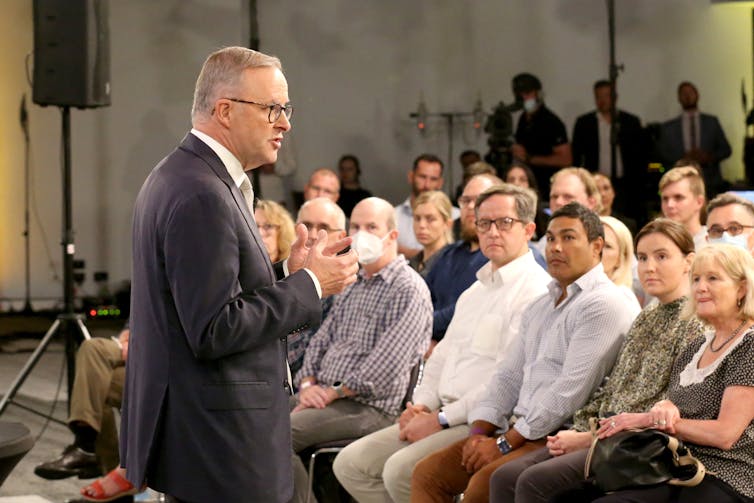
Prime Minister Scott Morrison and Labor leader Anthony Albanese met at the Gabba in Brisbane on Wednesday evening with 100 undecided voters.
In the first leaders’ debate of the election campaign, the leaders took questions on a range of issues from how young people can get into the housing market, to support for Australian nurses and electric cars.
After the hour-long session, 35% of the audience members gave the debate to Morrison, 40% to Albanese and 25% were undecided. Here three political observers provide their take on the debate.
Andrea Carson, Associate Professor, Department of Politics, Media and Philosophy, La Trobe University
There were no knockout blows in the first leaders’ debate. Both party leaders looked sharp in navy blue suits, standing before the undecided voters. The audience covered diverse policy ground. But, conspicuously absent was any meaningful debate from the leaders on climate change.
At every opportunity, Morrison, predictably brought the topic back to the economy. He knows voters (rightly or wrongly) perceive economic issues as a Coalition strength. Labor “couldn’t manage money”, he told them.
Albanese was keen to shift the conversation onto government trust and integrity. As a point of difference from the Coalition, he led early with the ALP’s support for a federal integrity commission. He ended the night on the same note: as prime minister he would “accept responsibility”, meaning that Morrison does not.
First name terms
Both men were polished, but there were no magic moments. The folksy use of addressing one another by their first names became awkward when Scott asked Anthony why he didn’t support boat turnbacks policy when he was deputy prime minister in 2013. For a moment, Albanese looked flustered, sensing perhaps the impending wedge on immigration policy that hurt Labor’s vote in 2013. Was this the moment when Morrison would deliver a winning blow? But, Albanese recovered, quickly agreeing he’d done his own turnback and now supported Morrison’s deterrence strategy on overseas boat arrivals.
Morrison had his own stumble when answering a question from a mother whose four-year-old son with autism requires NDIS support. He turned the conversation to how “blessed” he was to have two daughters who did not have disabilities. It was clumsy, lacking the empathy he may have intended. His recovery was to circle back to safer ground – the budget. The NDIS now cost more than Medicare, Labor was good at spending, while the Coalition worked out how to pay for it, he argued.
The voters’ verdict? An Albanese win - just. But the real winner from my perspective was the forum format, getting Australians to ask their own questions to the leaders.
Paul Williams, Associate Professor of Politics and Journalism, Griffith University
This was probably Albanese’s last chance to reset a Labor campaign derailed by some own goals in the campaign’s first week. But Albanese – relatively low-key, relaxed and speaking in softer tones – performed well against an ebullient Morrison, exuding his usual confidence.
If election debates are the intersection at which ambition and rhetoric meet, then the audience of 100 undecided voters had much to consider.
Each leader offered strong introductory statements: Morrison reminded us of Australia’s 4% unemployment rate and the A$100 billion lift to the budget bottom line, while Albanese highlighted the cost-of-living crisis and how a “better future” begins with a “better government”.
But it was only in response to audience questions – on housing affordability, nurses and aged care, a federal anti-corruption commission, electric vehicles, the NDIS, the recent floods and young Australians’ disillusion with politics – that rhetoric was really let loose.
To borrow from the Ancient Greek philosopher Aristotle, each leader offered generous servings of pathos (emotion): Morrison spoke of being “blessed” with children with wife Jenny, Albanese recalled growing up poor in public housing. But, critically, Morrison out-gunned Albanese on logos (facts) in his machine-like recitation of statistics and took the upper hand in ethos (character), and especially phronesis (practical skill), in listing his personal achievements, most notably a strong economic performance during and since the pandemic.
Morrison – quite tellingly – more than once said “I” instead of “my government”.
Testy moments
The debate was also remarkably civil. Each leader used the other’s first name and acknowledged policy successes of the other side. Only a few testy moments occurred: during debate on the Solomon Islands when Morrison accused Labor of “being on China’s side” (enough to see at least audience member groan), another over refugee boat “turnbacks”, and a third when Albanese alleged Morrison would dump the “better off overall test” in industrial relations (the Coalition has said it won’t change it).
Indeed, asylum seekers and industrial relations – matters not significant in Australian federal elections for almost a decade – could become sleeper issues this election. Interestingly, the questions on a federal anti-corruption commission also suggest political integrity is a substantial issue not confined to inner city “elites”.
It would disappoint many the debate saw no knock-out blows and no major gaffes. Albanese did forget an audience member’s name and he looked uncomfortable when conceding Labor originally opposed refugee boat turn backs. Morrison looked similarly pained on NDIS funding and industrial relations.
But the debate also revealed just how much work each leader has to do over the next four weeks. Albanese must remind Australians Labor can deliver economic miracles just as Bob Hawke, Paul Keating and Kevin Rudd did. Conversely, Morrison must rely less on what he did in his last term and outline what goodies we can expect in the next.
My verdict? It is the narrowest win for Morrison, but the fact Albanese held his own when most expected him to fail means he is a winner, too.
Rob Manwaring, Associate Professor, Politics and Public Policy, Flinders University
The Australian Election Study tells us there is a clear decrease in the number of Australian who watch election leaders debates. In 1993, about 70% of respondents indicated they watched the leaders debates and by 2019 it was just 30%.
At the end of the first leaders debate, there were two questions on growing public and youth disengagement from democracy and whilst both leaders acknowledged the problem, their answers seemed partial at best. Whoever goes onto win this election, the disillusionment will be hard to arrest.
Will this debate matter? Given it was not on free-to-air TV, the ratings are not likely to be high. However, the subsequent media narrative about them can be important, given there is some increase in the number of Australians who only make their vote decision during the campaign (about 37% at the last election according to the Australian Election Study).
No major errors, some plans
After Albanese’s mishaps in week one, he will be relieved he made no major errors and managed to outline some of Labor’s key pledges, especially on health and ageing. For Morrison, it was a solid and experienced performance and he is much more comfortable with details and costings.
Whilst the election coverage has been dominated by gaffes and “pointless shoutfests” it was refreshing that on Wednesday night both leaders set out a number of mid-level plans and strategies, although both avoided major reforms. Albanese was strong in pointing out areas of waste, Morrison reverted back to the focus on economic growth. In terms of the issues covered, notable absences were questions on Indigenous affairs, education and climate change.
3 areas of difference
There were three main points of difference during the debate.
First, Morrison put Albanese on the backfoot on immigration policy, highlighting how Labor had changed its position on boat turn backs. Albanese recovered well when he returned to this at the end but given the focus on COVID at the moment (not immigration) it’s not likely to be a high-salience issue.
Read more: #SetTheAgenda: What The Conversation's readers want politicians to address this federal election
Second, the discussion on the NDIS exposed the different ideological positions of the parties. Albanese trumpeted Labor’s record on social and economic reform and Morrison claimed it’s “always the Liberals who have to work out how to pay for them”.
The third area was the testy exchange over China’s growing influence in the Pacific, and Labour’s accusation of the government’s policy failure here. Morrison went on the offensive suggesting the ALP would not stand up to China – with Albanese calling this an “outrageous slur”.
Whilst there might not be huge public engagement with the leaders debate, there were clear competing visions and policy agendas on display.
Authors: Andrea Carson, Associate Professor, Department of Politics, Media and Philosophy, La Trobe University


 Daily Bulletin


