

Recent COVID-19 court cases show New Zealand's Bill of Rights Act is not as strong as some might wish
- Written by: Claire Breen, Professor of Law, University of Waikato
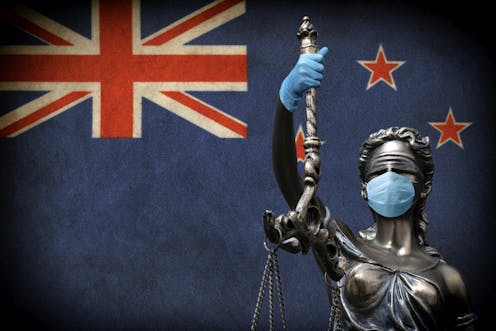
While the recent legal challenges to elements of the government’s COVID-19 response have had mixed results in the courts, they have revealed something important – how the rule of law works in New Zealand.
In the past two years, a raft of laws have been passed or amended as the government put its response to COVID-19 on a legal footing.
Some of these laws have been subsequently challenged in the courts, starting with the Borrowdale case in May 2020. Plaintiff Andrew Borrowdale argued the government’s lockdown orders were based on an improper use of its powers under the Health Act and that a range of New Zealanders’ rights had been violated as a result.
Other cases have argued, with varying degrees of success, that the government’s requirement of mandatory vaccinations violated the rights of some New Zealanders.
At the end of April, the High Court found the border quarantine (MIQ) system did work well to protect public health and many of the resulting restrictions on rights were justifiable.
However, the court also found the allocation of space in MIQ through a virtual lobby system amounted to an unjustifiable limit on the right of New Zealand citizens to return because it did not prioritise citizens over non-citizens, and it did not prioritise on individual need or delays experienced.
What we see in these cases is the New Zealand constitution in action, operating as a system of checks and balances to protect individuals from arbitrary interference by the state.
As an aspect of that, the cases show the operation of the rule of law, which means any power exercised by the government has to be based on legal authority and that everyone is subject to the law, whether they are members of the public or politicians.
Bill of Rights has its limits
The Bill of Rights Act plays an important role in that regard, although its ability to protect our rights is not as strong as we might like to think.
There are four ways the Bill of Rights works in the creating of laws.
Firstly, the Bill of Rights Act states clearly that it does not affect all other laws passed before or after it simply because those laws are inconsistent with the Bill of Rights.
For example, New Zealanders have the right to protest but their protest actions cannot be unduly disorderly, violent or unsafe. Neither can the courts use the Bill of Rights Act to invalidate the COVID-19 Public Health Response Act 2020.
Read more: How far should compulsory proof of vaccination go — and what rights do New Zealanders have?
The Bill of Rights Act does, however, stipulate that wherever an act, such as the Health Act, can be interpreted in a manner that is consistent with the Bill of Rights, then that interpretation is to be preferred.
Thirdly, the Bill of Rights Act, on the whole, does not protect absolutely the rights of New Zealanders, but any restrictions on those rights must be justifiable.
This balancing act has been at the core of the COVID cases so far. The limitations on the right to refuse medical treatment, for example, have largely been justified on the grounds of public health.
Finally, the attorney-general is required to report to parliament when they find any proposed law appears to be inconsistent with the Bill of Rights. Parliament is still free to pass the proposed law, thanks to the provision outlined above.
The point of the Bill of Rights
At this stage, we might be left wondering what the point of the New Zealand Bill of Rights Act actually is.
The Act still operates as a mechanism by which New Zealanders can challenge the law in the courts, and the courts can scrutinise the law in question.
Even if they can’t force the government to change the law, judges can point out any problems and put the onus back on the government to respond.
One aspect of this part of the constitutional process is a “declaration of inconsistency”, which allows judges to signal to the government and parliament that a law has seriously problematic implications for the protection of rights and freedoms contained in the Bill of Rights Act.
Read more: Five ways New Zealanders' lives and liberties will be heavily controlled, even after lockdown eases
Efforts to improve this part of the constitutional system of checks and balances are currently under further discussion, as the New Zealand Bill of Rights (Declarations of Inconsistency) Amendment Bill makes its way through parliament, providing another example of our constitution and our democracy at work.
Limited options for change
If New Zealanders are unhappy with the current state of play regarding their own rights and the powers of the government, they have two options. Both are based on a question of trust.
Disgruntled kiwis can leave things as they are and continue to trust our elected representatives to protect our rights and freedoms. Any perceived failures in that regard can be dealt with at the ballot box.
Alternatively, those dissatisfied with the situation can push to change the New Zealand Bill of Rights Act itself to allow judges to have greater powers to curb parliament’s law-making power.
But changing the balance of law-making in favour of the courts involves a greater level of trust in those who are not so easily removed from power.
In a 2017 public talk, former prime minister and constitutional legal expert Geoffrey Palmer traversed these difficult issues. Somewhat presciently, however, he noted that such changes should not be undertaken in a time of crisis.
Trust in the rule of law to ensure the accountability of government – the structures of governance that stand aside the electoral ebbs and flows of political parties – is a core aspect of our democracy.
The “COVID cases” shine an important light on how the rule of law works in Aotearoa New Zealand; how the courts, the government and parliament must continue to work to ensure the rights of New Zealanders.
Even if now is not the time for change, as we emerge from this current crisis, it may well be the time to reflect on the importance of the rule of law as we continue to navigate uncertain seas.
Authors: Claire Breen, Professor of Law, University of Waikato


 Daily Bulletin


