

Read The Times Australia

Daily Bulletin

At 3.9%, Australia's unemployment rate now officially begins with '3'. What's next?

  • Written by: John Hawkins, Senior Lecturer, Canberra School of Politics, Economics and Society and NATSEM, University of Canberra
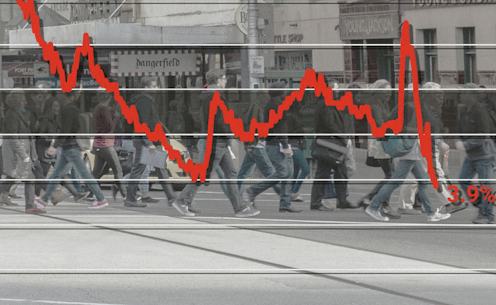
At 3.9%, Australia's unemployment rate now officially begins with '3'. What's next?

Early in the election campaign, on April 14, we learned that Australia’s unemployment rate had slipped below 4% in March, to 3.95% – the lowest rate in 48 years.

But the Coalition was denied the bragging rights that would flow from an unemployment rate beginning with “3” because of a Bureau of Statistics convention of quoting the rate to only one decimal place, which meant the rate was presented as “4.0%”, the same as the month before (when it was actually 4.04%).

Thursday’s figure, for the month of April, has broken the barrier. Officially 3.9% (and actually 3.85%), it is clearly below 4% for the second consecutive month (because the March figure has been revised downwards to also round to 3.9%).

Read more: Technically unemployment now begins with a '3'. How to keep it there?

It means the unemployment rate has decisively broken out of the band of 5-6% it has been in or near for the past two decades and slipped below 4%.

It has fallen to where it was a half-century ago when (in the days the survey was quarterly) it jumped from 3.7% to 5.4% between November 1974 and February 1975.

Of course, 3.9% is an average. Over the country, the unemployment rate ranges from lows of 2.9% in Western Australia and 3.1% in the Australian Capital Territory, to highs of 4.5% in Queensland and South Australia.

For women, the rate is an almost half-century low of 3.7%, less than the 14-year low of 4.0% for men.

Australia isn’t alone. The unemployment rate is below 4% in the United States, the United Kingdom and New Zealand; and below 3% in Japan, Germany and Korea.

Further declines are expected. The Reserve Bank is forecasting unemployment of 3.6% by 2023, a few points less than the Treasury, which is forecasting 3.75%.

But the Bank is modest about its forecasting ability. It only claims to be 90% confident that by mid-2024 the rate will be somewhere between 2% and 5%.
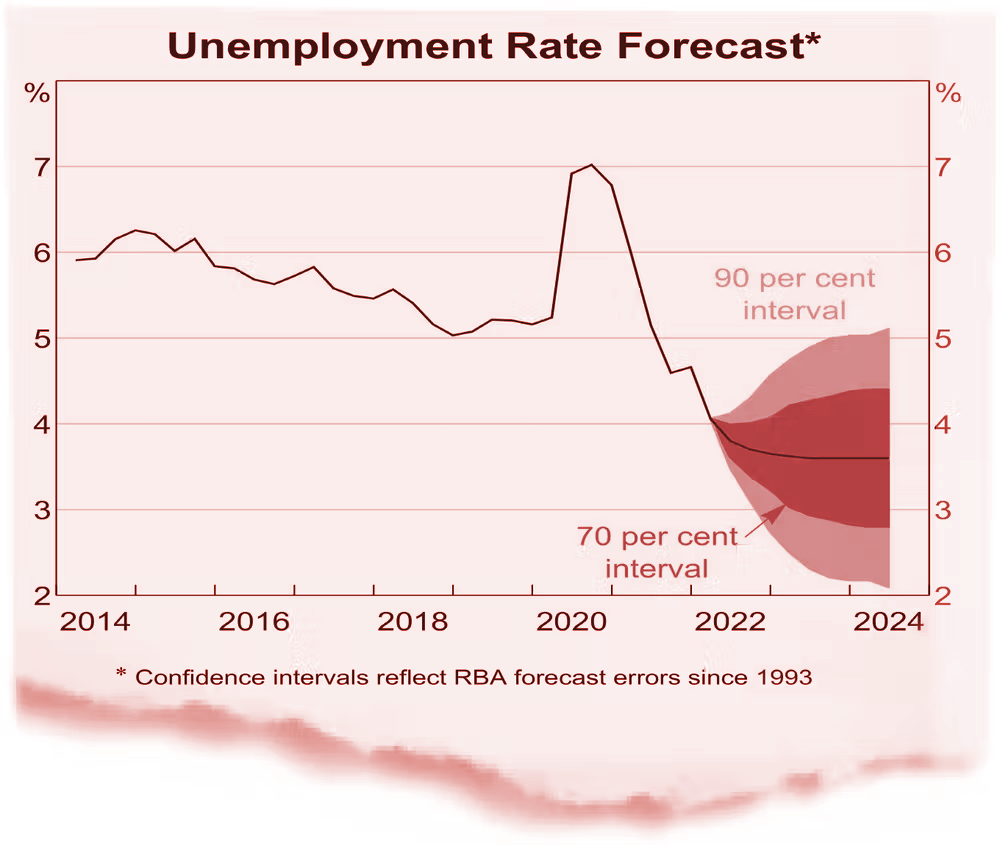
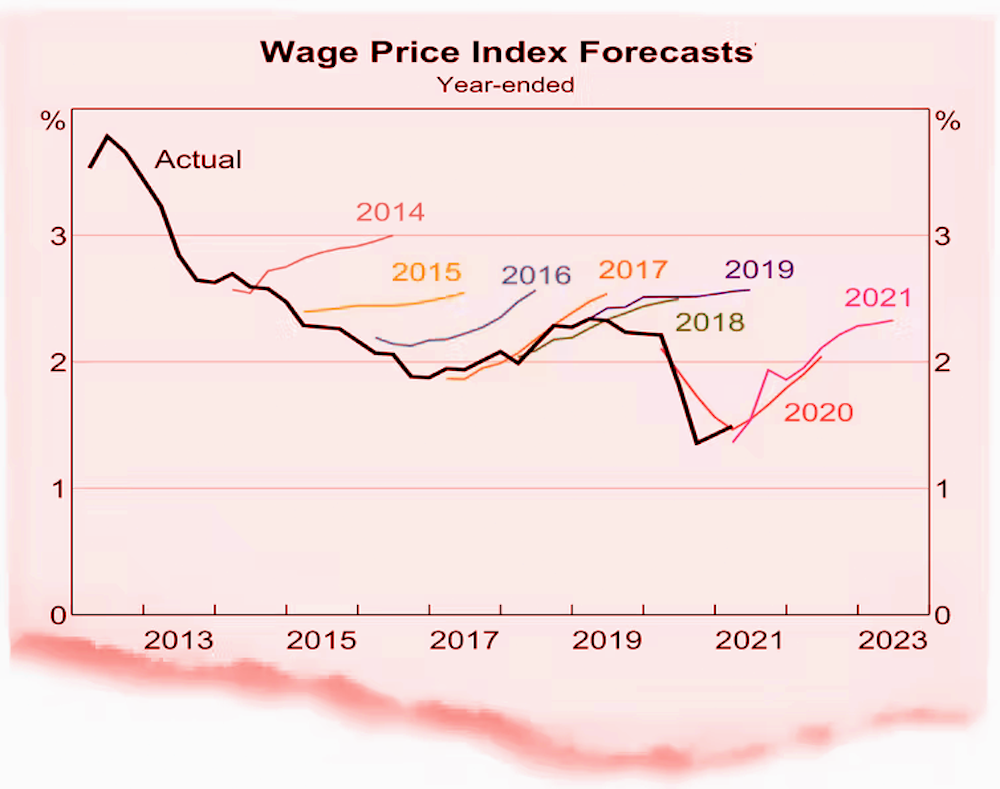
Reserve Bank of Australia At a press conference to release Labor’s election policy costings hours after the employment numbers were released, Labor treasury spokesman Jim Chalmers held out the prospect of more optimistic forecasts in Labor’s first budget as a result of the net $7.4 billion of extra spending it is proposing. He said he would work with the Treasury if elected to ensure the dividends of Labor’s investments in childcare, training and energy were reflected in those forecasts. The improvement is real Sometimes the unemployment rate can be misleading. It can fall because people have left their jobs and are too despondent to search for new ones, meaning they are classified as “not in the labour force” rather than unemployed. And it can fall even though people are less fully employed, working fewer hours than they did (in accordance with an international convention, one hour per week is all that’s needed to be “employed”). Read more: Forget the election gaffes: Australia's unemployment rate is good news – and set to get even better by polling day But in these figures the share of the working age population in work remains at an all-time high of 63.8%, well above the 62.4% before the COVID crisis and the hundreds of billions of dollars spent in response from March 2020. The number of hours worked rose in April to a record 1,833 million hours. Underemployment – the proportion of people working fewer hours than they would like – fell to a fresh 14-year low of 6.1%. Wages missing out Australia’s steadily falling unemployment rates have to date had little effect on wages growth. The figures released on Wednesday showed wages grew 2.4% in the year to March, up only marginally on the 2.3% in the year to December. Read more: Are real wages falling? Here's the evidence The Reserve Bank says its business liaison programme is giving it a more positive picture, with firms telling it they are having to pay to attract and retain staff. The Bank is forecasting annual wages growth of 3% by December and 3.5% by December 2023, but it concedes its wage growth forecasts have been overoptimistic in the past, producing higher numbers than eventuated in most of the past ten years. Reserve Bank of Australia The Bank remains hopeful. Previous dips in unemployment, in 2008 and 2010, boosted wages growth. A recent study by two of its economists finds that in the locations where unemployment fell below 4% in the decade before COVID, wages grew the most. Higher rates in store The most immediate impact of Thursday’s very welcome news on unemployment will be confirmation within Reserve Bank HQ that the economy can withstand further increases in interest rates. The next increase is likely a fortnight after the next government takes office, following the Bank’s June board meeting on Tuesday June 7. Only if it gets clear evidence that wages aren’t climbing as it expects is it likely to consider changing course. Authors: John Hawkins, Senior Lecturer, Canberra School of Politics, Economics and Society and NATSEM, University of Canberra

Read more https://theconversation.com/at-3-9-australias-unemployment-rate-now-officially-begins-with-3-whats-next-183226

Business News

The strategic rise of Bali as Australia’s next essential healthcare support hub

As Australian healthcare providers grapple with unprecedented operational bottlenecks, a new nearshore model is quietly transforming patient care delivery. Forward-thinking organisations,  including...

Daily Bulletin - avatar Daily Bulletin

Cost Savings and Benefits of Using Used Pallets in Logistics

In today’s competitive logistics and supply chain industry, businesses are constantly looking for ways to reduce operational costs without compromising efficiency and reliability. One of the most prac...

Daily Bulletin - avatar Daily Bulletin

How Fulfilment Services in Australia Help Businesses Scale Efficiently

The growth of e-commerce and modern retail has transformed customer expectations. Consumers now expect fast shipping, accurate order processing, and seamless delivery experiences regardless of where...

Daily Bulletin - avatar Daily Bulletin

Practical Ways Australian Workplaces Can Reduce Operating Costs

Reducing business costs doesn’t always mean cutting staff, shrinking services or making the workplace feel bare-bones. In many cases, the smarter savings are hiding in everyday operations: the light...

Daily Bulletin - avatar Daily Bulletin

Executive Recruitment Solutions That Help Organisations Secure Exceptional Leaders

Leadership has a direct impact on organisational performance, employee engagement, strategic growth, and long-term success. Businesses operating in increasingly competitive environments require experi...

Daily Bulletin - avatar Daily Bulletin

Why A WooCommerce Website Designer Matters For Online Growth

Running an online store today requires more than simply listing products and waiting for customers to arrive. Businesses need a website that is fast, reliable, easy to navigate, and designed to suppor...

Daily Bulletin - avatar Daily Bulletin

Turning Your Empty Tables into Revenue

The rise of AI demand tools in hospitality, the EatClub–CommBank partnership, and seven trends reshaping Australian dining  A growing number of Australian venues are turning to AI-powered demand mana...

Daily Bulletin - avatar Daily Bulletin

High-Impact Dental Marketing Strategies That Are Driving Real Practice Growth Today

The landscape of dental practice growth in Australia has shifted dramatically over recent years. Standard, broad-spectrum advertising campaigns no longer yield the return on investment they once did. ...

Daily Bulletin - avatar Daily Bulletin

How Telematics Helps Australian Companies Improve Productivity

Operating a commercial fleet in Australia is a uniquely demanding endeavour. Between the sprawling urban sprawl of cities like Sydney and Melbourne and the immense, unforgiving stretches of the Outb...

Daily Bulletin - avatar Daily Bulletin

The Daily Magazine

Lighting Shop in Perth: How The Right Lighting Can Transform Your Home And Business

The right lighting can completely change the look, feel, and functionality of any space. Whether it ...

Traffic Light System Solutions For Safer And More Efficient Traffic Management

Modern cities and growing communities rely heavily on effective traffic management to ensure safety...

Gold Migration Lawyers in Liquidation: How the Closure Affects Your ART Appeal

If your appeal was with Gold Migration Lawyers, a recent change to how the Tribunal decides cases ...

The pressure cooker: life in urban Australia in 2026

Australian cities have always been demanding. Long commutes, rising housing costs, busy schedules a...

What Actually Makes a Good Criminal Lawyer in Melbourne

Most people only think about this question once. That is usually too late. Most people charged wi...

Why Working With A Chatswood Tutor Can Improve Academic Performance

Academic expectations continue increasing for students across primary school, high school, and senio...

Is It Worth Getting Solar Panels in Melbourne?

The real question is not whether solar works in Melbourne. It works. The question is what it is co...

How A Diploma Of Project Management Builds Practical Skills For Modern Work Environments

Developing the ability to plan, execute, and deliver outcomes efficiently is a key requirement in to...

How to Choose the Right Football for Every Level

Choosing a football may seem straightforward, but the right option depends on who will be using it a...