

Read The Times Australia

Daily Bulletin

How did Sri Lanka run out of money? 5 graphs that explain its economic crisis

  • Written by: Thilak Mallawaarachchi, Honorary Associate Professor, Risk and Sustainable Management Group, The University of Queensland
How did Sri Lanka run out of money? 5 graphs that explain its economic crisis

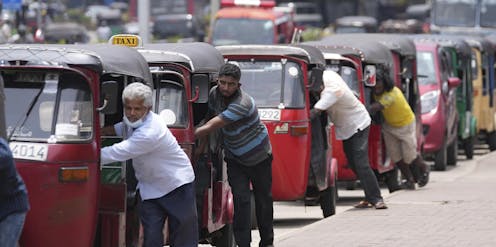
Sri Lanka is facing its worst economic crisis in modern history. Its 22 million strong population is struggling with huge price increases for food, power, medicines and other necessities. That’s if they can get them at all, with private motorists spending hours queuing for their fuel quota.

This is why Sri Lankans have been protesting on the streets and stormed the President’s House.

People in a conference room in the Sri Lankan president's palace a day after the storming official residences on July 9 2022.
People in a conference room in the Sri Lankan president’s palace a day after the storming official residences on July 9 2022. Chamila Karunarathne/EPA

How did it come to this?

The immediate cause of the crisis is straightforward: Sri Lanka ran out of foreign reserves, the currencies its government and citizens need to pay for imports.

How it got into this situation requires more explanation. It’s a story of fiscal imprudence, unsustainable exchange rate policy and chronic mismanagement.

Read more: Behind the crisis in Sri Lanka – how political and economic mismanagement combined to plunge nation into turmoil

Running out of foreign currency

Since the beginning of 2020 Sri Lanka’s demand for foreign currency has increased while its ability to earn foreign currency – through exports, loans and other capital inflows – has declined.

This is reflected in the steady decline in official foreign reserves held by the Central Bank of Sri Lanka, falling from about US$8 billion to less than $U2 billion. (The Sri Lankan currency is “closed”, meaning it isn’t traded outside the country, so foreign exchange transactions have to go through the central bank).

As bad these figures are, the reality is worse.

Gross reserves aren’t the same as money in a bank account that can be used for payments. They include, for example, currency already committed to payments, and loans with conditions that limit imports from certain countries.

The actual amount of “usable” foreign currency is less. By early May it was barely US$50 million – a miniscule level for an economy that by the end of 2021 needed about US$75 million a day to pay for imports. This led to Sri Lanka’s government defaulting on a US$78 million interest payment in late May.

Declining currency inflows

Sri Lanka’s declining foreign currency inflows and increasing outflows are due to imports outpacing exports, Sri Lankans overseas sending less money home, the devastation of the tourism sector and higher debt repayments.

In two years Sri Lanka’s annual trade deficit has climbed from about US$6 billion to US$8 billion.

Two other key sources of foreign currency, money sent home by Sri Lankans living abroad and international tourism, were also hit hard.

At their peak, they more than offset the trade deficit for goods.

But since 2019 the value of remittances has fallen more than 20%. Income from tourism, devastated by the 2019 Easter bombings in which 269 were killed, has dropped almost 90% from its 2018 peak.

Propping up the exchange rate

Ordinarily a nation can avoid running out of foreign currency in two ways.

One way is to borrow money. Sri Lanka, however, was already heavily in debt before this crisis. Successive governments borrowed to finance infrastructure projects and prop up loss-making public utilities. With estimated annual debt service costs of US$10 billion, Sri Lanka is now a bad bet for lenders.

The second, and better, way is a floating exchange rate along the lines of those in Australia, Britain, Japan and the United States.

A floating rate helps to balance trade value because the currency’s value changes according to demand.

Read more: Sri Lanka's crisis is not just about the economy, but a long history of discrimination against minority groups

Technically Sri Lanka has a floating currency, but it is a “managed float” – with the government, primarily through the Central Bank of Sri Lanka, pegging and repegging the rupee’s value to the US dollar.

A government can do a number of things to maintain the value its currencies, but the main way is buy the currency itself, using foreign reserves. This is what Sri Lanka’s central bank did.

As foreign reserves ran down, the government adopted other riskier policies. Particularly disastrous was the April 2021 decision to ban fertiliser imports.

This was marketed as a policy to promote organic farming, but really it was about cutting demand for foreign currency.

The subsequent drop in agricultural production has only compounded the economic crisis.

Deepthika Rupasinghe works in her garden in Colombo on June 24 2022. All government workers now get Fridays off to spend time growing vegetables to prevent looming food shortages.
Deepthika Rupasinghe works in her garden in Colombo on June 24 2022. All government workers now get Fridays off to spend time growing vegetables to prevent looming food shortages. Chamila Karunarathne/EPA

Rising prices

Just as short-term solutions can create longer-term problems, so too can long-term solutions mean short-term pain.

Allowing the (pegged) rupee to depreciate more than 40% against the US dollar has pushed up inflation to 54%.

The help the Sri Lankan government is seeking from the International Monetary Fund is likely to hit people hard, at least initially.

Based on past experience, the IMF will want major commitments on government expenditure and other economic indicators before bailing out Sri Lanka.

But without action, life in Sri Lanka looks even more grim.

With shortages of imported raw materials, industrial output will shrink, creating a downward spiral of low output, low investment, and resultant low economic growth.

On the other hand, Sri Lanka has some natural advantages – from its natural beauty to the most literate population in South Asia. What it needs now is principled political leadership, competent economic management and the right policies.

Authors: Thilak Mallawaarachchi, Honorary Associate Professor, Risk and Sustainable Management Group, The University of Queensland

Read more https://theconversation.com/how-did-sri-lanka-run-out-of-money-5-graphs-that-explain-its-economic-crisis-187352

Business News

Options Available When a Company Faces Financial Distress

Financial distress can develop gradually or arrive suddenly, and when it does, the decisions made in the early stages often determine what options remain available later. Directors who act promptly ...

Daily Bulletin - avatar Daily Bulletin

What Healthcare Teams Look for When Choosing Specialist Surgical Supplies

In clinical environments, small details rarely stay small. A delayed instrument, a poorly matched device or inconsistent supply quality can affect theatre flow, staff confidence and patient outcomes. ...

Daily Bulletin - avatar Daily Bulletin

Reducing Sales Friction Through Centralized Content Delivery

Sales friction appears whenever buyers or sales teams face unnecessary obstacles in the buying journey. It can happen when information is hard to find, when messaging feels inconsistent, when product ...

Daily Bulletin - avatar Daily Bulletin

Why Choosing the Right Bollard Supplier Matters for Australian Businesses and Public Spaces

From busy CBD streetscapes to sprawling warehouse loading docks, bollards have become one of the most essential safety and security fixtures across Australia. Whether protecting pedestrians from veh...

Daily Bulletin - avatar Daily Bulletin

Why Modular Content Is Transforming Modern Marketing Teams

Modern marketing teams are expected to produce more content than ever before. They need to support websites, landing pages, email campaigns, social channels, product pages, sales enablement material...

Daily Bulletin - avatar Daily Bulletin

Everything You Need to Know About Getting Support from Optus

Whether you've been an Optus customer for years or you've just switched over, at some point you'll probably need to contact their support team. Maybe your bill looks different from what you expected. ...

Daily Bulletin - avatar Daily Bulletin

The Marketing Strategy That’s Quietly Draining Sydney Business Owners’ Bank Accounts

Sydney businesses are investing more in digital marketing than ever before. The intention is clear. More visibility should mean more leads, more customers, and steady growth. However, many business ...

Daily Bulletin - avatar Daily Bulletin

Why Mining Hose Solutions Are Essential For High-Performance Industrial Operations

In environments where the ground itself is constantly shifting, breaking, and being reshaped, every component must be built to endure. Mining operations are among the most demanding in the industria...

Daily Bulletin - avatar Daily Bulletin

The Reason Talented Teams Underperform

If you’re in business, you might have seen it before. A team of capable and smart people just suddenly slows down, and things start spiraling out of control. On paper, everything looks perfect, but ...

Daily Bulletin - avatar Daily Bulletin

The Daily Magazine

Why Stress Relief For Dogs Is Essential For Emotional Balance And Long-Term Wellbeing

Managing emotional health is just as important as physical care when it comes to pets, which is why ...

Australia’s Best Walking Trails and the Shoes You Need to Tackle Them

Australia is not short on spectacular walks. You can follow ocean cliffs in Victoria, cross ancien...

Why Pre-Purchase Building Inspections Are Essential Before Buying a Home in Australia

source Have you ever walked through an open home and started picturing your furniture, family d...

5 Signs Your Car Needs Immediate Attention Before It Breaks Down

Car problems rarely appear without warning. In most cases, your vehicle gives clear signals before...

Ensuring Safety and Efficiency with Professional Electrical Solutions

For businesses in Newcastle, a safe and fully functioning workplace remains a key part of day-to-d...

Choosing The Right Bin Hire Solution For Hassle-Free Waste Management

When it comes to managing waste efficiently, finding the right solution can save both time and eff...

Why Cleanliness Is Critical In Childcare Environments

Children explore the world with curiosity, often touching surfaces, sharing toys, and interacting ...

What to Look for in a Reliable Australian Engineering Partner

Choosing an engineering partner is rarely just about technical capability. Most businesses can fin...

How to Choose a Funeral Home That Supports Families with Care

Choosing a funeral home is rarely something families do under ideal circumstances. It often happen...