

I spent a year squeezing leaves to measure their water content. Here's what I learned
- Written by: Tomás I. Fuenzalida, Postdoctoral Fellow, Research School of Biology, Australian National University
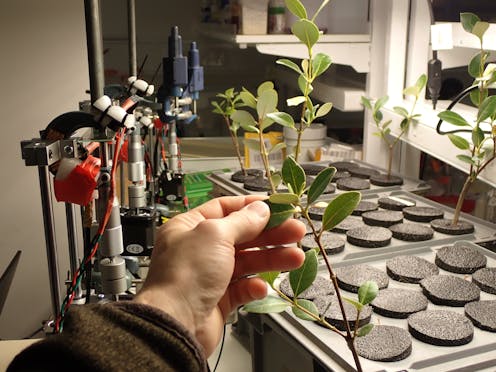
How do you tell if your plants need water? Recently, I asked this question of a group of about 40 biologists at the Australian National University.
Most of them said they would stick their fingers into the soil. If you want to be more scientific about it, most horticulturalists would argue it is best to weigh the pot to determine how much water it contains.
I took a different view. After building special tools to measure the “pulse” of plants, I am more inclined to feel the leaves.
Not only can touch provide a new way to follow the flow of water through plant cells, it may also deliver new possibilities for plant monitoring and care.
The rhythm of plants
Plants have a natural rhythm, like a very slow heartbeat, caused by changing water pressure inside their cells.
Plants only beat around once a day, dehydrating during the day and rehydrating during the night. This process is too slow to watch for all but the most patient observers.
The pressure inside plant cells is called “turgor” and is usually between five and 20 atmospheres (up to 10 times the pressure inside a car tyre!). But while this pressure is large, plant cells are only a fraction of a millimetre in size.
For this reason, measuring turgor pressure has been traditionally been difficult and only done in lab settings. Put simply, we do not have a plug-and-play method to monitor the beating of plants.
Squeezing leaves
Measuring plant water status is pretty important. On a global scale, more water flows through plants than through rivers, and a great part of this flux is regulated by changes in leaf turgor pressure.
Similarly, agriculture uses about 70% of all the water managed by humans, and many forests around the world are succumbing to drought. It is a key time to study the beating of plants. But where to start?
While doing my PhD studying water movement in plants, I was trying to find a simple way to measure turgor pressure and water content.
Although turgor is a property of single cells, I thought I could monitor a group of cells by carefully squeezing a leaf.
My ideas were simple. Leaves are thicker when they contain more water, so I could monitor the water content by measuring the thickness of the leaf, which I would do by squeezing it with a constant amount of force.
And to monitor the water pressure inside a leaf’s cells, I could measure the force exerted by the leaf when constrained to a given thickness.
As it turned out, these two ideas were not new – only new to me, and perhaps new to plant science. Materials scientists use tests like these all the time: a constant-force test is called a creep experiment, while a constant-thickness test is called a stress relaxation experiment.
How it works
A year of tinkering and thinking about this problem allowed me to test my ideas in a very simple way. I bought a micrometer (a workshop tool used to measure distances very accurately), coupled it with a motor, a force sensor and some computer controls, and devoted myself to squeezing leaves.
Preliminary tests worked well, and then I couldn’t stop doing it!
Within the next six months, I had replaced the last chapter of my PhD with this serendipitous project. Colleagues and I successfully validated and published this simple method to monitor plant water status.
In the figure below, you can see the changes in the leaf thickness and turgidity of a grey mangrove (Aviennia marina) measured under changing light conditions.
Touching plants
Measuring the beating of plants is important, but this is not the only exciting aspect of this project.
More broadly, touch-based measurements could uncover a new wealth of information about plant life. This venture may help us understand climate, save water, and hopefully help us in addressing “plant blindness”.
Plants are very adaptable organisms. Much of their adaptability comes from the ability to modify their body plan to suit different conditions.
Read more: Botanists are disappearing – just when the world needs them most
Being modular organisms made up of a collection of different cells, plants often modify the structure of cells and tissues, the strength of their walls, and the concentration of water-retaining compounds inside the cells. All of these properties, like turgor, are difficult to measure.
Touch provides scientists with a simple tool to study these mechanical properties of plant tissues.
A simple robotic system that could stay on a tree and continuously “feel” how the properties of its leaves (and stems, fruits and roots) change over time would have vast applications in research and industry.
Authors: Tomás I. Fuenzalida, Postdoctoral Fellow, Research School of Biology, Australian National University


 Daily Bulletin


