

Inspiration, mentor and a truly great man: Tim Flannery farewells scientist James Lovelock, who has returned to Gaia at 103
- Written by: Tim Flannery, Professorial fellow, Melbourne Sustainable Society Institute, The University of Melbourne
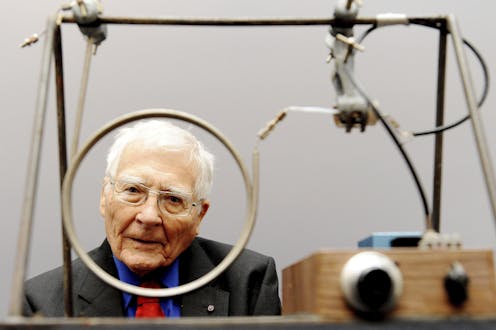
James Lovelock, scientist and inventor, returned to Gaia on his 103rd birthday, July 26 2022.
Just three years earlier, I had attended his 100th birthday celebration at Blenheim Castle, Oxfordshire. There he sat, surrounded by some of the greats of British science, including the astronomer and ex-president of the Royal Society Sir Martin Rees, and other rather idiosyncratic thinkers such as the diplomat Sir Crispin Tickell and the French philosopher Bernard Latour, who had travelled from overseas to be there.
Lovelock was in rude good health. Later, at the Lovelock Centenary Meeting at Exeter University, he was the subject of a rigorous one-and-a-half-hour interview, on stage. The first question from the audience was asked by a young man. “You are famous for thinking outside the box,” he said. “How do you do it?”
Lovelock sat thoughtfully for a moment or two, before replying: “What box?”
A man of elfin stature, Lovelock was born in 1919. He began life in a world where biplanes had recently taken to the skies, and left it as NASA’s Perseverance Rover was drilling into sedimentary rocks in its search for traces of life on Mars.
He was delightful, honest and astonishingly candid. His work on air quality (which preconditioned his thinking to take climate change seriously) began in London’s air-raid shelters during World War II. He was fascinated with the fact that in some shelters there was so little oxygen you couldn’t light a cigarette, yet nobody was having difficulty breathing.
He also mentioned that his sex life was never so vigorous nor varied as it was during the war, the possibility of being blown to bits at any moment being a great disinhibitor.
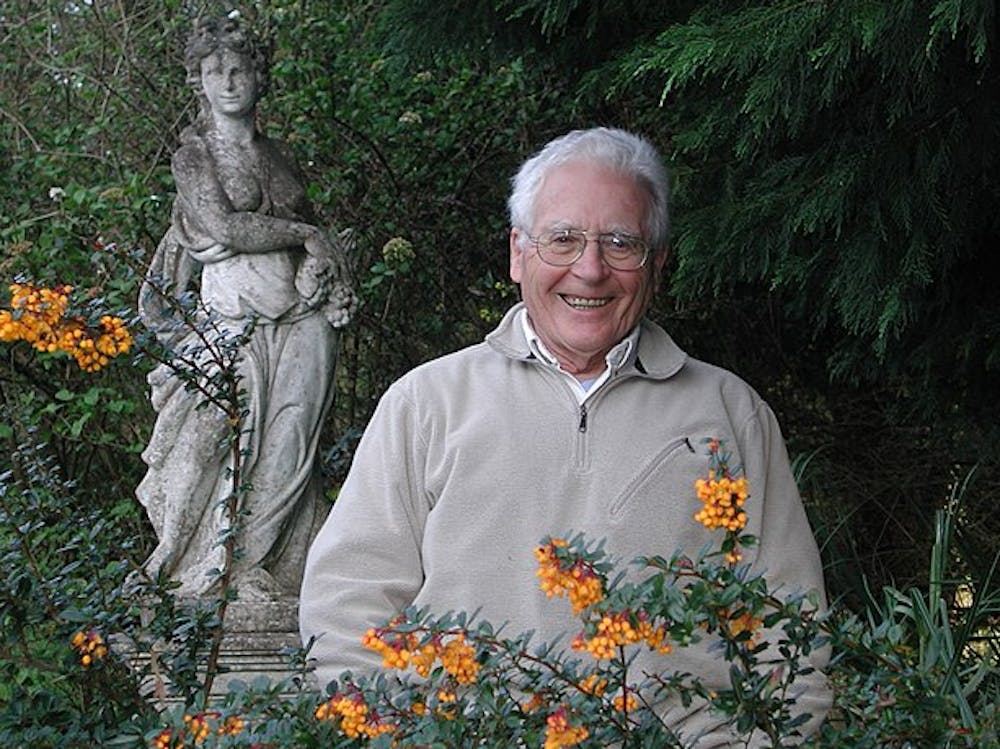
An independent scholar
Lovelock was always an independent scholar, never accepting a tenured university position, although many would gladly have had him. Instead, he supported himself with royalties from his inventions, visiting fellowships, and contract work, including a longstanding engagement with the British Secret Services. His was a highly unconventional academic career, but an extraordinarily influential one.
Arguably his greatest invention is the electron capture detector, a device that allows for the detection of atoms in gases. Used in gas chromatography to detect minute amounts of chemical compounds, it has revolutionised our understanding of the distribution of many compounds in the atmosphere, including harmful pollutants. Without it, the destruction of the ozone layer may not have been detected until it was too late.
Lovelock was at NASA’s Jet Propulsion Laboratory in Pasadena, California, when the first analyses of the Martian and Venusian atmospheres were received. He realised immediately that they were very different from Earth’s atmosphere, in that they were at equilibrium with the planet’s geology. Venus and Mars, he concluded, were dead planets.
Earth, in contrast, was a living system that worked to maintain the atmosphere in violent disequilibrium with the planet’s geology. This, Lovelock realised, was the signature of life that could be highly useful as we searched for other living planets.
Gaia
Lovelock’s Gaia: A New Look at Life on Earth (1979) is one of the few truly revolutionary books on Earth systems to be published during the 20th century. Named after the Greek goddess of the Earth, the Gaian hypothesis conceived of the living planet as a single system. Not since Alfred Russell Wallace’s 1903 classic Man’s Place in the Universe had such a bold, holistic theory been proposed.
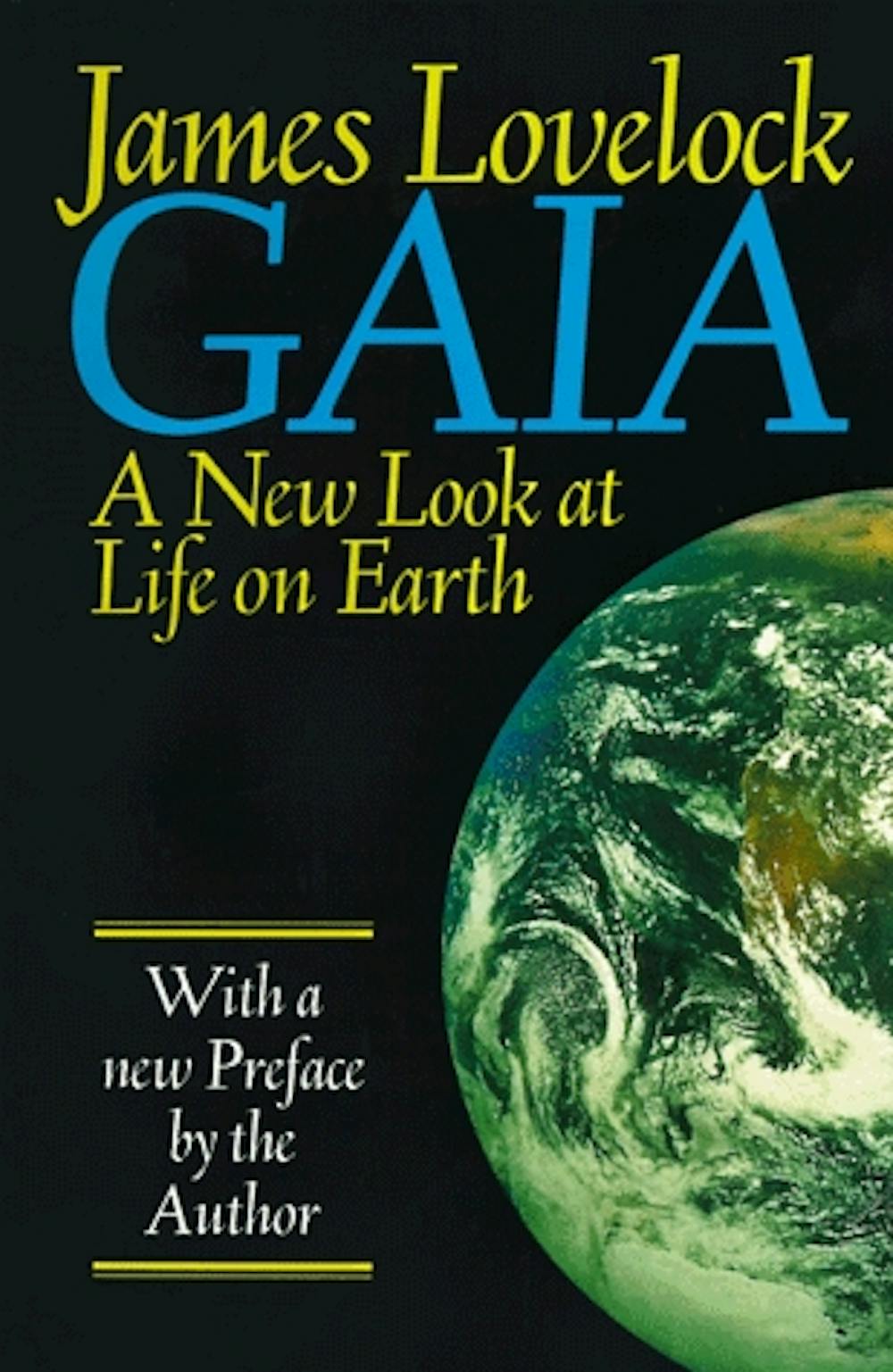 It immediately attracted detractors, many of whom, judging from their comments, had not read the book. Portrayed as a sort of hippy, flower-power view of the world, the work is in fact a rigorous, numbers-heavy analysis of Earth function at the highest level. Reading and re-reading it and its sequels has had a profound influence on my thinking.
In his later years, Lovelock became a leading activist in the fight against fossil fuels. His warnings about climate change were seen by some as shrill and extreme. For example, in The Revenge of Gaia (2006), he predicted that if we continued to use fossil fuels at the current rate, humanity might become extinct outside far northern refuges such as Greenland, where perhaps a billion of us might survive.
I thought that Lovelock was being gloomy, but today, as I take in the astonishing rate at which flood, fire, drought and heatwaves are impacting our global civilisation, I’m beginning to give him more credibility.
Read more:
The UK just hit 40℃ for the first time. It's a stark reminder of the deadly heat awaiting Australia
Lovelock was ever curious. I once took him for a walk around Sydney’s North Head. I explained that the sandstones that form the headland were so solid and devoid of fossils because they had been laid down by anastomosing rivers, such as those seen at glacial snouts today, just after the greatest mass extinction in Earth’s history, at the beginning of the Triassic Period, when 95% of all species on Earth perished.
We examined the vegetation that manages to grow in the impoverished soils derived from the extinction-affected rocks, and agreed that disruptions of Gaia’s function can have profound consequences indeed.
James Lovelock was an inspiration and a mentor, a truly great man the likes of whom we shall not see again. Today, science is compartmentalised, collaborative, regulated and peer-reviewed in ways that do not sit well with the maverick. And yet there is a crying need for such people, especially those able to take the holistic view, as risky and uncertain as that sometimes is.
Vale James. You have now paid the ultimate price that Gaia demands of us all – a once animate piece of Earth’s crust now returned to the mother lode. But what a legacy you have left your species!
Authors: Tim Flannery, Professorial fellow, Melbourne Sustainable Society Institute, The University of Melbourne
It immediately attracted detractors, many of whom, judging from their comments, had not read the book. Portrayed as a sort of hippy, flower-power view of the world, the work is in fact a rigorous, numbers-heavy analysis of Earth function at the highest level. Reading and re-reading it and its sequels has had a profound influence on my thinking.
In his later years, Lovelock became a leading activist in the fight against fossil fuels. His warnings about climate change were seen by some as shrill and extreme. For example, in The Revenge of Gaia (2006), he predicted that if we continued to use fossil fuels at the current rate, humanity might become extinct outside far northern refuges such as Greenland, where perhaps a billion of us might survive.
I thought that Lovelock was being gloomy, but today, as I take in the astonishing rate at which flood, fire, drought and heatwaves are impacting our global civilisation, I’m beginning to give him more credibility.
Read more:
The UK just hit 40℃ for the first time. It's a stark reminder of the deadly heat awaiting Australia
Lovelock was ever curious. I once took him for a walk around Sydney’s North Head. I explained that the sandstones that form the headland were so solid and devoid of fossils because they had been laid down by anastomosing rivers, such as those seen at glacial snouts today, just after the greatest mass extinction in Earth’s history, at the beginning of the Triassic Period, when 95% of all species on Earth perished.
We examined the vegetation that manages to grow in the impoverished soils derived from the extinction-affected rocks, and agreed that disruptions of Gaia’s function can have profound consequences indeed.
James Lovelock was an inspiration and a mentor, a truly great man the likes of whom we shall not see again. Today, science is compartmentalised, collaborative, regulated and peer-reviewed in ways that do not sit well with the maverick. And yet there is a crying need for such people, especially those able to take the holistic view, as risky and uncertain as that sometimes is.
Vale James. You have now paid the ultimate price that Gaia demands of us all – a once animate piece of Earth’s crust now returned to the mother lode. But what a legacy you have left your species!
Authors: Tim Flannery, Professorial fellow, Melbourne Sustainable Society Institute, The University of Melbourne


 Daily Bulletin


