

Precarious employment, hiring discrimination and a toxic workplace: what work looks like for Australian cinematographers
- Written by: Amanda Coles, Senior Lecturer, Employment Relations, Department of Management, Deakin University, Deakin University
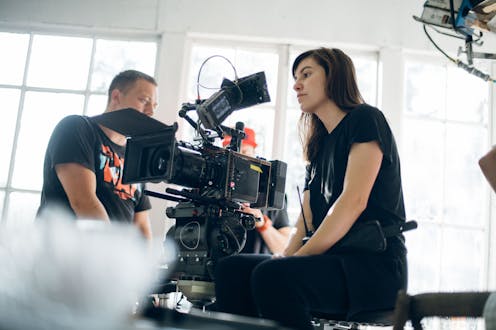
It has been a fantastic year for Australian cinematographers in Hollywood.
Australian directors of photography represented two of the five nominees for best cinematography at the 2022 Oscars. Greig Fraser won the Oscar for his work as cinematographer on Dune. Ari Wegner became the second woman ever to be nominated for best cinematography in the 94-year history of the Oscars, for her work on Power of the Dog.
Now, the work of Aussie director of photography Mandy Walker is being seen by audiences around the globe on Baz Luhrmann’s film Elvis, grossing more than US$210 million (A$304 million) at the worldwide box office.
The director of photography or cinematographer is responsible for the overall look of a film. This key creative leadership role demands advanced artistic and technical expertise. Our new report, A Wider Lens: Australian camera workforce development and diversity, looks behind the red carpet glitz to analyse the workforce, the work model and the work culture of Australian film and television camera departments.
We have found a workplace lacking in diversity and a toxic work culture rife with discrimination, stress and precarious employment.
Our findings suggest Australian cinematographers are succeeding on the international stage in spite of – rather than because of – labour markets and working conditions in the Australian film and television production industry.
A serious lack of diversity
Commissioned by the Australian Cinematographers Society, the report draws from Screen Australia production data and on 640 complete responses to a survey of Australian film and television camera professionals conducted in early 2021.
In line with a growing body of research in Australia and internationally on diversity in the film and television production industry, our study finds that gender inequality is a defining feature of work and labour markets in the camera department.
The Australian film and television camera workforce is 80% men, 18% women and 2% trans/gender diverse. It is an ageing workforce, with nearly 70% of camera professionals over the age of 35. It is also largely white, with 63% identifying as Anglo-Celtic. Only 2% of the survey respondents identified as Indigenous, and only 13% as non-European.
The workforce is 85% heterosexual, and 8% identify as a person with a disability.
This data snapshot must be understood in relation to the quantity and quality of work for film and television camera professionals – and indeed in the film and television production industry more generally.
A stressful environment
Work as a camera professional is high-performance, requiring a highly specialised, technical skill set and intense concentration for extended periods of time.
Job stress is compounded by the fact that film crews commonly work in unusual, and at times dangerous, locations.
The very real dangers that camera professionals face in doing their jobs is demonstrated by the tragic deaths of director of photography Halyna Hutchins on the set of Rust in 2021, and of camera assistant Sarah Jones on the set of Midnight Rider in 2014.
Read more: We are filmmakers who work with firearms. This is what is important in on-set safety
Work stress is compounded by an employment model that is the definition of precarity.
Employment and income insecurity are driven by short-term freelance contracts that can be for as little as one day. Employment is accessed through highly exclusionary, informal hiring networks.
Half our survey respondents report directly experiencing discrimination in the hiring process, with gender, age and racial discrimination being the most frequently encountered.
When work is secured, working patterns are highly erratic, with irregular, frequently excessive and antisocial hours.
This work model produces severe consequences for workforce development and wellbeing. From our survey respondents, 60% of all camera professionals – and 70% of women – reported the work model actively prevents work-life balance.
Precarity and health stressors are even further exacerbated by what can only be described as a toxic industry work culture. Discrimination and harassment at work is commonly experienced.
Half of all non-European and Indigenous respondents report experiencing racism at work. Sexism at work has been experienced by 75% of trans and gender diverse respondents, and 89% of women. Sexual harassment is routine for women.
Those in positions of power and influence are often the perpetrators of discrimination, harassment and bullying. Unsurprisingly, reporting is a key challenge facing the industry.
Freelancers work in a reputation economy. There is widespread fear that reporting incidents of bullying, discrimination and harassment will jeopardise both future job prospects and career longevity in the camera department.
A workforce-wide problem
The timing is good for action. Many of the key policy and industrial issues fall across Tony Burke’s dual portfolios as Minister for Employment and Workplace Relations, and Minister for the Arts.
These issues aren’t unique to film sets. Many of the issues raised by the report speak to key issues in Australian work places more generally.
The upcoming Jobs + Skills Summit offers an opportunity to advance the core issues raised here as emblematic of the types of workforce development and diversity issues cultivated by high-skill, low-quality and insecure work.
A lack of diversity in camera departments will not be solved by simply adding different people to the existing toxic system.
An industry-wide commitment to equity, diversity and inclusion must first focus not on the excluded, but those doing the excluding.
Authors: Amanda Coles, Senior Lecturer, Employment Relations, Department of Management, Deakin University, Deakin University


 Daily Bulletin


