

Read The Times Australia

Daily Bulletin

Jane Goodall joins Barbie’s ‘inspiring women’ series: the strange evolution of an iconic doll

  • Written by: Katie Pickles, Professor of History, University of Canterbury
Jane Goodall joins Barbie’s ‘inspiring women’ series: the strange evolution of an iconic doll

In news many probably never expected to see, no-frills, outdoorsy, animal behaviour expert and conservation activist Jane Goodall has become a Barbie doll (accompanied by her famous chimpanzee, David Greybeard).

Jane Goodall speaking at a conference in 2020. Getty Images

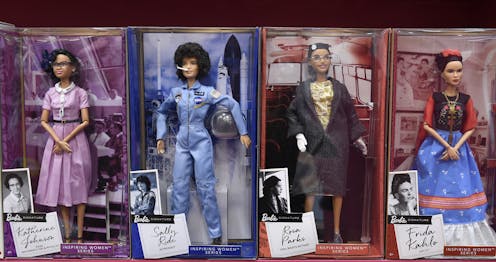
As the latest member of toymaker Mattel’s “Barbie Inspiring Women Series” honouring historical and contemporary heroines, she joins aviator Amelia Earhart, NASA mathematician and physicist Katherine Johnson and artist and political activist Frida Kahlo.

The range was launched on International Women’s Day in 2018, part of Mattel’s response to mothers’ concerns about their daughters’ role models. Others in the series include civil rights activist Rosa Parks, disability advocate Helen Keller, author Maya Angelou, medical reformer Florence Nightingale and suffragist Susan B. Anthony.

Each doll comes with information about their namesake’s achievements and influence. Instead of being generic plastic bodies to be clothed and posed, the dolls were now pitched as “real” women, with Mattel engaged in “shining a light on empowering role models past and present in an effort to inspire more girls”.

Collection of Barbie dolls
The plastic ideal: Barbie dolls have been criticised for promoting an idealised, white body type that reflected women’s subservient place in society. Getty Images

What makes a heroine?

Barbie has certainly come a long way since she was first manufactured in 1959 and became synonymous with what feminists saw as the objectification and commodification of women.

But the fact some of the world’s most famous and groundbreaking women – who sought careers outside their physical appearance – were now being re-imagined as plastic dolls also interested me professionally.

My new book, Heroines in History: A Thousand Faces, examines the patterns that underpin the construction of heroines over the past 200 years. In it I argue that representations of women who have rebelled, rocked, shaken and changed the world are constrained through casting them as either “super-womanly” or “honorary men”. Taking the individual stories of women, including those now appearing as Barbies, I explore a series of archetypal themes, revealing how heroines are produced by the hetero-sexist societies that surround them. Read more: Barbie at 60: instrument of female oppression or positive influence? Despite many advances for women, the persistence and reinvention of heroic iconography for women continues to value image over substance. And because of their iconic appeal, throughout history it has been common for heroines to be used for commercial purposes. In the 19th century, for example, British sea heroine Grace Darling’s image appeared on chocolate boxes and was used to advertise soap. Since her death in 1954, Frida Kahlo’s face has promoted everything from tequila to lip gloss. And Marilyn Monroe’s image has endured to sell any number of products. Antithesis of feminism? So the appropriation of heroic women of substance as plastic Barbies should not surprise us. Dolls have a long and rich history, after all. They’ve appeared as representational figures, including gods and royalty, or dressed in distinct costumes representing national identities. They’ve served as lucky charms and voodoo talismans. Read more: Barbie doll that honors Ida B. Wells faces an uphill battle against anti-Blackness As they evolved from eclectic homemade rag, woollen and wooden figures to mass-produced commercial objects, they became important in children’s gender role play. Rehearsing for their adult years, boys played with toy soldiers, action figures and superheroes, while girls had baby dolls to tend to and model figures to dress and groom alluringly. In a sense, then, the Inspiring Women series can be seen as a positive development, encouraging empowerment by including a diverse range of ethnicities to appeal to girls whose communities were previously not represented as Barbies. Overall, however, Barbie has a lot of work to do to overcome her image as the antithesis of the feminist goal of freeing girls and women from lives that cast them, in the words of writer Simone de Beauvoir, as “living dolls”. Barbie doll in black and white stripped swimsuit. The first Barbie was created in 1959 by Ruth Handler, an American businesswoman. Chesnot/Getty Images In 1991, the author Susan Faludi even defined feminism by referencing Mattel’s famous product: It is the simply worded sign hoisted by a little girl in the 1970 Women’s Strike for Equality: I AM NOT A BARBIE DOLL. Barbie dolls have also been criticised by social scientists for promoting a white, idealised body type that advanced a kind of compulsory heterosexuality and subservience. The call was for women to escape inferior lives as “sex objects” and instead to pursue “real” lives and be recognised for their achievements. And yet some women even underwent plastic surgery to mimic the Barbie body. As the feminist writer Martine Delvaux saw it, “Barbie is the image of what happens to women, their invisible and silent murder.” Read more: Why the curvy new Barbie is good news for your little girl Can dolls freighted with this much cultural baggage really honour inspiring women or serve as feminist role models? Or might it be better to view them as examples of what I term “designer feminism” – somewhere image and substance collide, but where valuing appearance ultimately underpins and contains achievement? The clothing of these dolls may symbolise real lives, but underneath there is still a plastic body. Authors: Katie Pickles, Professor of History, University of Canterbury

Read more https://theconversation.com/jane-goodall-joins-barbies-inspiring-women-series-the-strange-evolution-of-an-iconic-doll-187839

Business News

How Telematics Helps Australian Companies Improve Productivity

Operating a commercial fleet in Australia is a uniquely demanding endeavour. Between the sprawling urban sprawl of cities like Sydney and Melbourne and the immense, unforgiving stretches of the Outb...

Daily Bulletin - avatar Daily Bulletin

Inside the Icon: The BridgeMuseum Officially Opens at the Sydney Harbour Bridge

A bold new way to experience one of Australia’s most recognisable landmarks has arrived, with BridgeClimb Sydney officially opening the all-new BridgeMuseum.  Located inside the Sydney Harbour Brid...

Daily Bulletin - avatar Daily Bulletin

Is Your Brand Showing Up in AI Search? Most Melbourne Brands Aren't.

The New Front Door Nobody Told You About Something changed. Quietly. Without a press release. The way buyers find businesses in Australia has been rewired. Not replaced, rewired. Google isn't dead...

Daily Bulletin - avatar Daily Bulletin

How Australian Businesses Can Measure SEO ROI

SEO can feel vague when you are staring at a dashboard full of numbers that do not clearly connect to revenue. The key is to measure the right signals in the right order, then tie them back to outcome...

Daily Bulletin - avatar Daily Bulletin

How Commercial Roller Shutters Improve Site Security Without Slowing Operations

Security upgrades can be frustrating when they make everyday work harder. A door that takes too long to open, creates bottlenecks at shift change, or fails at the worst time can turn “better protectio...

Daily Bulletin - avatar Daily Bulletin

Why a Document Destruction Service Still Matters for Modern Businesses

Businesses generate large volumes of information every day, from staff records and contracts to invoices, reports and customer files. While attention often focuses on how documents are stored, the way...

Daily Bulletin - avatar Daily Bulletin

Bicycle Rack Safety and Space-Smart Storage

Bike storage problems usually show up as small annoyances first: tangled handlebars, scratched frames, and bikes that topple when you pull one out. Over time, those issues become safety risks, especia...

Daily Bulletin - avatar Daily Bulletin

How to Tell if a Childcare Centre Is a Good Fit for Your Child

Choosing childcare can feel like you’re making a huge decision with limited information. Tours are short, centres are often on their best behaviour, and your child might act differently in a new space...

Daily Bulletin - avatar Daily Bulletin

Car Import Timeline: What Usually Happens at Each Stage

Importing a car into Australia can feel confusing because multiple agencies and checkpoints are involved, and the timeline is shaped as much by paperwork quality as it is by shipping speed. The most u...

Daily Bulletin - avatar Daily Bulletin

The Daily Magazine

Gold Migration Lawyers in Liquidation: How the Closure Affects Your ART Appeal

If your appeal was with Gold Migration Lawyers, a recent change to how the Tribunal decides cases ...

The pressure cooker: life in urban Australia in 2026

Australian cities have always been demanding. Long commutes, rising housing costs, busy schedules a...

What Actually Makes a Good Criminal Lawyer in Melbourne

Most people only think about this question once. That is usually too late. Most people charged wi...

Why Working With A Chatswood Tutor Can Improve Academic Performance

Academic expectations continue increasing for students across primary school, high school, and senio...

Is It Worth Getting Solar Panels in Melbourne?

The real question is not whether solar works in Melbourne. It works. The question is what it is co...

How A Diploma Of Project Management Builds Practical Skills For Modern Work Environments

Developing the ability to plan, execute, and deliver outcomes efficiently is a key requirement in to...

How to Choose the Right Football for Every Level

Choosing a football may seem straightforward, but the right option depends on who will be using it a...

What to Ask a Wedding Photographer Before You Book

Booking a wedding photographer can feel deceptively simple: you like the photos, you like the vibe...

Why Stress Relief For Dogs Is Essential For Emotional Balance And Long-Term Wellbeing

Managing emotional health is just as important as physical care when it comes to pets, which is why ...