

A clean energy grid means 10,000km of new transmission lines. They can only be built with community backing
- Written by: Asma Aziz, Lecturer in Power Engineering, Edith Cowan University
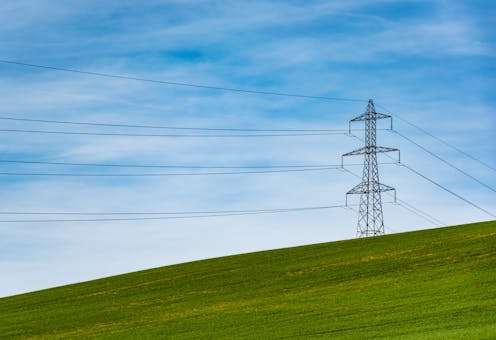
If you drive through central Victoria, you might wonder at the signs reading “Piss off AusNet” in shop windows or even mown into grassland. Communities and farmers are pushing back against plans for new 85-metre towers and transmission lines needed to transmit renewable power to the cities.
Expect to see many more of these stories in coming years. To decarbonise by 2050, we must build more than 10,000 kilometres of new high-voltage transmission lines to carry renewable energy. That’s according to the Australian Energy Market Operator’s new plan for the energy system, which Labor committed to before the election.
But local opposition could derail this – even though the influential National Farmers Federation has backed the plan. The plan recognises this: “As the rate and scale of transformation continue to accelerate … social licence will require urgent and continuing focus.”
Read more: We calculated emissions due to electricity loss on the power grid – globally, it's a lot
Why do we need more transmission lines?
High-voltage transmission lines can deliver electricity economically and efficiently over longer distances. For decades, we’ve used these transmission lines to balance electricity demand and generation.
Australia’s National Electricity Market is one of the world’s longest interconnected power systems, able to move power between the east coast states, Tasmania and South Australia.
To ramp up our renewable electricity base, governments have introduced renewable energy zones – our sunniest and windiest places – to encourage investment. But these zones are often far from energy-hungry cities. That’s where transmission lines come in.
Building more high-voltage lines will let us make the future grid more resilient, enabling electricity to be brought in from other areas if one zone isn’t generating as much, or exporting it if there’s a spike in production. This is a key way of tackling the intermittency issue with renewables. If the sun isn’t shining or the wind isn’t blowing in one area, we can draw energy from the places where it is.
Are there any alternatives?
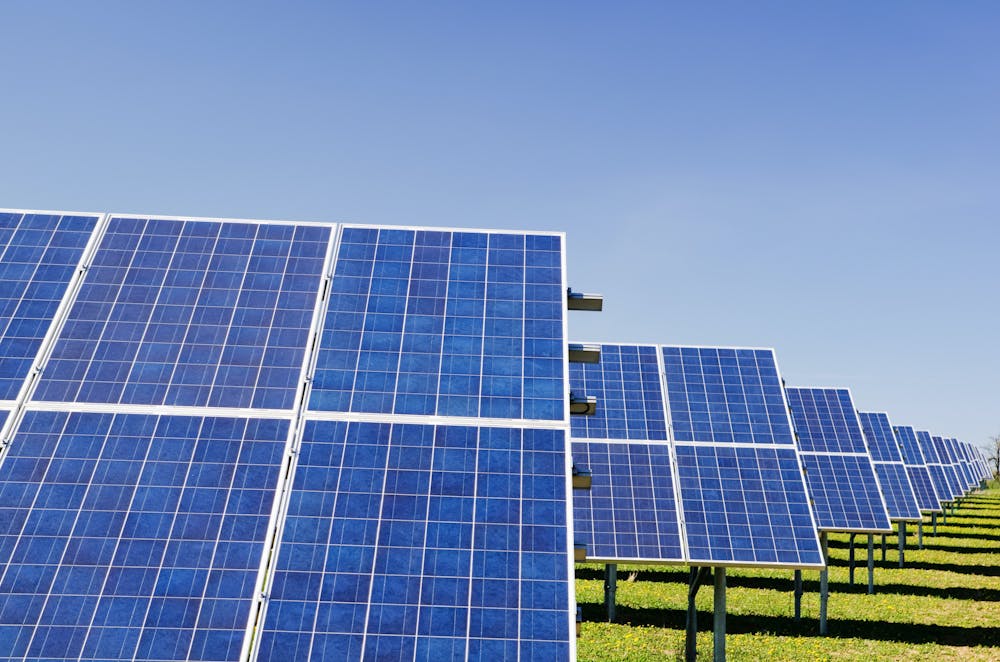
As battery technology and other electricity storage methods improve, it may be possible to ramp up storage methods rather than rely on large new transmission links.
Huge and sparsely populated Western Australia is leading the way on this front. To slash transmission costs, the state has rolled out more than 100 standalone power systems that combine renewables and storage. Over the next 10 years, WA plans another 4,000 of these.
This model shows us what could be possible for sections of the east coast’s grid. We could see a decentralised electricity system, in which local renewable energy is generated and stored locally in standalone power systems or micro-grids. Towns like Victoria’s Yackandandah are pioneering this local-first approach.
We could defer or reduce the scale of these mammoth transmission network projects and make the most of our existing transmission lines by strategically deploying virtual transmission capacity. That means putting battery storage or small-scale pumped hydro in place, cutting the need to source electricity from distant sources while maintaining supply and demand balance.
There’s a lot more work to do on this front before virtual transmission can start reducing how much new transmission infrastructure we will need. Early virtual transmission projects like the Kennedy Energy Park have shown us we need a better technical understanding of how they work best, as well as updated regulations.
Utilities like Powerlink Queensland are exploring alternatives such as duplicating existing transmission lines or planning lines for areas already under development, such as along highways or forest tracks.
Community advocates worried about the visual and physical impact of new transmission lines often argue for cables to run underground.
This is possible, but can be more expensive. To put these high-voltage lines safely underground, you need trenches 2-3 metres deep, dug in parallel, with inspection bays every 800-1,000 metres. Compared with transmission towers, this actually causes a higher direct impact on the land.
Not only that, but you cannot allow deep-rooted trees and shrubs within the easement, which means maintenance. If there’s a fault, you have to excavate the affected land. Major bushfires can also pass significant heat through the ground to the cables, so this must be taken into account.
Does that rule out underground transmission lines? Not entirely. In fact, in some cases, it could be cost-effective, as the proposed Star of the South offshore wind project demonstrates.
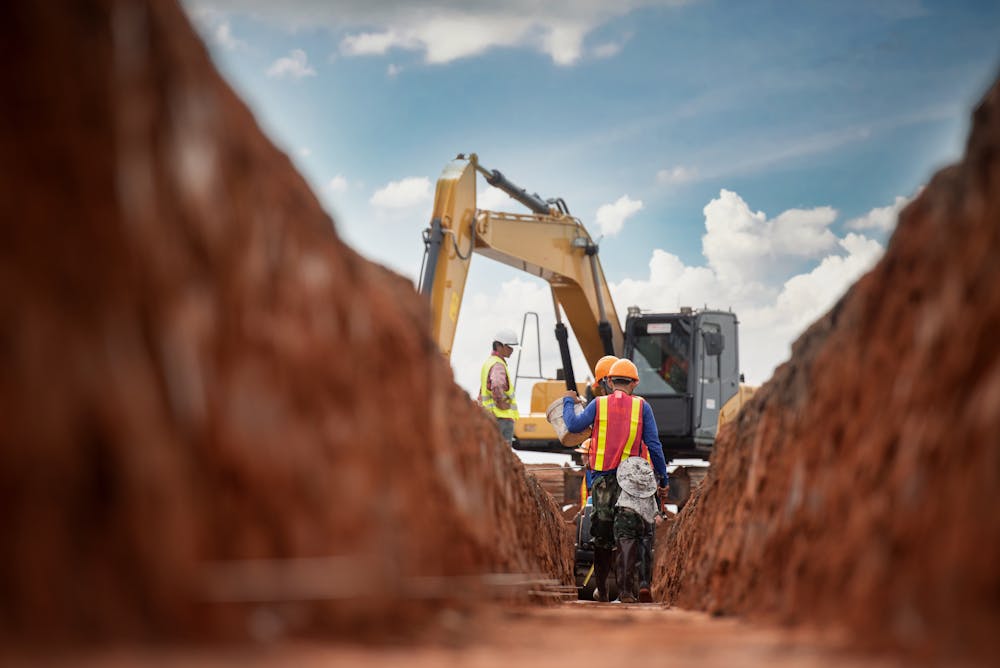 Undergrounding power cables can be cost effective for some projects - but it’s a case by case approach.
Shutterstock
Undergrounding power cables can be cost effective for some projects - but it’s a case by case approach.
Shutterstock
Could community opposition slow the clean energy shift?
It is a risk. Efforts to get emitting sources of electricity out of our grid will face a very real bottleneck based on the social acceptance of new high-voltage transmission lines.
Even though 83% of us now recognise climate change as a threat, people can change their views when clean energy solutions are proposed near them. This is nothing new – the “not in my backyard” issue is well-known.
So how can we deal with community pushback? First, we need to acknowledge that these transmission lines are an imposition. They have a significant footprint on their land corridors, in the form of tall towers, conductors, and the need for access.
Local landholders, neighbours, and the broader community often perceive these types of development – regardless of the need – as a symbolic intrusion on their personal property.
Victorian farmers and residents protest the AusNet project in the belief the new infrastructure will mean loss of control over their lands, an uglier landscape, and possible restrictions on farming practices such as irrigation. Their concerns are legitimate. But the need is also great, and time is limited.
We know what doesn’t work in these settings. The traditional approach for big infrastructure items has been dubbed decide, announce and defend. This would be a mistake.
Instead, utilities and planners should focus on open community discussions over the environmental impact of the proposed above-ground transmission lines compared to the costs and impacts of underground cabling, as well as virtual site visits. By laying out the issue clearly for the public to see, utilities have a better chance of gaining the social licence – community permission – to actually build the infrastructure we will need.
Read more: A 21st-century reinvention of the electric grid is crucial for solving the climate change crisis
Authors: Asma Aziz, Lecturer in Power Engineering, Edith Cowan University


 Daily Bulletin


