

A climate scientist on the planet's simultaneous disasters, from Pakistan’s horror floods to Europe’s record drought
- Written by: Andrew King, Senior Lecturer in Climate Science, The University of Melbourne
Extreme floods are devastating Pakistan, caused by a combination of heavy monsoon rains and melting glaciers. While Pakistan is no stranger to deadly floods, this event is especially shocking with more than 1,100 people dead so far and many millions more affected.
Pakistan’s climate chief has said one-third of the country is underwater - an area larger than the state of Victoria.
This Northern Hemisphere summer has seen extreme weather event after extreme weather event, from record-breaking drought in Western Europe, the United States and China, to flooding in Japan and South Korea.
This begs the question of the extent climate change is to blame. And, if so, is this what we should expect from now on?
A summer of extremes
The flooding in Pakistan is the latest in a sequence of exceptional disasters in the Northern Hemisphere.
Western Europe and central and eastern China have experienced record-breaking heatwaves and droughts leading to water restrictions. These heatwaves and droughts have also caused crop shortages, which are adding to the rising costs of food around the world.
China was plunged into an energy security crisis. And Italy’s longest river is flowing at one tenth of its usual rate. These droughts and their significant impacts are forecast to continue for the foreseeable future.
Severe downpours have caused floods in places ranging from Dallas in the United States to Seoul in South Korea, which experienced its heaviest torrential rain in a century.
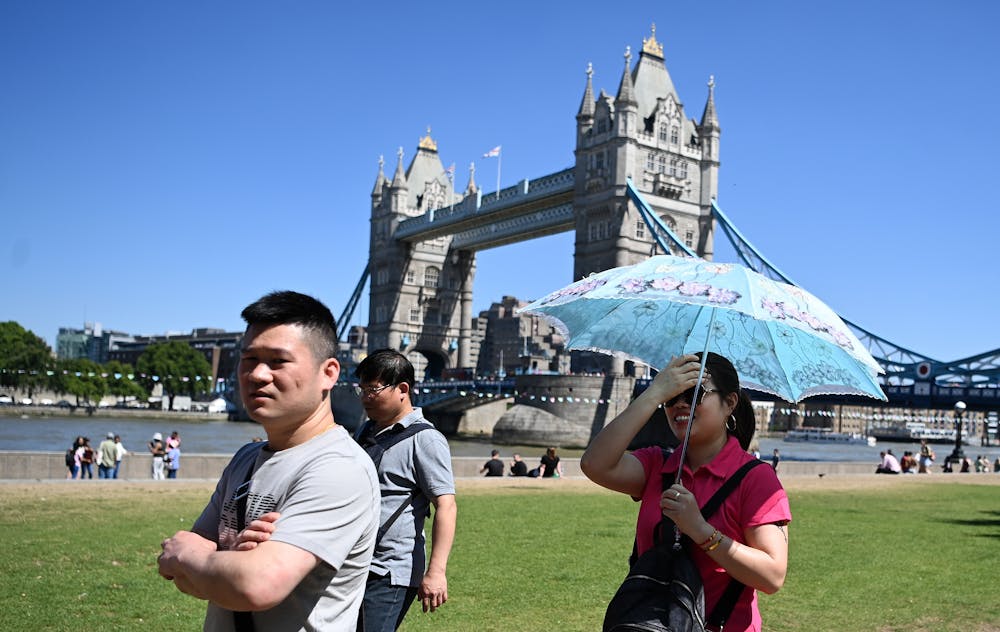
Record-breaking heat extremes have also been recorded in Japan, the central US and in the UK, where temperatures exceeded 40℃ for the first time.
It has also only been a few months since we saw temperatures reach 50℃ ahead of the monsoon rains in northern India and Pakistan.
Putting it into perspective
While it’s true that several of this summer’s extreme events have been exceptional, we normally see more high-impact extreme weather events in Northern Hemisphere summer than any other time. This is because extreme heat, very heavy downpours, and drought are more likely at the warmest time of year.
Two-thirds of the planet’s land and more than 85% of the world’s population are in the Northern Hemisphere. This means there are more people to be affected by extreme weather than in the Southern Hemisphere, making the Northern Hemisphere summer the prime time for disasters to have severe impacts.
Additionally, extreme weather events can occur at the same time over different places, because of large-scale atmospheric waves called “Rossby waves”, which are a naturally occurring phenomenon, like La Niña and El Niño.
 Soldiers carry debris after the floodwater drained from submerged houses following heavy rains in Seoul, South Korea.
Kiim In-chul/Newsis via AP
Soldiers carry debris after the floodwater drained from submerged houses following heavy rains in Seoul, South Korea.
Kiim In-chul/Newsis via AP
Back in 2010, western Russia experienced severe heat and wildfires while Pakistan had some of their worst floods to date. These events were connected by a Rossby wave causing a high pressure pattern to get stuck over western Russia and low pressure to persist over Pakistan.
Rossby waves can also result in heatwaves occurring at the same time, thousands of kilometres apart. Earlier this Northern Hemisphere summer, we saw simultaneous heatwaves strike the western US, western Europe and China.
Rossby waves may well have contributed to simultaneous disasters this summer, but it’s too soon to say for sure.
Climate change and the never-ending extremes
With so many extreme weather events causing mass deaths and large economic and environmental problems, it’s worth considering whether climate change may be making these events worse.
Human-caused climate change has warmed the planet by about 1.2℃ to date and this has caused some types of extreme weather to become more frequent and more intense, particularly extreme heatwaves and record-high temperatures.
 Corn fields are completely dry in the Kochersberg, in eastern France.
AP Photo/Jean-Francois Badias
Corn fields are completely dry in the Kochersberg, in eastern France.
AP Photo/Jean-Francois Badias
Every heatwave in today’s climate has the fingerprint of climate change resulting from our greenhouse gas emissions. Indeed, rapid analyses have already demonstrated that the human effect on the climate greatly increased the likelihood of the extreme heat in India and Pakistan in May, and the record high UK temperatures in July.
Research also shows climate change is increasing the occurrence of simultaneous heatwaves in the Northern Hemisphere, mainly due to long-term warming.
It’s less clear whether the Rossby wave pattern that causes simultaneous heatwaves in different places is becoming more frequent.
Climate change is also shifting rainfall patterns resulting in worsening drought in some areas, such as in much of Western Europe.
And severe downpours and extreme short-duration heavy rain, such as that seen in Seoul and Dallas in recent weeks, are being intensified by climate change. This is because global warming results in the air being able to hold more moisture – for every 1℃ of warming, the atmosphere can hold 7% more moisture.
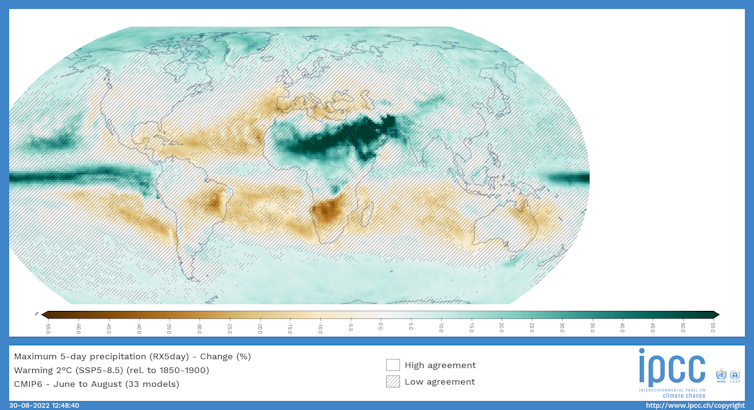
Indeed, the heavy rains in Pakistan follow an observed trend towards increasing extreme daily rainfall totals. This area of the world is projected to see a continued intensification of daily and multi-day extreme rain events over summer, as the planet warms.
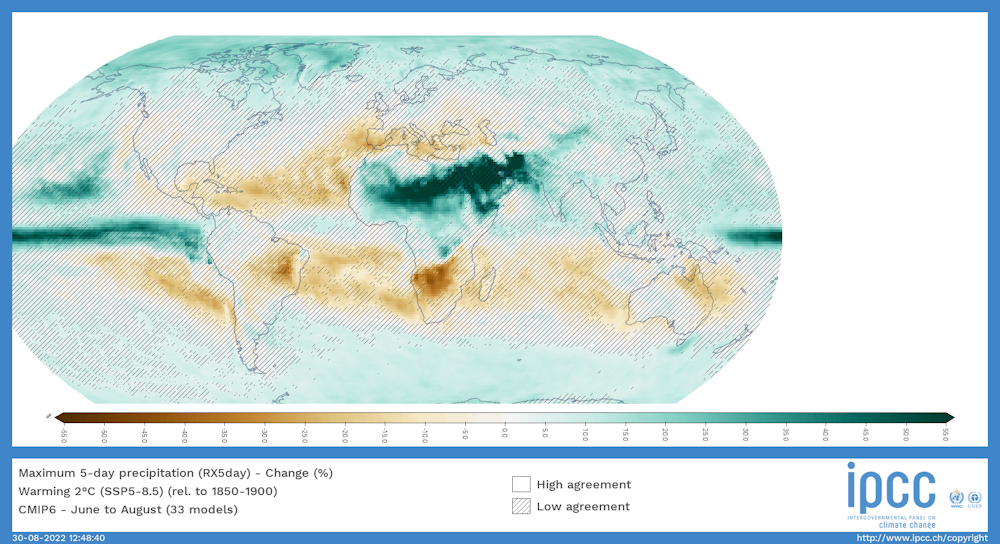 Maximum 5-day rainfall in June-August is projected to increase in Pakistan at 2°C global warming.
IPCC AR6 Interactive Atlas
Maximum 5-day rainfall in June-August is projected to increase in Pakistan at 2°C global warming.
IPCC AR6 Interactive Atlas
Read more: The world endured 2 extra heatwave days per decade since 1950 – but the worst is yet to come
Worse extremes to come
We can expect more extreme weather events in the coming years as global greenhouse gas emissions continue at near-record rates.
Scientists have been predicting worsening extreme weather events - particularly heatwaves - for decades. Now, we are seeing this happen before our eyes.
Some heat extremes in recent years have been far beyond what we thought would happen after just over 1℃ of global warming, such as western North America’s record heat of last summer. But it’s hard to tell if our projections are under-forecasting extreme heat.
In any case, the world must prepare for further possible record-shattering high temperatures in the months, years and decades to come. We need to rapidly decarbonise to limit the damage caused by future extreme events.
Read more: The UK just hit 40℃ for the first time. It's a stark reminder of the deadly heat awaiting Australia
Authors: Andrew King, Senior Lecturer in Climate Science, The University of Melbourne


 Daily Bulletin


