

Read The Times Australia

Daily Bulletin

For the first time, robots on Mars found meteorite impact craters by sensing seismic shock waves

  • Written by: Katarina Miljkovic, ARC Future Fellow, School of Earth and Planetary Sciences, Curtin University
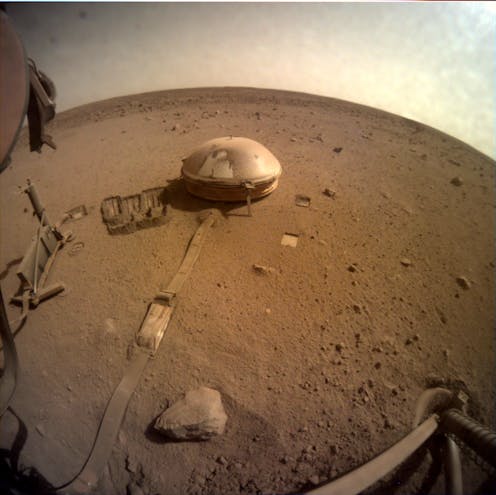
For the first time, robots on Mars found meteorite impact craters by sensing seismic shock waves

Since 2018, NASA’s InSight mission to Mars has recorded seismic waves from more than 1,300 marsquakes in its quest to probe the internal structure of the red planet. The solar panels of the car-sized robotic lander have become caked with Martian dust, and NASA scientists expect it will completely power down by the end of 2022.

Read more: First recorded 'marsquakes' reveal the red planet's rumbling guts

But the internal rumblings of our planetary neighbour aren’t the only things that InSight’s seismometers detect: they also pick up the thuds of space rocks crashing into the Martian soil.

In new research published in Nature Geoscience, we used data from InSight to detect and locate four high-speed meteoroid collisions, and then tracked down the resulting craters in satellite images from NASA’s Mars Reconnaissance Orbiter.

Rocks from space

The Solar System is full of relatively small rocks called meteoroids, and it’s common for them to collide with planets. When a meteoroid encounters a planet with an atmosphere, it heats up due to friction – and may burn up entirely before reaching the ground.

On Earth, we know these incoming meteoroids as shooting stars, or meteors: beautiful events to observe in the night sky. Sometimes a meteoroid explodes when it reaches the thicker atmosphere closer to the ground, creating a spectacular airburst.

Read more: Where do meteorites come from? We tracked hundreds of fireballs streaking through the sky to find out

Occasionally, a space rock survives its fiery path through the air and drops to the ground, where it is known as a meteorite.

A few of these meteorites hit the surface at such speed they blast a hole in the ground called an impact crater. Compared to a human lifetime, these events are very rare on Earth.

Recording space rock impacts

Scientists have detected the vibrations from meteoroid airbursts using seismic detectors numerous times, including a recent survey of bright meteors above Australia.

However, only once has a high-speed space rock crashing into the ground been observed both visually and with modern seismic equipment. This was an impact crater that formed in 2007 near the village of Carancas in Peru.

Numerous impacts were detected on the Moon by the network of seismic sensors set up during the US Apollo missions of the 1960s and ’70s. However, there was no recording of a natural impact associated with visual detection of a new crater.

Read more: The moon is still geologically active, study suggests

The closest things to such an observation were artificial impacts: the crash-landings of the booster rockets of the ascent modules that lifted Apollo astronauts off the Moon.

These human-made impacts on the Moon were recorded both in seismic data and visual imagery from orbit. These data were recently used to test simulations of how impacts produce seismic waves.

Martian meteorites

Incoming meteoroids make waves in the atmosphere and also the ground. The atmosphere of Mars is equivalent to 1% of the Earth’s, and has a different chemical composition. This means meteor events on Mars take a different form.

For meteor events large enough to drop a meteorite, the fate of the meteorite and any resulting crater is different from what we have come to expect on our home planet.
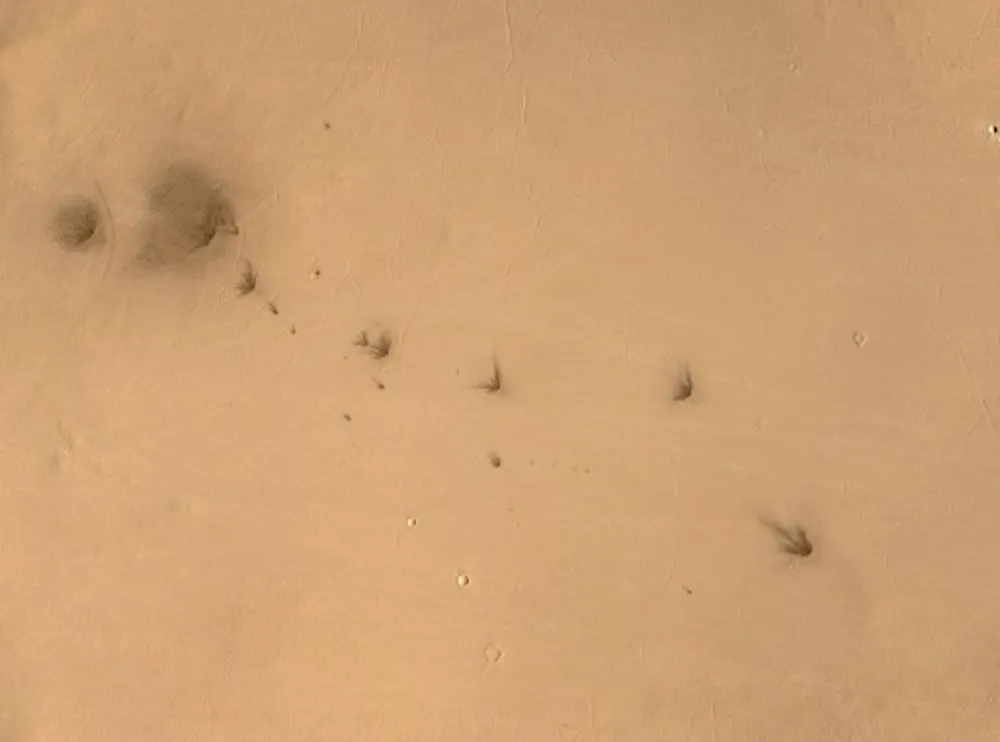
Many craters on Mars come in clusters, because meteoroids often explode into fragments not long before they hit the surface. MRO / HiRISE / NASA / JPL-Caltech / UArizona

Here on Earth, or on the Moon, single craters are the norm. On Mars, however, about half the time a high-speed space rock will burst in the atmosphere shortly before impact, resulting in a tightly grouped cluster of craters.

The separation of these individual fragments remains close at ground level, forming a cluster of small impacts.

From vibrations to craters

Recently, the InSight mission has observed acoustic and seismic waves from four meteoroid impact events. These waves travel at different speeds, and comparing their different arrival times and other properties allowed us to estimate the location of the impacts.

These impact locations were then confirmed with satellite imaging from the Mars Reconnaissance Orbiter.

A sketch of how an incoming space rock makes waves that InSight can detect and interpret. Garcia et al. / Nature Geoscience

Knowing the size and exact location of these impact craters helps us calculate the size and speed of the incoming space rock and how much energy the impact released.

Once we are confident we know something about the impact that created the seismic waves we detected, we can use the waves to learn about the interior of Mars. What’s more, when we compare seismic observations on Mars with observations from Earth and the Moon, we can learn more about how the planets formed and how the Solar System evolved.

Authors: Katarina Miljkovic, ARC Future Fellow, School of Earth and Planetary Sciences, Curtin University

Read more https://theconversation.com/for-the-first-time-robots-on-mars-found-meteorite-impact-craters-by-sensing-seismic-shock-waves-190755

Business News

How Telematics Helps Australian Companies Improve Productivity

Operating a commercial fleet in Australia is a uniquely demanding endeavour. Between the sprawling urban sprawl of cities like Sydney and Melbourne and the immense, unforgiving stretches of the Outb...

Daily Bulletin - avatar Daily Bulletin

Inside the Icon: The BridgeMuseum Officially Opens at the Sydney Harbour Bridge

A bold new way to experience one of Australia’s most recognisable landmarks has arrived, with BridgeClimb Sydney officially opening the all-new BridgeMuseum.  Located inside the Sydney Harbour Bridge...

Daily Bulletin - avatar Daily Bulletin

Is Your Brand Showing Up in AI Search? Most Melbourne Brands Aren't.

The New Front Door Nobody Told You About Something changed. Quietly. Without a press release. The way buyers find businesses in Australia has been rewired. Not replaced, rewired. Google isn't dead...

Daily Bulletin - avatar Daily Bulletin

How Australian Businesses Can Measure SEO ROI

SEO can feel vague when you are staring at a dashboard full of numbers that do not clearly connect to revenue. The key is to measure the right signals in the right order, then tie them back to outcome...

Daily Bulletin - avatar Daily Bulletin

How Commercial Roller Shutters Improve Site Security Without Slowing Operations

Security upgrades can be frustrating when they make everyday work harder. A door that takes too long to open, creates bottlenecks at shift change, or fails at the worst time can turn “better protectio...

Daily Bulletin - avatar Daily Bulletin

Why a Document Destruction Service Still Matters for Modern Businesses

Businesses generate large volumes of information every day, from staff records and contracts to invoices, reports and customer files. While attention often focuses on how documents are stored, the way...

Daily Bulletin - avatar Daily Bulletin

Bicycle Rack Safety and Space-Smart Storage

Bike storage problems usually show up as small annoyances first: tangled handlebars, scratched frames, and bikes that topple when you pull one out. Over time, those issues become safety risks, especia...

Daily Bulletin - avatar Daily Bulletin

How to Tell if a Childcare Centre Is a Good Fit for Your Child

Choosing childcare can feel like you’re making a huge decision with limited information. Tours are short, centres are often on their best behaviour, and your child might act differently in a new space...

Daily Bulletin - avatar Daily Bulletin

Car Import Timeline: What Usually Happens at Each Stage

Importing a car into Australia can feel confusing because multiple agencies and checkpoints are involved, and the timeline is shaped as much by paperwork quality as it is by shipping speed. The most u...

Daily Bulletin - avatar Daily Bulletin

The Daily Magazine

Gold Migration Lawyers in Liquidation: How the Closure Affects Your ART Appeal

If your appeal was with Gold Migration Lawyers, a recent change to how the Tribunal decides cases ...

The pressure cooker: life in urban Australia in 2026

Australian cities have always been demanding. Long commutes, rising housing costs, busy schedules a...

What Actually Makes a Good Criminal Lawyer in Melbourne

Most people only think about this question once. That is usually too late. Most people charged wi...

Why Working With A Chatswood Tutor Can Improve Academic Performance

Academic expectations continue increasing for students across primary school, high school, and senio...

Is It Worth Getting Solar Panels in Melbourne?

The real question is not whether solar works in Melbourne. It works. The question is what it is co...

How A Diploma Of Project Management Builds Practical Skills For Modern Work Environments

Developing the ability to plan, execute, and deliver outcomes efficiently is a key requirement in to...

How to Choose the Right Football for Every Level

Choosing a football may seem straightforward, but the right option depends on who will be using it a...

What to Ask a Wedding Photographer Before You Book

Booking a wedding photographer can feel deceptively simple: you like the photos, you like the vibe...

Why Stress Relief For Dogs Is Essential For Emotional Balance And Long-Term Wellbeing

Managing emotional health is just as important as physical care when it comes to pets, which is why ...