

Eliud Kipchoge broke the men's marathon record by 30 seconds. How close is the official sub-2 hour barrier now?
- Written by: Simon D Angus, Associate Professor, Department of Economics, Monash University
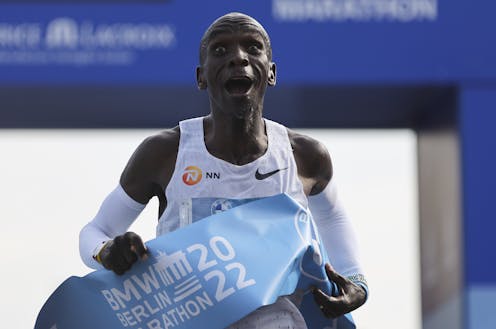
Sixty-nine seconds.
In that time, you could reheat a cuppa in the microwave or get halfway through brushing your teeth. But for Eliud Kipchoge, the greatest men’s marathoner of all time, his life’s work has come down to a cruel clutch of seconds.
After surpassing his own world record in Berlin on Sunday, 69 seconds is all that separates him from breaking the historic “sub-2” barrier – that is, completing a full marathon (42.195 kilometres) in under two hours.
Kipchoge’s new world record of 2h, 1m and 9s was an astonishing achievement, even by his own lofty standards. It was 30s faster than his previous record (also set in Berlin, in 2018) and the second-largest lowering of the world record since 2003 (Kipchoge himself has the largest margin).
Is Kipchoge well on the way to breaking the elusive sub-2 hour marathon barrier?
But wait, didn’t he already go sub-2?
First, let’s go back a step.
Back in October, 2019, Kipchoge took part in a commercial enterprise set up entirely to see him make history. Running 4.4 laps around Vienna’s Prater Hauptallee, behind a phalanx of elite distance runners set out in exquisite formation, Kipchoge kept up an alarming pace of 2m and 52s per kilometre for 42.195km.
The clock stopped to euphoric crowds and a seemingly transcendental Kipchoge; he’d smashed the sub-2 barrier with a time of 1h 59m and 40s. But as Kipchoge himself knew, an asterisk forever sits next to this time.
The International Association of Athletics Federation’s rules stipulate the event must be a sanctioned race, pacers can’t substitute in and out of the event at whim, and nutrition must be taken from stationary tables (not bikes riding next to the runner as Kipchoge did in Vienna). Each of these rules was set aside for the “historic” attempt in 2019.
You may think this is overreaching by officials. But the fact is ignoring these rules does confer an advantage. And at this end of the competition, seconds determine the whole ball game.
So for all the wonder of that day, the official record remained that which Kipchoge set in 2018 in Berlin: 2h 1m and 39s. That is, until Sunday.
Read more: Can Eliud Kipchoge run a sub-2hr marathon? It all comes down to 15 extraordinary seconds
Was the new world record ‘expected’?
Using statistical tools, we can estimate not only the average tendency for the fastest marathon time to drop over the course of history, but also the likelihood that a given time will be run on a given day.
The approach I take is to fit a mathematical model to the trend of marathon records improving over time, as shown in the figure below. I can not only make predictions (by extending the fitted trend forward), but can also calculate the likelihood of a new record appearing below the average fitted trend.
It’s here the statistics get interesting.
In one previous prediction, I calculated the official sub-2 barrier would not be broken until May 2032.
Specifically, in this scenario I assumed it would be set by a highly exceptional runner even more talented than Kipchoge. This fictional runner, let’s call them runner X, would have not only accumulated the performance gains of previous generations, but would be exceptional within their own generation too.
In likelihood terms, runner X is assumed to be a “1 in 10” runner – forever navigating the 1 in 10 likelihood line of marathon progression as shown in the figure below. Runner X improves their time and gets a little faster every week, eventually crossing the sub-2 barrier in May, 2032.
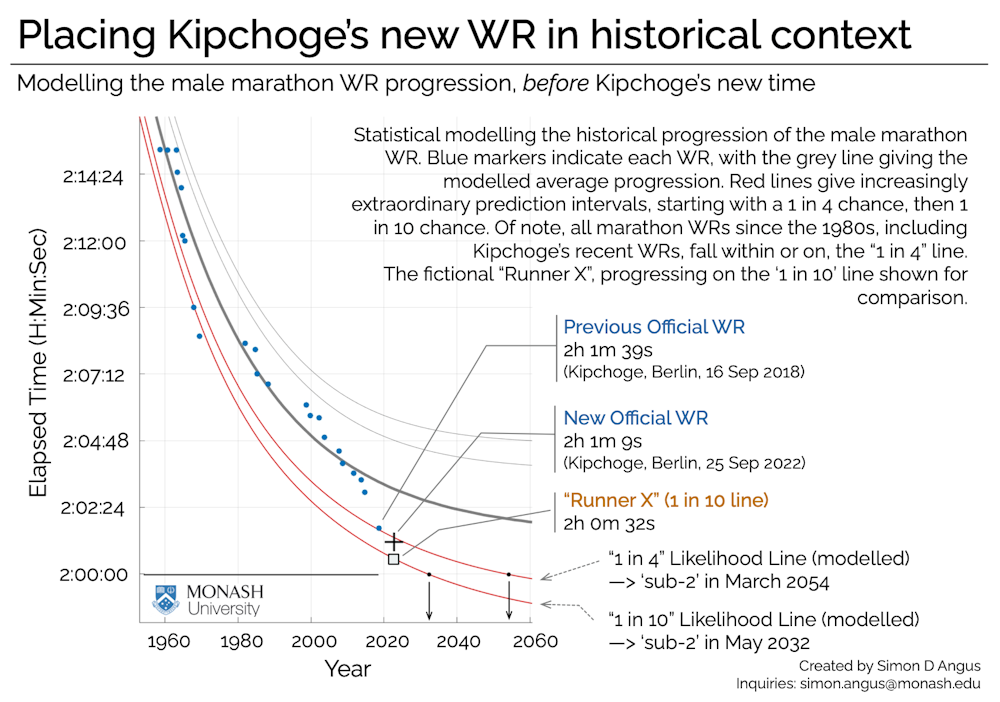
Importantly, this figure shows predictions before Kipchoge’s newest record is added to the modelling, though we place his record on the figure (as “+”) to contextualise his performance.
Based on this modelling, if runner X turned up in Berlin on Sunday they would already be skating closer to the sub-2 line than Kipchoge managed – finishing at 2h 32s or better (about 37s faster than Kipchoge). You can see this time marked as the square in the figure.
But marathoners are not robots. And the monumental cog of any grand human endeavour moves forward in exhilarating leaps, not metronomic steps.
When will we see an official sub-2?
Until now, I’ve discussed predictions based on records from before Sunday’s run. What happens if I add Kipchoge’s newest record run into the annals of records past, and let the model reassess?
Here are the results.
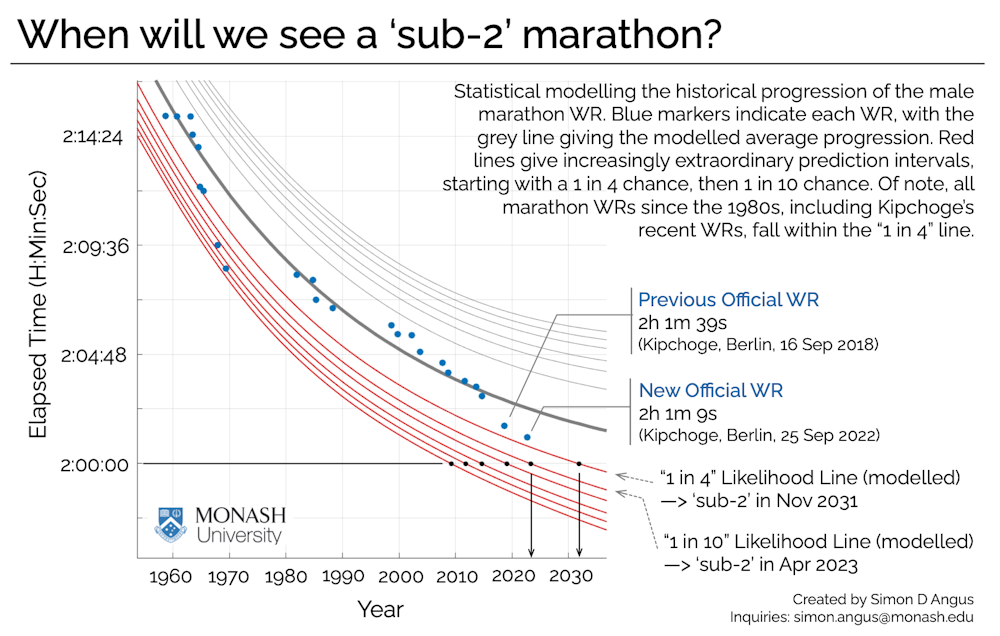 Modelling the historical male marathon WR progression.
Author created.
Modelling the historical male marathon WR progression.
Author created.
Two insights fall out of this new analysis. First, the goalposts have moved – substantially.
With Kipchoge’s new record included, runner X’s chance of breaking sub-2 has moved forward nine years from May 2032 to April 2023 – next year! A single data point has shifted the expectations significantly.
The second observation is also important. Have a look at the world records (the blue markers) in the plot and you’ll notice since the 1980s they all fall within the main alley, near the bold grey line.
This model tells us no runner has broached the 1 in 4 likelihood line in more than 40 years. Kipchoge runs near it, but even he falls closer to the average than to the “extraordinary”.
In other words, when trying to realistically predict when we might see a runner break the sub-2 barrier, perhaps we should look at when this would happen for someone like Kipchoge who runs close to the 1 in 4 line – rather than someone like runner X.
That brings us back to the important question: when would a runner of Kipchoge’s calibre break the sub-2 barrier?
Based on the current world record data, a runner as extraordinary as Kipchoge will demand the world’s patience, with an estimated time of November, 2031.
The statistics present us with a choice. Either we look to a runner in the mould of Kipchoge and expect the official sub-2 breakthrough in 2031, or we hold onto the hope of a seemingly impossible runner X to emerge and achieve this in the next 12 months.
Perhaps Kipchoge is teaching us something important: there is such a thing as extraordinary enough.
Life is full of the extraordinary. With elite marathon running, we can attempt to quantify it. In this rarefied realm Kipchoge is king, and perhaps the most extraordinary aspect of all is his unfettered joy in the running.
Read more: Kipchoge's marathon success remains a mystery: some clues from my research
Authors: Simon D Angus, Associate Professor, Department of Economics, Monash University


 Daily Bulletin


