

Read The Times Australia

Daily Bulletin

Visually striking science experiments at school can be fun, inspiring and safe – banning is not the answer

  • Written by: Nathan Kilah, Senior Lecturer in Chemistry, University of Tasmania
Visually striking science experiments at school can be fun, inspiring and safe – banning is not the answer

To a young mind, science can be magical. Perhaps you remember a visually striking or seemingly inexplicable scientific demonstration from your own youth?

A liquid spontaneously and unexpectedly changes colour. A banknote is set alight without being burnt. A column of colourful bubbles shoots into the air.

Scientists and science teachers often make use of dramatic demonstrations to capture the attention of young, impressionable minds, to inspire and to teach. But sometimes these experiments go wrong.

In September, a public display in Girona, Spain involving liquid nitrogen in large metal barrels failed, causing injuries to the presenters and the audience.

In October, a teacher and a student in the US state of Virginia were airlifted to hospital after a methanol fire demonstration caused an explosion.

And last week, a demonstration known as the “carbon snake” injured several schoolchildren in Sydney, leading to the suggestion that such experiments should be banned.

A bowl with sand and a dark curled burnt object on top
Burning sugar and baking soda produces the ‘carbon snake’, a classic demonstration of several chemical reactions. Vins Contributor/Shutterstock

Demonstrations are a valuable teaching tool

Our rapidly changing, technologically complex world benefits greatly from a scientifically informed and engaged population.

A key aspect of achieving a “science-savvy” community is inspiring our children to value and connect with science. Demonstrations can be inspirational and memorable.

They are valuable tools to link young people with science, but a careful line must be walked to balance spectacle with the expectation that school is a safe place.

Read more: Science education the key to a better public debate

Demonstrations have been used in science education for centuries, and shown to enhance education when students are actively engaged in the experiment.

Scientific demonstrations are the living embodiment of science as an observational practice: seeing is believing.

Participating in an experiment provides direct, lived experience of scientific principles in action, while also affording an element of mystery and intrigue. This intrigue can open a curiosity-driven, questioning mindset that is central to building hypotheses, understanding, and applying the scientific method.

Not just ‘scientific theatre’

For effective learning it is crucial that a demonstration is more than scientific theatre.

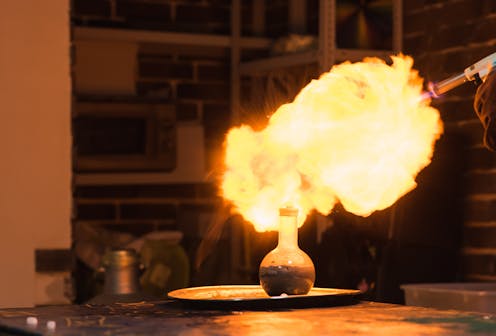
Recreating an ancient alchemical pyrotechnic based on honey gives a brilliantly violent burst of flames. On its own, this is just noise, flash and smoke. It becomes much more when discussed in the context of the origins of medicine, the development of gunpowder, the ratio of chemicals needed for optimal reaction, and the contribution of alchemy to modern science.

Video showing a plate above a bunsen burner spontaneously burst into flame
Honey, potassium nitrate, and sulphur provide a demonstration of a brilliant alchemical pyrotechnic. Author provided

However, this is also a potentially dangerous experiment, and should only be attempted by a suitably cautious chemist, with appropriate preparation and assessment of risk.

Assessing risk is an act of imagination. The worst possible outcomes must first be considered before controls are applied to make the activity as safe as possible.

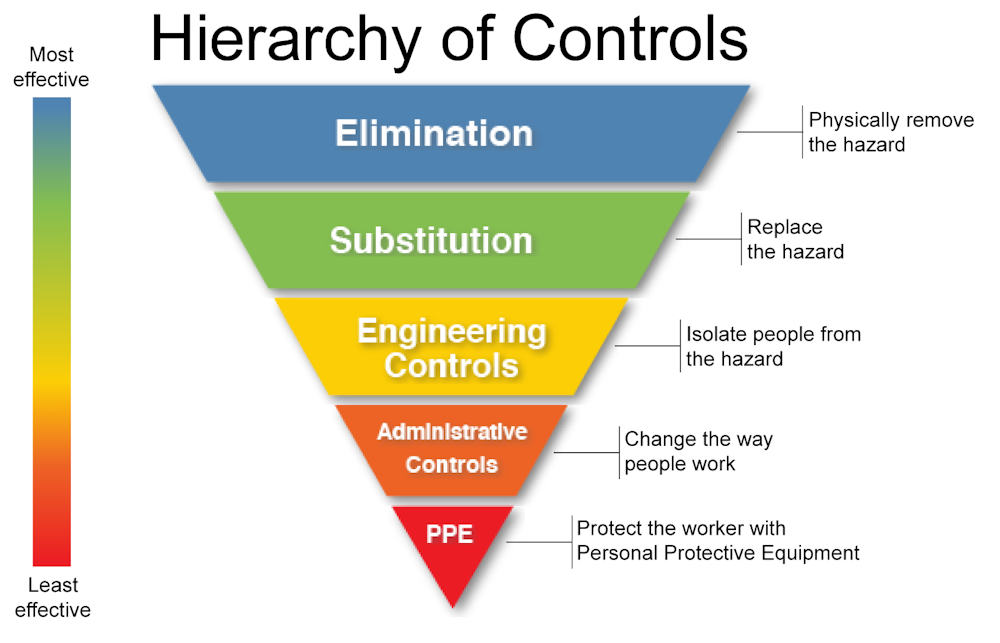
Risk assessments are typically managed through the application of the hierarchy of controls to reduce or eliminate the dangers of an activity.
A rainbow-coloured inverted pyramid listing a series of practices for safety
The hierarchy of controls as defined by the US National Institute for Occupational Safety and Health. NIOSH/Wikimedia Commons

You might be surprised to see that personal protective equipment (think lab coats, gloves and safety glasses) only come into play at the final step in this process. These are among the first things that come to mind when we think “safety”. But they are most effective only after other elements of control have been implemented before them.

Introducing some controls can be challenging, like finding a suitable substitute for a hazardous material that is uniquely suited to a particular chemical reaction.

But engineering controls, such as increasing the distance between viewer and demonstration, are simple and usually highly effective.

Once we establish the risks and have considered their likelihood and potential consequences, we can decide whether the activity is worth pursuing.

Training, not banning

Universities and professional scientific bodies have a role to play in providing training, professional development and mentoring to teachers.

This is especially important for teachers who may be teaching outside their direct area of training and who may not have the hands-on experience of experimental risk assessment or chemical handling.

In addition to workplace-specific risk-assessment processes, the American Chemical Society has many resources available for school teachers, including highly useful safety guidelines for chemical demonstrations.

These guidelines show the depth of thought and preparation required before conducting a demonstration in front of others.

Time will tell what factors were responsible for the incidents mentioned above. In the meantime, teachers should be empowered to share the wonder and visual impact of science through demonstrations to their classes.

And while failed experiments are an important part of learning how to do science, they can and must be safe.

Read more: Curious Kids: how is lava made?

Authors: Nathan Kilah, Senior Lecturer in Chemistry, University of Tasmania

Read more https://theconversation.com/visually-striking-science-experiments-at-school-can-be-fun-inspiring-and-safe-banning-is-not-the-answer-195362

Business News

Designing Eco-Friendly Custom Water Bottles for Your Next Event

The Evolution of Sustainable Event Merchandise Event planning has undergone a massive transformation over the last decade. Gone are the days when organizers could hand out cheap, single use plastic...

Daily Bulletin - avatar Daily Bulletin

Why Choosing a Professional Florist Melbourne Makes Flower Delivery Impactful

Flowers have a great power to speak when humans cannot express their feelings with right words. Flowers are the best gifts when you are celebrating a birthday or welcoming a newborn child into your fa...

Daily Bulletin - avatar Daily Bulletin

The Business Case for Choosing Australian Fabricators Over Imported Alternatives

For a long time, you might have defaulted to overseas suppliers when sourcing fabricated metal components for a project. The unit price was lower on paper, and the maths seemed straightforward. That...

Daily Bulletin - avatar Daily Bulletin

Australian organisations are relying on business continuity plans built for a far more predictable world

Tariff escalations, supply chain fragility, geopolitical events, and the ongoing threat of cyber disruption have reshaped the risk environment facing Australian organisations. The problem is that ma...

Daily Bulletin - avatar Daily Bulletin

How to Rent a Car for Uber in Melbourne: What Every New Driver Needs to Know

Starting out as an Uber driver in Melbourne is not as complicated as it sounds but getting the vehicle right is where most new drivers get stuck. Uber has strict requirements around vehicle age, condi...

Daily Bulletin - avatar Daily Bulletin

When Should You Speak to a Lawyer About a Legal Issue?

Legal issues can begin with a simple question, then become harder to manage once formal steps are involved. Many people wait until a matter feels urgent before seeking guidance, even though earlier ...

Daily Bulletin - avatar Daily Bulletin

The strategic rise of Bali as Australia’s next essential healthcare support hub

As Australian healthcare providers grapple with unprecedented operational bottlenecks, a new nearshore model is quietly transforming patient care delivery. Forward-thinking organisations,  including...

Daily Bulletin - avatar Daily Bulletin

Cost Savings and Benefits of Using Used Pallets in Logistics

In today’s competitive logistics and supply chain industry, businesses are constantly looking for ways to reduce operational costs without compromising efficiency and reliability. One of the most prac...

Daily Bulletin - avatar Daily Bulletin

How Fulfilment Services in Australia Help Businesses Scale Efficiently

The growth of e-commerce and modern retail has transformed customer expectations. Consumers now expect fast shipping, accurate order processing, and seamless delivery experiences regardless of where...

Daily Bulletin - avatar Daily Bulletin

The Daily Magazine

Top 4 Wheelchair Ramp Providers in the Boulder Area

Finding the right wheelchair ramp in Boulder will feel like a turning point. Whether you are plann...

Thermoplastic vs. Paint: The True Long-Term Cost Comparison

Line marking looks like a simple line item on a school maintenance budget, until the true cost of ...

Why Vetting Beats Volume: The Real Story Behind Australia's Growing Applicant Pools

On paper, hiring should be getting easier. Job ads across the country are pulling in more applicat...

Moving Out of a Rental in Melbourne? A Practical Moving Checklist

Moving out of a rental in Melbourne is one of those things that always feels further away than it ...

Why a Cordless Rebar Tying Machine Is a Smart Investment for Australian Construction Projects

Tying reinforcing steel by hand means spending hours bent over while making the same twisting moti...

How to Get a Document Notarised in Sydney: What to Bring, What It Costs and How Long It Takes

If an overseas bank, embassy, university, employer or land registry has asked you for a notarised ...

The 2026 Used-Car Market

For a few strange years, the used-car market rewrote its own rules. Supply shortages sent second-h...

Why CCTV Alone Is Not Enough for Modern Business Security

Cameras are usually the initial step that companies take to strengthen their physical security. If...

Why Every Workplace Should Take Emergency Preparedness Seriously

Emergency planning is one of those things many workplaces know they should think about, but it oft...