

Women and girls at risk, at the end of the world: these subversive short stories reflect our anxieties
- Written by: Ariella Van Luyn, Lecturer in Creative Writing, University of New England
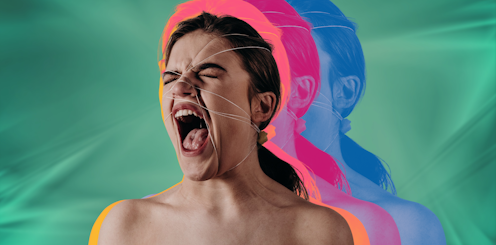
Anne Casey-Hardy’s Cautionary Tales for Excitable Girls and Else Fitzgerald’s Everything Feels like the End of the World share feminist concerns. But while both use the short-story collection to explore latent social violence and collective anxieties, they are dramatically distinct.
As a reader, writer and teacher of short fiction, I am continually fascinated by the way short fiction often lends itself to punchy imagery, emotional resonance and curious interiority. Short stories throw readers into the middle of a world – and a character’s mind.
And the curated collection, which functions as a single text, creates a shared relationship between diverse narratives.
Review: Cautionary Tales for Excitable Girls – Anne Casey-Hardy (Simon & Schuster); Everything Feels Like the End of the World – Else Fitzgerald (Allen & Unwin)
Collective traumas
The short story recognisable to many Australian readers is a relatively recent kind of writing, tied to the emergence of the magazine industry. The magazine and print culture that flourished in American, Australia and Britain in the 19th century popularised short fictive narratives.
Famously, Edgar Allen Poe, in his review of Nathaniel Hawthorne’s Twice Told Tales, defined the emerging genre as a story that can be read in one sitting. The historical period in which short fiction emerged was one of tumultuous world events: industrial revolution, world wars and resistance to colonisation.
Writers of short fiction often expressed their confusion at what must have seemed to them like the unravelling of the known world. The genre’s history is steeped in these collective traumas. Short fiction’s fragmentation, disorientation and resistance to easy resolution or reading reflects its response to trauma.

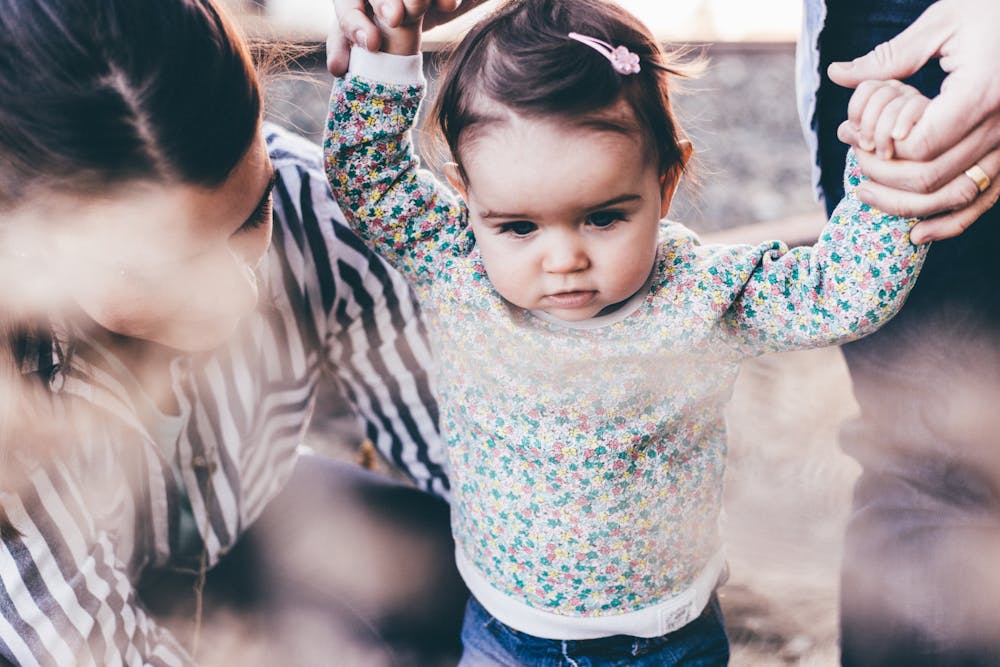 Two 14-year-old girls steal a baby in one of Anne Casey-Hardy’s stories.
Priscilla Du Preez/Unsplash, CC BY
Each story picks up and knots this thread. One story, New Year’s Eve, starts: “The boys didn’t have to lie of course but the girls did.” This line establishes the hypocrisy that means the Year 9 boys can safely party by the creek, “exactly the sort of place where things could go wrong”, while the girls who sneak away to join them are already at risk.
And the story’s body-conscious and “hopefully” lesbian narrator is doubly at risk. When, in a ghost-story tense atmosphere, a boy pretends to kill her, she can only think of her mother’s words: “what do you expect if you go down the creek at night?”
Read more:
More than half of Australians will experience trauma, most before they turn 17. We need to talk about it
Australian gothic landscapes
The latent risk of violence for the story’s characters is reinforced by the Australian gothic landscapes entangled in the narratives. Bodies of water are liminal and dangerous spaces. The creek and bank, ocean and beach, are sites of risk, confusion, vulnerability and violence.
For example, in one story, a girl goes missing at a beachside camp after leaving for a party, only for her face to be glimpsed in a car many stories later. Inner-north Melbourne’s Merri Creek is told from the perspective of a murdered ghost haunting it. (An author’s note at the end reveals it’s based on a true story.) Casey-Hardy’s evocative style stunningly renders the uncanny qualities of the polluted waterway:
the Merri comes to me like an old-school slide show. Click slide through scrubland, faded brown and jaundiced, drains pouring petrol blue chemicals into the flow, rusted car bodies half-submerged.
Yet the characters in these stories are not victims. These girls and women resist loss, violence and the threat of violence using the means available to them: imagination and deliberate disobedience.
In Literally Beside Myself, a woman mourning the loss of her baby fantasises about sex with Viking Ragnar Lothbrok. In a retold myth, When Bees Become Diamonds, Persephone herself calls on Hades to take her to the underworld and away from her demanding mother Demeter. And two sisters left in charge of their mother’s bakery while on work experience create their own “super healthy slice” and try to sell their inedible creation.
Casey-Hardy co-opts the tradition of short tales “of mystery and imagination”, for feminist purposes. Through these multiple narratives, she depicts both the hypocritical and violent expectations enforced on girls and women – and the means by which they resist them.
Read more:
Friday essay: recovering a narrative of place - stories in the time of climate change
Climate disaster and speculative fiction
In her introduction to the classic speculative fiction Left Hand of Darkness, Ursula K. Le Guin wrote that “purely extrapolative science fiction generally arrives […] somewhere between the gradual extinction of human liberty and the total extinction of terrestrial life”. But, Le Guin suggests, speculative fiction is not really about accurate predictions, but describes current social conditions. Everything Feels Like the End of the World does both.
Two 14-year-old girls steal a baby in one of Anne Casey-Hardy’s stories.
Priscilla Du Preez/Unsplash, CC BY
Each story picks up and knots this thread. One story, New Year’s Eve, starts: “The boys didn’t have to lie of course but the girls did.” This line establishes the hypocrisy that means the Year 9 boys can safely party by the creek, “exactly the sort of place where things could go wrong”, while the girls who sneak away to join them are already at risk.
And the story’s body-conscious and “hopefully” lesbian narrator is doubly at risk. When, in a ghost-story tense atmosphere, a boy pretends to kill her, she can only think of her mother’s words: “what do you expect if you go down the creek at night?”
Read more:
More than half of Australians will experience trauma, most before they turn 17. We need to talk about it
Australian gothic landscapes
The latent risk of violence for the story’s characters is reinforced by the Australian gothic landscapes entangled in the narratives. Bodies of water are liminal and dangerous spaces. The creek and bank, ocean and beach, are sites of risk, confusion, vulnerability and violence.
For example, in one story, a girl goes missing at a beachside camp after leaving for a party, only for her face to be glimpsed in a car many stories later. Inner-north Melbourne’s Merri Creek is told from the perspective of a murdered ghost haunting it. (An author’s note at the end reveals it’s based on a true story.) Casey-Hardy’s evocative style stunningly renders the uncanny qualities of the polluted waterway:
the Merri comes to me like an old-school slide show. Click slide through scrubland, faded brown and jaundiced, drains pouring petrol blue chemicals into the flow, rusted car bodies half-submerged.
Yet the characters in these stories are not victims. These girls and women resist loss, violence and the threat of violence using the means available to them: imagination and deliberate disobedience.
In Literally Beside Myself, a woman mourning the loss of her baby fantasises about sex with Viking Ragnar Lothbrok. In a retold myth, When Bees Become Diamonds, Persephone herself calls on Hades to take her to the underworld and away from her demanding mother Demeter. And two sisters left in charge of their mother’s bakery while on work experience create their own “super healthy slice” and try to sell their inedible creation.
Casey-Hardy co-opts the tradition of short tales “of mystery and imagination”, for feminist purposes. Through these multiple narratives, she depicts both the hypocritical and violent expectations enforced on girls and women – and the means by which they resist them.
Read more:
Friday essay: recovering a narrative of place - stories in the time of climate change
Climate disaster and speculative fiction
In her introduction to the classic speculative fiction Left Hand of Darkness, Ursula K. Le Guin wrote that “purely extrapolative science fiction generally arrives […] somewhere between the gradual extinction of human liberty and the total extinction of terrestrial life”. But, Le Guin suggests, speculative fiction is not really about accurate predictions, but describes current social conditions. Everything Feels Like the End of the World does both.
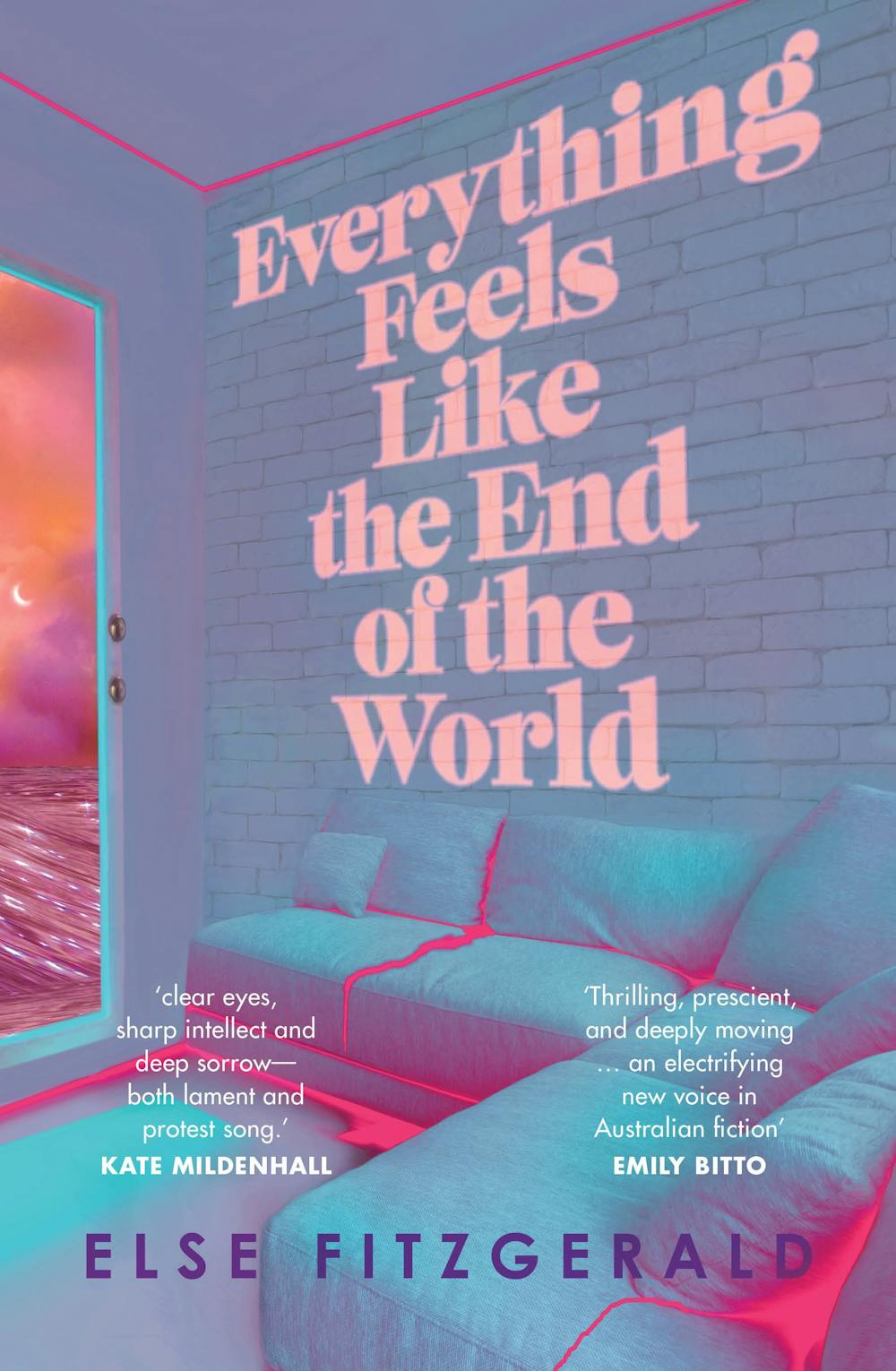 Delivering on the promise of its title – and the zeitgeist of climate disaster and global pandemic – every story in the collection offers a different vision of the end of the world. The curation of these speculative short stories gives the collection a sense of extrapolating from recognisable climate disasters to a distant future.
The stories in the early part of the collection are set in a recognisable Australia: baked dry with drought (Feather/Stone), eroded by rising seas (Dandelion, Maps) or alight with catastrophic bushfire (River). And in the title story, rising rent prices lead to housemates being evicted from their city dwelling.
Read more:
Fan of sci-fi? Psychologists have you in their sights
The collection then imagines a more distant, bleak future. One story shows us a world “After the Water Ran Out”. Another, Fibian, is set in a long-flooded Melbourne where the young children are amphibious: one is born with webbed feet to adapt.
This fictional time travel allows the reader to follow the steps of climate change to their devastating conclusion – the extinction of life. Readers feel the full weight of this loss at the collection’s conclusion: a story set in a desert world bereft of humans, populated only by artificial intelligence.
Delivering on the promise of its title – and the zeitgeist of climate disaster and global pandemic – every story in the collection offers a different vision of the end of the world. The curation of these speculative short stories gives the collection a sense of extrapolating from recognisable climate disasters to a distant future.
The stories in the early part of the collection are set in a recognisable Australia: baked dry with drought (Feather/Stone), eroded by rising seas (Dandelion, Maps) or alight with catastrophic bushfire (River). And in the title story, rising rent prices lead to housemates being evicted from their city dwelling.
Read more:
Fan of sci-fi? Psychologists have you in their sights
The collection then imagines a more distant, bleak future. One story shows us a world “After the Water Ran Out”. Another, Fibian, is set in a long-flooded Melbourne where the young children are amphibious: one is born with webbed feet to adapt.
This fictional time travel allows the reader to follow the steps of climate change to their devastating conclusion – the extinction of life. Readers feel the full weight of this loss at the collection’s conclusion: a story set in a desert world bereft of humans, populated only by artificial intelligence.
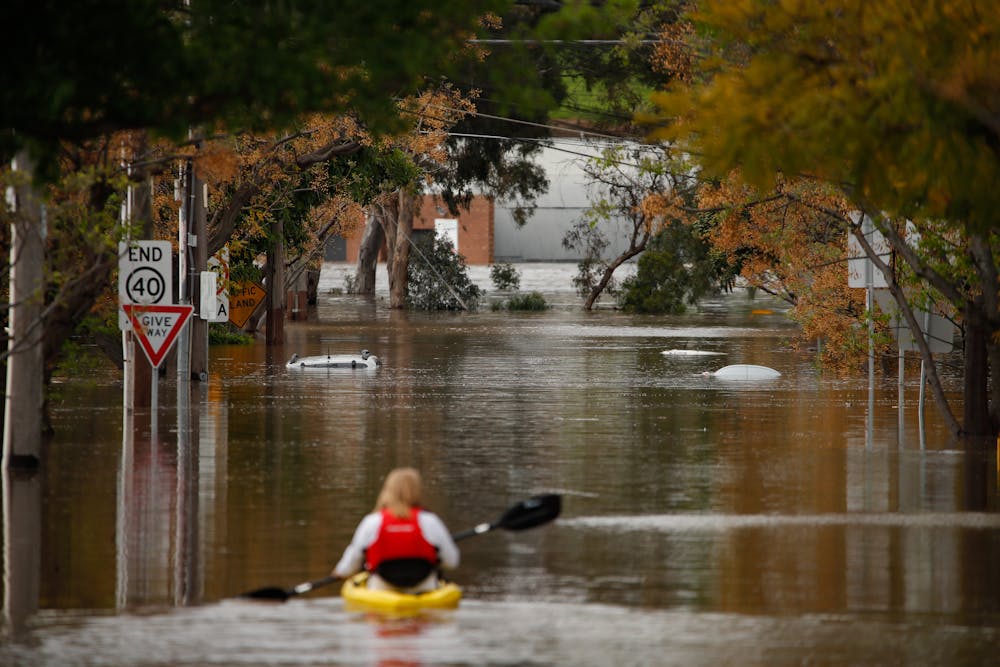 One of Else Fitzgerald’s stories is set in a long-flooded Melbourne where the young children are amphibious.
Nathan Coote/AAP
Read more:
Friday essay: the macabre metaphysic and fragmented style of Cormac McCarthy
Contemporary anxieties in futuristic settings
Short fiction is good at creating recognisable, coherent, yet contradictory characters. This means these stories are devastating, but not didactic. The multiple perspectives add up to a complex view of contemporary anxieties, projected onto the future.
The unresolvable problem of biological legacy is a central anxiety for many of these characters – who simultaneously long for, celebrate and fear the birth of children.
In Fertile Ground, Lo knows she can’t bring a baby into a world devastated by climate change. In Dandelion, Oliver is jealous at his friend’s wealth – acquired through marriage; he reminds himself he didn’t want a house with kids because of “the climate crisis” and “wanting a different kind of life”.
Gill, a mother of two, narrates “this has been our great mistake […] the drilling and fracking and mining that have mining that have destroyed the world I leave for my children” (Fracture). Yuki illegally codes a child in All the Parts, Assembled. A woman gives birth to a half-human, half genetically modified feline in Felidae. And in Sheen, even the artificial intelligence shaped most like a woman picks up a baby doll from a sand dune.
Two stories focus on inequalities associated with childbirth. In All the Parts, Assembled, childbirth is rendered so costly, it’s prohibitive. And in The Gift, it comes at the cost of another community member’s life.
Fitzgerald builds on current climate disasters and growing economic inequalities, closely tied to the threat of biological extinction. In the process, she powerfully taps into very real and present anxieties about loss, decline and displacement. Her vision is emotionally devastating – and necessary.
Yet, I wonder if we also need other ways of imagining the future. José Esteban Muñoz has argued for “queer futurity” – visions of the future need room for utopia and community beyond the genetic family.
Both new collections demonstrate how the genre of short fiction in Australia continues to evolve in response to crisis – whether that means anxieties around gender or climate change. They continue the short-story tradition of rendering trauma stylistically. Both collections are playful, startling and subversive. They are tales for our times.
Authors: Ariella Van Luyn, Lecturer in Creative Writing, University of New England
One of Else Fitzgerald’s stories is set in a long-flooded Melbourne where the young children are amphibious.
Nathan Coote/AAP
Read more:
Friday essay: the macabre metaphysic and fragmented style of Cormac McCarthy
Contemporary anxieties in futuristic settings
Short fiction is good at creating recognisable, coherent, yet contradictory characters. This means these stories are devastating, but not didactic. The multiple perspectives add up to a complex view of contemporary anxieties, projected onto the future.
The unresolvable problem of biological legacy is a central anxiety for many of these characters – who simultaneously long for, celebrate and fear the birth of children.
In Fertile Ground, Lo knows she can’t bring a baby into a world devastated by climate change. In Dandelion, Oliver is jealous at his friend’s wealth – acquired through marriage; he reminds himself he didn’t want a house with kids because of “the climate crisis” and “wanting a different kind of life”.
Gill, a mother of two, narrates “this has been our great mistake […] the drilling and fracking and mining that have mining that have destroyed the world I leave for my children” (Fracture). Yuki illegally codes a child in All the Parts, Assembled. A woman gives birth to a half-human, half genetically modified feline in Felidae. And in Sheen, even the artificial intelligence shaped most like a woman picks up a baby doll from a sand dune.
Two stories focus on inequalities associated with childbirth. In All the Parts, Assembled, childbirth is rendered so costly, it’s prohibitive. And in The Gift, it comes at the cost of another community member’s life.
Fitzgerald builds on current climate disasters and growing economic inequalities, closely tied to the threat of biological extinction. In the process, she powerfully taps into very real and present anxieties about loss, decline and displacement. Her vision is emotionally devastating – and necessary.
Yet, I wonder if we also need other ways of imagining the future. José Esteban Muñoz has argued for “queer futurity” – visions of the future need room for utopia and community beyond the genetic family.
Both new collections demonstrate how the genre of short fiction in Australia continues to evolve in response to crisis – whether that means anxieties around gender or climate change. They continue the short-story tradition of rendering trauma stylistically. Both collections are playful, startling and subversive. They are tales for our times.
Authors: Ariella Van Luyn, Lecturer in Creative Writing, University of New England


 Daily Bulletin


