

Jailing Indonesians for shark finning in Australian waters doesn't solve the real driver – poverty
- Written by: Anthony Schuyler Marinac, Lecturer, College of Business, Law and Governance, James Cook University
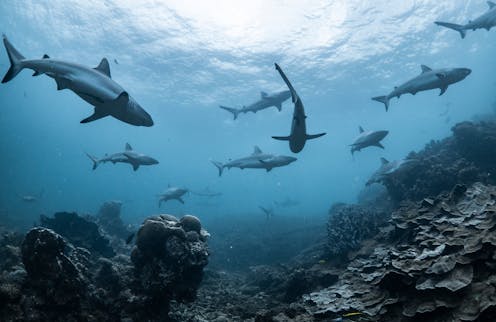
Last week, four Indonesian fishermen were convicted for taking shark fins and poaching fish in Australian waters. The four men were spotted off remote Niiwalarra/Sir Graham Moore island in the Kimberley region of Western Australia, more than 150 nautical miles inside Australia’s exclusive economic zone.
But is fining them up to A$6,000 – a huge sum for these men – likely to stop sharks being killed? Hardly. The reality is, they have no capacity to pay the sum. Instead, they’ll likely serve a month or so in jail and return to Indonesia. There, they’ll face the same problem driving them into Australian waters – poverty.
Desperate Indonesian fishers are setting out across the Arafura Sea in record numbers, with 46 fishing boats detected since June this year. Many gamble with their lives – and some have lost. Authorities have found illegal fishing camps on Niiwalarra Island, alongside shark carcasses with their fins taken.
Shark fins are sought mainly in Chinese markets for use in a high-status soup and in traditional medicine. Demand has seen wholesale slaughter of these predators, essential to the proper functioning of ocean ecosystems. We’re hardly blameless – Australia exports tonnes of shark fin each year. We have to find a better way of protecting sharks in our waters – some of the last healthy populations on the planet.
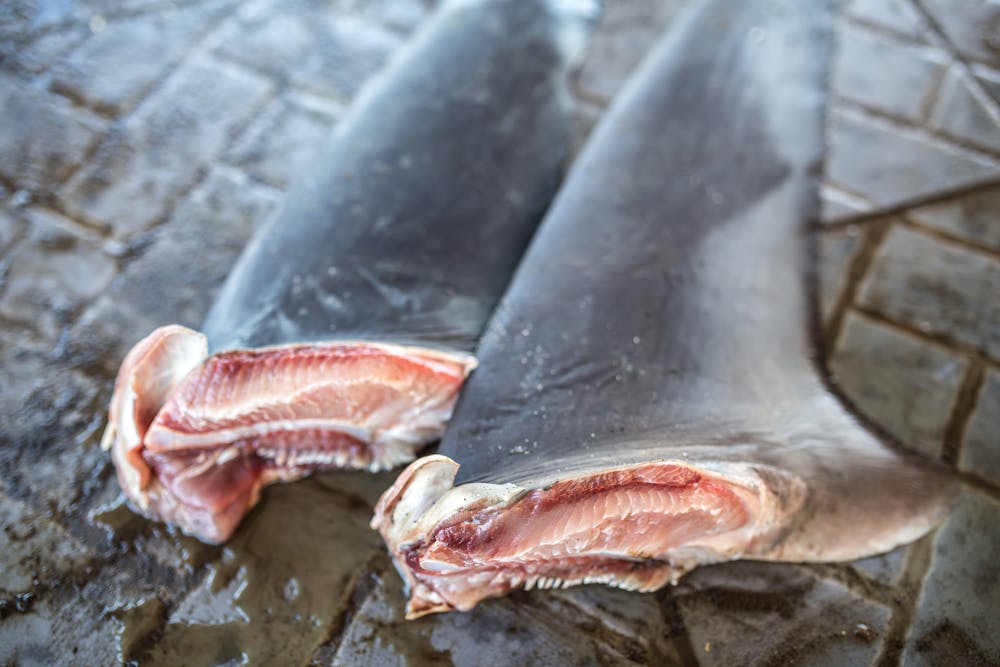
Would you risk your life for a shark fin?
While Indonesia’s economy is growing strongly, there’s a huge divide between rich and poor. The waters around its thousands of islands are fished heavily, and Indonesian fishers catch seven million tonnes a year, second only to China.
But heavy fishing means many fish stocks are now low, and tensions have risen between larger trawlers and small-scale fishers from villages. If you’re from a poor village and there’s nothing left to catch locally, where do you go?
You can admire the courage of fishers who set out in very small, barely seaworthy vessels with rudimentary fishing equipment to cross the Arafura to poach fish. In reality though, it’s a mix of courage and poverty-driven desperation. A 2018 report found fisher monthly income was roughly A$50 per month, well below the minimum wage in coastal regions.
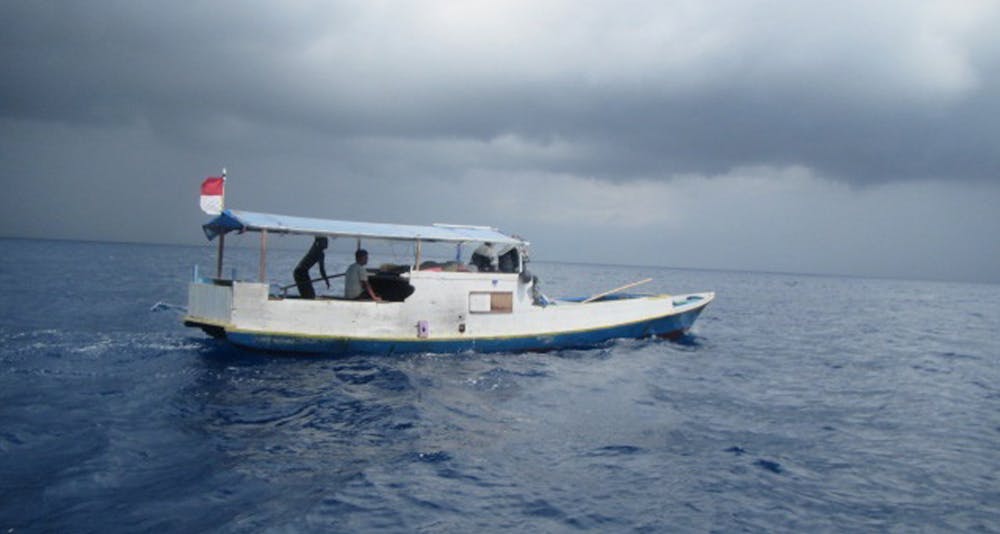 Indonesian fishers brave the crossing to fish illegally in small wooden boats like this one intercepted in 2017.
Australian Border Force/AAP
Indonesian fishers brave the crossing to fish illegally in small wooden boats like this one intercepted in 2017.
Australian Border Force/AAP
You can see the choice many face. Continue in poverty – or try to catch sharks, knowing a fin can sell for as much as a month’s wages.
Not all shark fins are the same. Particularly prized are fins from the critically endangered scalloped hammerhead shark. These sharks have fins with a high thread count, meaning they are desirably fibrous. Killing of these sharks for their fins has almost wiped out populations in parts of their range – but they’re still relatively abundant in Australian waters.
How is Australia responding?
The Australian Defence Force has a near-constant presence watching for fishers through its Operation Resolute and assisting with enforcement efforts run by Australia’s fisheries management authority.
Enforcement ranges from “educating” fishers found inside Australian waters and sending them on their way to confiscating equipment and catch to criminal charges. Australia and Indonesia regularly talk about illegal fishing. And Australia has signed up to shark protection efforts internationally.
Read more: How you can help protect sharks – and what doesn't work
Despite this, the issue is worse than ever. Last decade, an average of 20 foreign fishing boats were intercepted each year. Last financial year, it soared to a staggering 337. Sharks aren’t the only drawcard – fishers take finfish and sea cucumber too.
Why? The pandemic. Indonesia was hit hard, with tourism drying up and many people losing income. But another is that sharks are vanishing from their usual ranges. To find them, you have to go further afield.
Why are sharks still killed for their fins?
Eating shark fins is good for no one. There are no identifiable health benefits. There’s no taste you couldn’t get from eating cartilage from farm animals instead. And when you eat the fin, you’re likely to get a dangerous dose of mercury, which accumulates up the food chain.
 Shark fin soup has long been an expensive high status meal in Chinese culture, as in this 2009 photo from a Hong Kong restaurant.
BionicGrrl/Flickr, CC BY
Shark fin soup has long been an expensive high status meal in Chinese culture, as in this 2009 photo from a Hong Kong restaurant.
BionicGrrl/Flickr, CC BY
From the shark’s perspective, it’s a particularly gruesome way to die. Fins are typically cut from the shark while it’s alive. When released back to the water, it will either sink and drown, get eaten by another predator, or die from blood loss.
Sharks and their close cousins, rays, have been decimated, with populations of 18 key species falling a disastrous 70% since the 1970s. They’ve been caught as bycatch by trawlers and longliners, sought for their fins or their oily livers, or killed out of fear.
While there’s occasional good news, it is difficult to be optimistic.
Our slaughter of an estimated 100 million sharks a year is devastating for nature. Before we began killing them wholesale, shark numbers were much higher. Healthy shark populations act as a stabilising force on prey species and keeps ecosystems in balance. Tiger sharks keep seagrass beds healthy by eating the turtles which graze them.
Killing sharks can destroy other fisheries. Losing large sharks led to the end of the North Carolina scallop fishery. Without large sharks, cownose ray populations exploded, and the hungry rays ate all the scallops.
So what can we do to save our sharks from desperate fishers?
This is a wicked problem. “Education” is hardly going to stop fishers who know precisely why they’re here and what risks they’re taking, as the steep rise in illegal fishing suggests. Fines they can’t pay and the inconvenience of short prison sentences are clearly not doing the job.
You might wonder why we can’t get advance warning of fishers heading into our waters. Even modern radar struggles to spot small wooden boats across millions of square kilometres of ocean, and surveillance planes and patrol boats can’t be everywhere. Besides, until the vessels reach Australia’s exclusive economic zone, they have every right to be on the high seas.
In 2011, China launched a campaign to make shark fin soup unpopular, driving demand down 80%. But demand is still high in Hong Kong, Macau and Taiwan, and rising fast in places like Vietnam and Thailand. Wider campaigns like this are needed.
We should also help Indonesia find more sustainable ways of tending its own fisheries, and tackling coastal community poverty.
Jailing and fining fishers is a knee-jerk solution. As long as shark fin soup is on the menu and as long as we have valuable sharks, there will be fishers desperate enough to come into Australian waters to hunt them.
Read more: Crimes at sea: when we frame illegal fishers as human and drug smugglers, everyone loses
Zoe Schmidt contributed to the research basis for this article
Authors: Anthony Schuyler Marinac, Lecturer, College of Business, Law and Governance, James Cook University


 Daily Bulletin


