

Read The Times Australia

Daily Bulletin

5,700 years of sea-level change in Micronesia hint at humans arriving much earlier than we thought

  • Written by: Juliet Sefton, Assistant Lecturer, Monash University
5,700 years of sea-level change in Micronesia hint at humans arriving much earlier than we thought

Sea levels in Micronesia rose much faster over the past 5,000 years than previously thought, according to our new study published today in Proceedings of the National Academy of Sciences.

This sea-level rise is shown by the accumulation of mangrove sediments on the islands of Pohnpei and Kosrae. The finding may change how we think about when people migrated into Remote Oceania, and where they might have voyaged from.

Formidable voyagers

While recent decades saw significant advancements in linguistic, bio-anthropological and archaeological research in the region, the exact pattern and timing of human settlement of Remote Oceania is still debated.

Humans began migration into Remote Oceania – the area of the “open” Pacific Ocean east of New Guinea and the Philippines – some 3,300–3,500 years ago. This migration required formidable long-distance ocean voyaging of the likes never seen before in human history.

Read more: What wind, currents and geography tell us about how people first settled Oceania

The region of Micronesia extends many thousands of kilometres and contains thousands of low-lying atolls. Many of these atolls formed roughly 2,500 years ago when the sea level in the region stabilised close to where it is today.

Before that, the sea level might have been up to two metres higher than at present. People could only settle these atolls successfully once sea levels had lowered and stabilised.

But there are also older and higher volcanic islands in Micronesia. Across Remote Oceania, these higher islands were more desirable for settlement than low-lying atolls because they have more reliable freshwater sources, more developed soils for agriculture, and are less vulnerable to storm surges.

We looked at the published ages of settlement across the western part of Remote Oceania and found that high islands tend to show earlier ages of settlement compared to atolls, which is what we would expect. But we don’t see this pattern in Micronesia: the high islands of Pohnpei and Kosrae show settlement ages about 1,000 years later than other similar islands. Why?

Mangrove clues

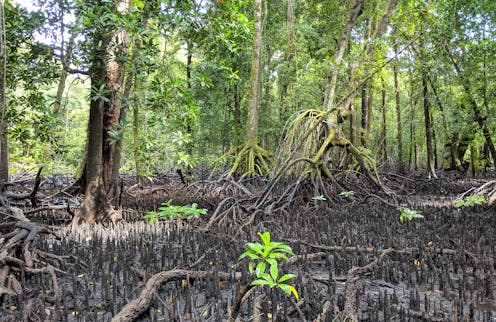
Deep within the mangrove forests of Pohnpei and Kosrae, previous researchers found mangrove sediments up to five metres deep. The only explanation for such deep mangrove sediments is sustained sea-level rise.

Mangroves live at the coast, between low tide and high tide. Therefore, as sea level rises, organic carbon and sediments accumulate beneath the mangrove forests, creating deep soils.

We visited the mangroves on Pohnpei and Kosrae and collected sediment cores to find out how old the sediments beneath them were. Our new data, as well as previous works, show that the oldest mangrove sediment is about 5,700 years old.

From this, we calculated that over the past 5,700 years, sea level rose by about four metres. The most likely cause for this rise is that the islands are sinking: the land is going down relative to the sea surface.

In our new study, we suggest this sea-level rise obscured the archaeological record on Pohnpei and Kosrae. Consequently, evidence of earlier settlement – in line with other high islands – may be submerged today.

It is possible that people settled this region of Micronesia much earlier than previously thought, which also raises questions about whether people voyaged from the west or from the south to reach these islands.

A testament to rising seas

The UNESCO World Heritage Site of Nan Madol on Pohnpei may also stand as a testament to rising seas. Nan Madol is an impressive array of abandoned megalithic buildings constructed from dark basalt columns and crushed coral.

This site has been dubbed the “Venice of the Pacific” because of the characteristic network of waterways around the buildings, resembling canals and islets.
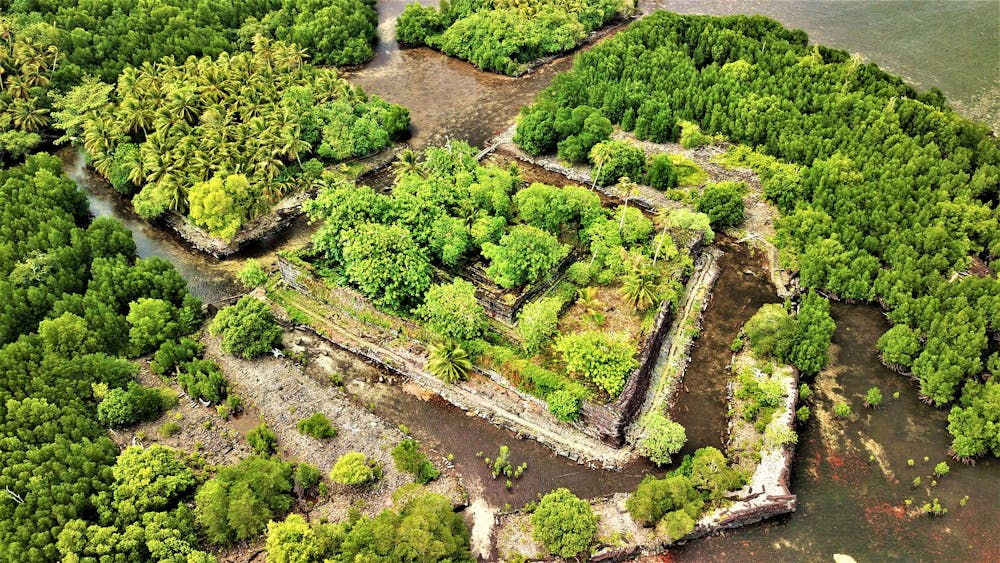
Aerial view of stone constructions topped with lush jungle greenery, with brown canal-like waterways around them
Nan Madol is characterised by waterways snaking around ancient megalithic buildings. KKvintage/Shutterstock

Our record of sea-level rise from the mangrove sediment shows that when Nan Madol was constructed (around 1180 to 1200 CE), the sea level was nearly one metre lower than it is today.

We suggest that it is unlikely Nan Madol was built with canals and islands in mind. Rather, the canals and islets are a result of sea-level rise over nearly 1,000 years.

Much like island nations today, large stone walls may have been constructed to protect the site from waves that were slowly encroaching higher and higher.

Read more: Islands lost to the waves: how rising seas washed away part of Micronesia's 19th-century history

Authors: Juliet Sefton, Assistant Lecturer, Monash University

Read more https://theconversation.com/5-700-years-of-sea-level-change-in-micronesia-hint-at-humans-arriving-much-earlier-than-we-thought-196655

Business News

How Fulfilment Services in Australia Help Businesses Scale Efficiently

The growth of e-commerce and modern retail has transformed customer expectations. Consumers now expect fast shipping, accurate order processing, and seamless delivery experiences regardless of where...

Daily Bulletin - avatar Daily Bulletin

Practical Ways Australian Workplaces Can Reduce Operating Costs

Reducing business costs doesn’t always mean cutting staff, shrinking services or making the workplace feel bare-bones. In many cases, the smarter savings are hiding in everyday operations: the light...

Daily Bulletin - avatar Daily Bulletin

Executive Recruitment Solutions That Help Organisations Secure Exceptional Leaders

Leadership has a direct impact on organisational performance, employee engagement, strategic growth, and long-term success. Businesses operating in increasingly competitive environments require experi...

Daily Bulletin - avatar Daily Bulletin

Why A WooCommerce Website Designer Matters For Online Growth

Running an online store today requires more than simply listing products and waiting for customers to arrive. Businesses need a website that is fast, reliable, easy to navigate, and designed to suppor...

Daily Bulletin - avatar Daily Bulletin

Turning Your Empty Tables into Revenue

The rise of AI demand tools in hospitality, the EatClub–CommBank partnership, and seven trends reshaping Australian dining  A growing number of Australian venues are turning to AI-powered demand ma...

Daily Bulletin - avatar Daily Bulletin

High-Impact Dental Marketing Strategies That Are Driving Real Practice Growth Today

The landscape of dental practice growth in Australia has shifted dramatically over recent years. Standard, broad-spectrum advertising campaigns no longer yield the return on investment they once did. ...

Daily Bulletin - avatar Daily Bulletin

How Telematics Helps Australian Companies Improve Productivity

Operating a commercial fleet in Australia is a uniquely demanding endeavour. Between the sprawling urban sprawl of cities like Sydney and Melbourne and the immense, unforgiving stretches of the Outb...

Daily Bulletin - avatar Daily Bulletin

Inside the Icon: The BridgeMuseum Officially Opens at the Sydney Harbour Bridge

A bold new way to experience one of Australia’s most recognisable landmarks has arrived, with BridgeClimb Sydney officially opening the all-new BridgeMuseum.  Located inside the Sydney Harbour Bridge...

Daily Bulletin - avatar Daily Bulletin

Is Your Brand Showing Up in AI Search? Most Melbourne Brands Aren't.

The New Front Door Nobody Told You About Something changed. Quietly. Without a press release. The way buyers find businesses in Australia has been rewired. Not replaced, rewired. Google isn't dead...

Daily Bulletin - avatar Daily Bulletin

The Daily Magazine

Traffic Light System Solutions For Safer And More Efficient Traffic Management

Modern cities and growing communities rely heavily on effective traffic management to ensure safety...

Gold Migration Lawyers in Liquidation: How the Closure Affects Your ART Appeal

If your appeal was with Gold Migration Lawyers, a recent change to how the Tribunal decides cases ...

The pressure cooker: life in urban Australia in 2026

Australian cities have always been demanding. Long commutes, rising housing costs, busy schedules a...

What Actually Makes a Good Criminal Lawyer in Melbourne

Most people only think about this question once. That is usually too late. Most people charged wi...

Why Working With A Chatswood Tutor Can Improve Academic Performance

Academic expectations continue increasing for students across primary school, high school, and senio...

Is It Worth Getting Solar Panels in Melbourne?

The real question is not whether solar works in Melbourne. It works. The question is what it is co...

How A Diploma Of Project Management Builds Practical Skills For Modern Work Environments

Developing the ability to plan, execute, and deliver outcomes efficiently is a key requirement in to...

How to Choose the Right Football for Every Level

Choosing a football may seem straightforward, but the right option depends on who will be using it a...

What to Ask a Wedding Photographer Before You Book

Booking a wedding photographer can feel deceptively simple: you like the photos, you like the vibe...