

What is air turbulence?
- Written by: Todd Lane, Professor, School of Geography, Earth and Atmospheric Sciences, The University of Melbourne, The University of Melbourne
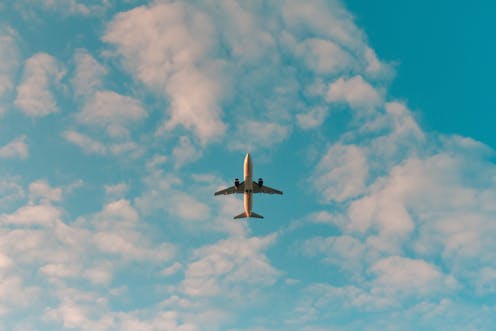
You probably know the feeling: you’re sitting on a plane, happily cruising through the sky, when suddenly the seat-belt light comes on and things get a little bumpy.
Most of the time, turbulence leads to nothing worse than momentary jitters or perhaps a spilled cup of coffee. In rare cases, passengers or flight attendants might end up with some injuries.
What’s going on here? Why are flights usually so stable, but sometimes get so unsteady?
As a meteorologist and atmospheric scientist who studies air turbulence, let me explain.
What is air turbulence?
Air turbulence is when the air starts to flow in a chaotic or random way.
At high altitudes the wind usually moves in a smooth, horizontal current called “laminar flow”. This provides ideal conditions for steady flight.
Turbulence occurs when something disrupts this smooth flow, and the air starts to move up and down as well as horizontally. When this happens, conditions can change from moment to moment and place to place.
You can think of normal flying conditions as the glassy surface of the ocean on a still day. But when a wind comes up, things get choppy, or waves form and break – that’s turbulence.
What causes air turbulence?
The kind of turbulence that affects commercial passenger flights has three main causes.
The first is thunderstorms. Inside a thunderstorm, there is strong up-and-down air movement, which makes a lot of turbulence that can spread out to the surrounding region. Thunderstorms can also create “atmospheric waves”, which travel through the surrounding air and eventually break, causing turbulence.
Fortunately, pilots can usually see thunderstorms ahead (either with the naked eye or on radar) and will make efforts to go around them.
The other common causes of turbulence create what’s typically called “clear-air turbulence”. It comes out of air that looks perfectly clear, with no clouds, so it’s harder to dodge.
The second cause of turbulence is jet streams. These are high-speed winds in the upper atmosphere, at the kind of altitudes where passenger jets fly.
While air inside the jet stream moves quite smoothly, there is often turbulence near the top and bottom of the stream. That’s because there is a big difference in air speed (called “wind shear”) between the jet stream and the air outside it. High levels of wind shear create turbulence.
The third thing that makes turbulence is mountains. As air flows over a mountain range, it creates another kind of wave – called, of course, a “mountain wave” – that disrupts air flow and can create turbulence.
Can air turbulence be avoided?
Pilots do their best to avoid air turbulence – and they’re pretty good at it!
As mentioned, thunderstorms are the easiest to fly around. For clear-air turbulence, things are a little trickier.
When pilots encounter turbulence, they will change altitude to try to avoid it. They also report the turbulence to air traffic controllers, who pass the information on to other flights in the area so they can try to avoid it.
Weather forecasting centres also provide turbulence forecasts. Based on their models of what’s happening in the atmosphere, they can predict where and when clear-air turbulence is likely to occur.
Will climate change make turbulence worse?
As the globe warms and the climate changes in coming decades, we think air turbulence will also be affected.
One reason is that the jet streams which can cause turbulence are shifting and may become more intense. As Earth’s tropical climate zones spread away from the equator, the jet streams are moving with them.
This is likely to increase turbulence on at least some flight routes. Some studies also suggest the wind shear around jet streams has become more intense.
Read more: Could climate change have played a role in the AirAsia crash?
Another reason is that the most severe thunderstorms are also likely to become more intense, partly because a warmer atmosphere can hold more water vapour. This too is likely to generate more intense turbulence.
These predictions are largely based on climate models, because it is difficult to collect the data needed to identify trends in air turbulence. These data largely come from reports by aircraft, the quality and extent of which are changing over time. These measurements are quite different from the long-term, methodically gathered data usually used to detect trends in the weather and climate.
How dangerous is air turbulence?
Around the globe, air turbulence causes hundreds of injuries each year among passengers and flight attendants on commercial aircraft. But, given the hundreds of millions of people who fly each year, those are pretty good odds.
Turbulence is usually short-lived. What’s more, modern aircraft are engineered to comfortably withstand all but the most extreme air turbulence.
And among people who are injured, the great majority are those who aren’t strapped in. So if you’re concerned, the easiest way to protect yourself is to wear your seat belt.
Read more: Here's the real reason to turn on aeroplane mode when you fly
Authors: Todd Lane, Professor, School of Geography, Earth and Atmospheric Sciences, The University of Melbourne, The University of Melbourne
Read more https://theconversation.com/what-is-air-turbulence-196872


 Daily Bulletin


