

Are Aussie pubs really filled with tiles because it's easier to wash off the pee? History has a slightly different story
- Written by: Tanja Luckins, Historian, Department of Archeology and History, La Trobe University
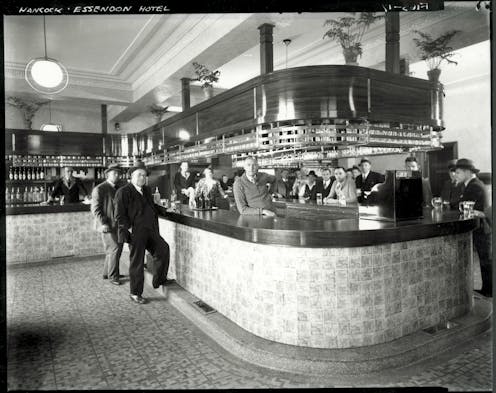
The “six o’clock swill” is one of the best known terms in Australian history. It captures the unedifying drinking habits of a 50-year period from the first world war until the 1960s, when hotel bars closed at 6pm in the south-eastern states of Australia.
Six o’clock closing legislation was impelled by wartime patriotism and austerity, and a temperance mood which aimed for the prohibition of alcohol.
You may have heard the myth that the six o'clock swill – and the excessive drinking it supported – led to the tiles which are so common in Australian pubs.
According to architectural historian J.M. Freeland in his 1966 book, after this early closing time was introduced, pubs became “no more than high-pressure drinking-houses”.
Freeland wrote about how these pubs became “disembowelled” and refurbished with tiles and linoleum to accommodate the “herds pressing for a place at the bar”.
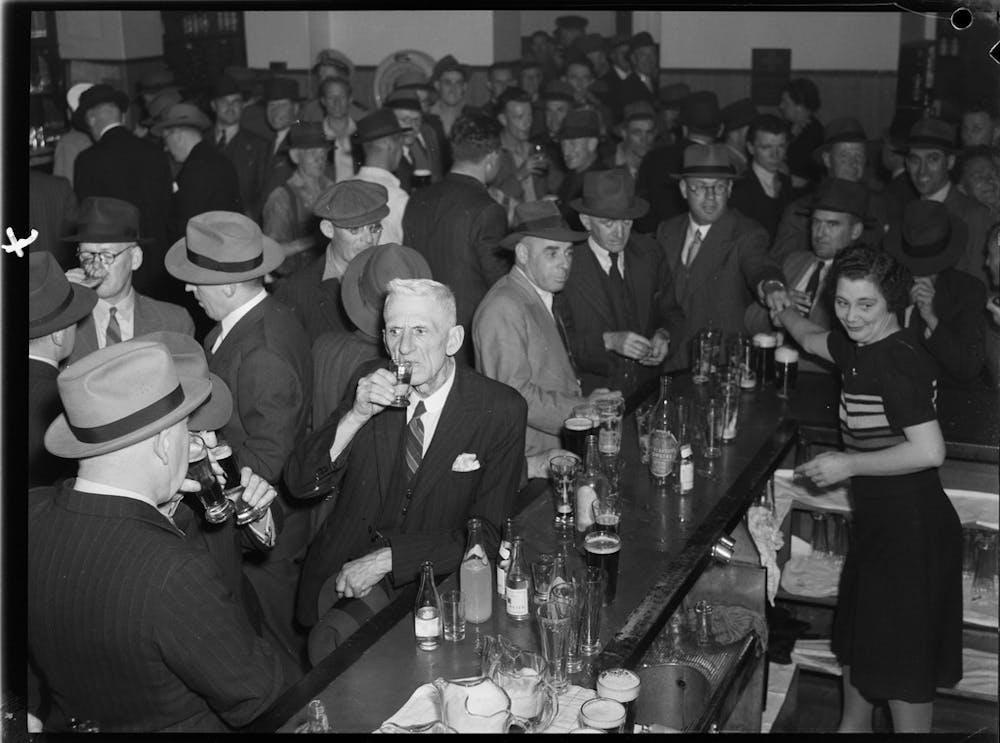
That same year, journalist Craig McGregor evocatively described:
long, slops-wet bars which men could rest an elbow on as they drank standing up, lavatory-style floors and walls so they could be hosed down when the pub closed for the night.
These men linked the tiles which had become a mainstay in Australian pubs directly to this six o'clock closing, and the need to hose them down after the swill.
But would it lessen the “Australianness” of the 20th century pub if we understood the “lavatory” tiles a little differently?
Read more: Curfews and lockouts: battles over drinking time have a long history in NSW
The moderne brewery hotel
In fact, little renovation of pubs was done in the first decade of six o’clock closing. Publicans of the time faced considerable uncertainty surrounding licensing laws, and so were reluctant to spend money on expensive structural changes.
They didn’t know if the influence of the temperance movement would increase, or if Australia would go down the path of the United States and introduce Prohibition. Local option polls in which people voted to decide if their suburb would be “wet” or “dry” also hung as a threat over publicans’ heads.
Much of the remodelling and rebuilding of pubs happened in the second half of the 1930s, as Australia came out of the Depression and cheaper materials and lower property prices encouraged investment in pubs.
Pubs which underwent major structural changes or were demolished and rebuilt were usually owned by breweries.
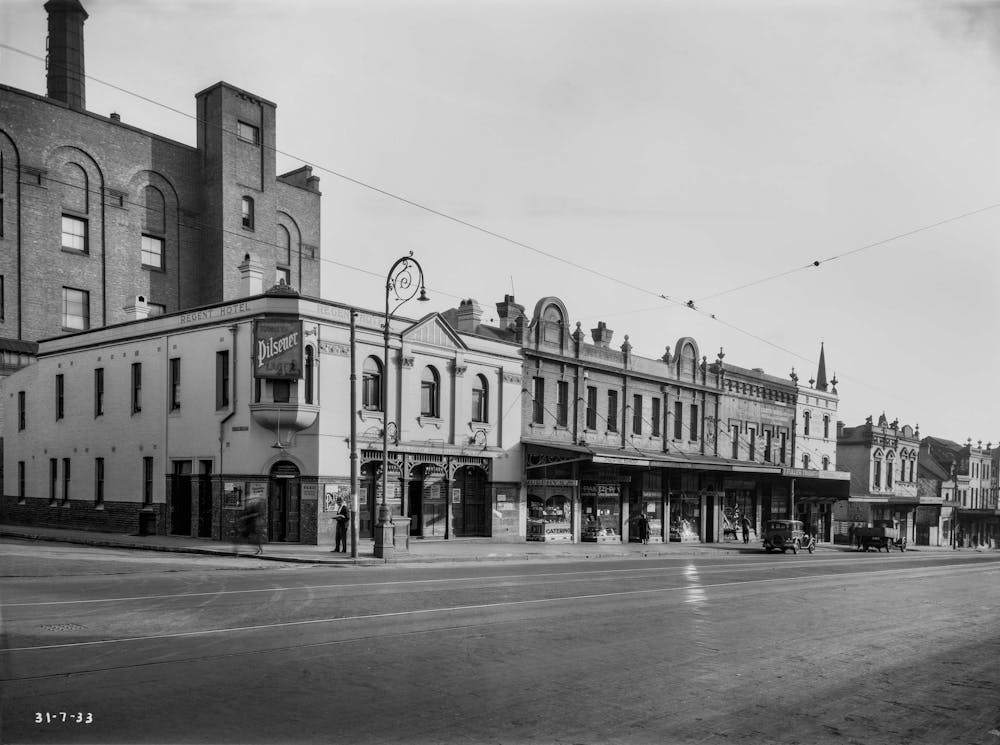 The Regent Hotel on Broadway, Sydney, in 1933 with the Tooths brewery building behind.
City of Sydney Archives
The Regent Hotel on Broadway, Sydney, in 1933 with the Tooths brewery building behind.
City of Sydney Archives
In New South Wales, where Tooheys and Tooth & Co vied for market dominance, the modernisation of their pubs was a conscious effort to woo patrons. Architectural journals like Building, Decoration and Glass and Architecture regularly featured moderne-style brewery hotels.
Pubs had always tried to keep up with modern building techniques. As the earliest wattle and daub or wooden pubs were demolished to make way for sturdier structures, many included modern features like electricity. But for every handsome hotel with lacework, pressed metal ceilings and dado tiles, there were dozens of small pubs, especially in country areas, that lacked basic amenities like running hot and cold water.
 The Commercial Hotel in Rockhampton, photographed around 1917.
John Oxley Library, State Library of Queensland. Neg 78244
The Commercial Hotel in Rockhampton, photographed around 1917.
John Oxley Library, State Library of Queensland. Neg 78244
At the same time, pubs were closely controlled through liquor licensing laws. The state-based Licensing Boards could compel a pub to renovate or, worse, force it to close.
‘The acme of cleanliness’
In the 1920s and 1930s, the boards adopted a modernising policy based on progressive reform. They targeted kitchens, bathrooms/toilets and bars, making publicans replace grimy, dusty surfaces with materials like rubber, linoleum and tiles.
Tiles were part of a broader hygiene discourse. They were not unique to pubs in the south-eastern 6pm closing states. Public buildings like swimming pools, hospitals and cafeterias used tiles. When Myer’s Emporium opened its caféteria in Adelaide in 1928, it was remarked the “spotless white-tiled walls and the electric refrigerators ensured the acme of cleanliness”.
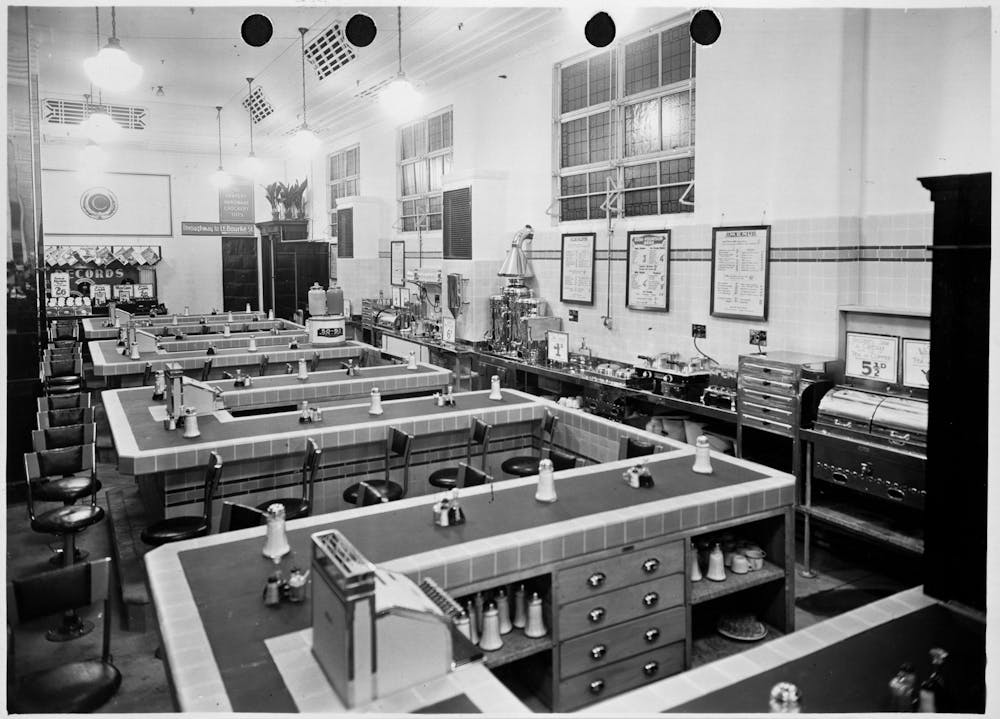 The cafeteria of the original Buckleys building of Coles Melbourne Store No. 4, 1934.
State Library Victoria
The cafeteria of the original Buckleys building of Coles Melbourne Store No. 4, 1934.
State Library Victoria
Mrs F.K. Thomas, the licensee of the Newtown Hotel, Brisbane, was commended for her judicious renovation with cream, blue and orange tiles on the exterior walls and green and deep cream tiles on the interior walls. This made for “cleanliness and hygiene”.
The Charing Cross, Sydney (1936), designed by Tooth’s architect Sidney Warden, featured cream wall tiles and tiled recesses in the public bar to replace the “old wooden mug shelf of earlier days”.
Cinemas and office buildings, like Melbourne’s landmark Nicholas Building (1926), used tiles. Sydney’s underground train stations used wall tiles throughout (like London’s Underground, New York’s subway and the Paris Metro). External tiles were also a feature of brewery pubs built around the turn of the century in Britain.
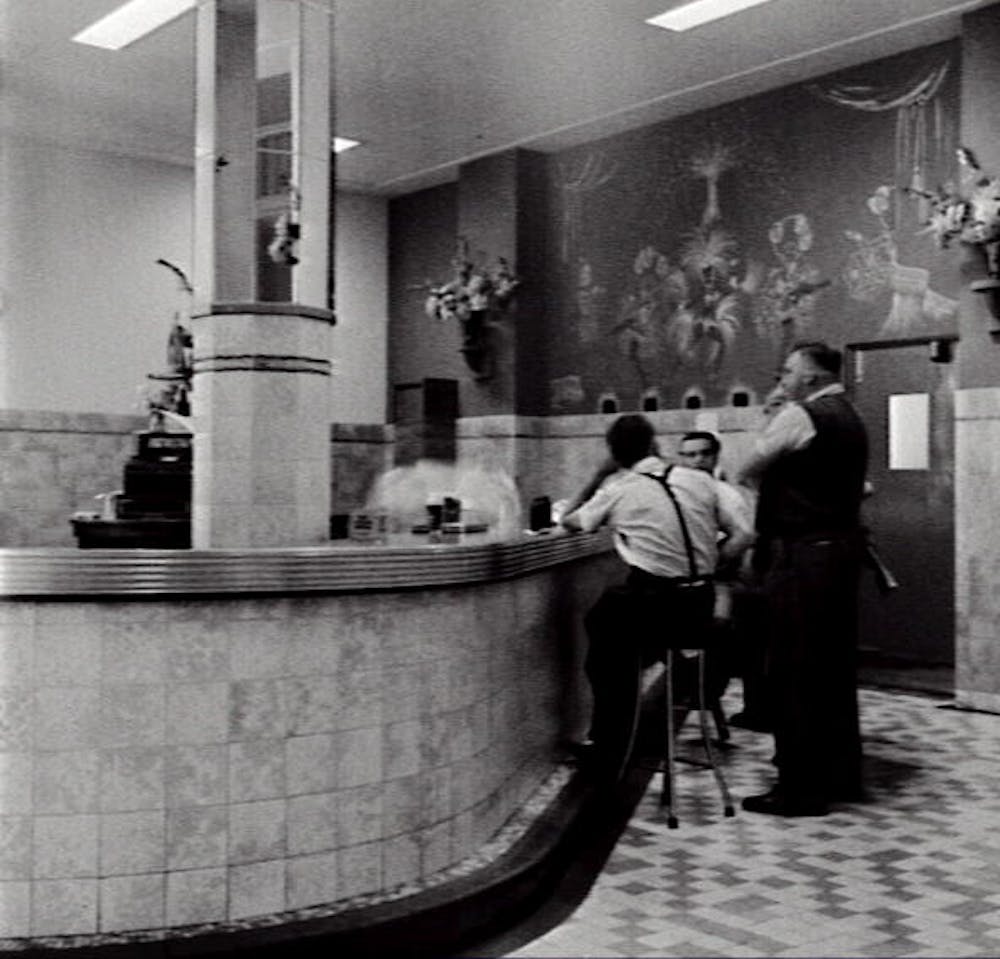 One of the bars in the Burlington Hotel, Sydney, 1953.
City of Sydney Archives, CC BY-NC-SA
One of the bars in the Burlington Hotel, Sydney, 1953.
City of Sydney Archives, CC BY-NC-SA
As tile historian Hans van Lemmen comments, tiles are not a modern architectural feature. The Ancients used terracotta, marble and ceramic tiles, while Dutch Delftware tiles were popular in Europe and the north American colonies from the 17th century onwards.
In the 19th century, industrial mass production made glazed wall tiles cheaper for both utilitarian and decorative uses. At the same time, the emerging awareness of sanitation and hygiene prompted the wider use of tiles as a way to manage germs and dirt. Tiles were easier to clean than plaster and wood. They were also more durable and colourful than traditional materials.
These days, the popular imagination might associate pub tiles with piss and vomit, even if the architectural move was more about general hygiene than the dangers of the six o'clock swill. Certainly, a pub with wall tiles was easy to clean, and breweries were keen to play-up the sparkling modernity of tiled bars.
After all, what would the swill pub have been like without tiles?
Read more: Why heritage protection is about how people use places, not just their architecture and history
Authors: Tanja Luckins, Historian, Department of Archeology and History, La Trobe University


 Daily Bulletin


