

Read The Times Australia

Daily Bulletin

Who owned this Stone Age jewellery? New forensic tools offer an unprecedented answer

  • Written by: Michelle Langley, Associate Professor of Archaeology, Griffith University
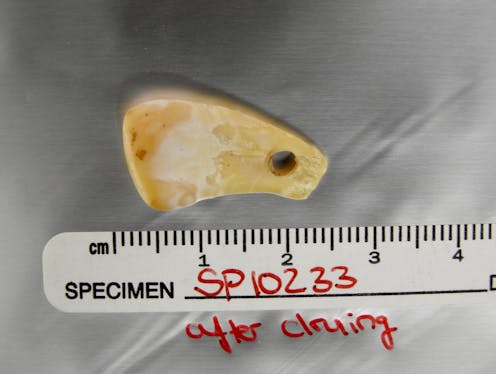
Who owned this Stone Age jewellery? New forensic tools offer an unprecedented answer

An international team of researchers has recovered DNA from the owner of a deer-tooth pendant that was buried inside a remote Siberian cave for tens of thousands of years.

In research published in Nature, Elena Essel of the Max Planck Institute for Evolutionary Anthropology in Germany and colleagues detail how they developed a new technique to extract DNA left behind on an artefact.

In much the same way police solve crimes using “touch DNA” – DNA recovered from skin cells or trace bodily fluids left behind when somebody touches an object – archaeologists will now be able to recover genetic traces of ancient humans from the artefacts they left behind.

These traces will reveal the biological sex and genetic ancestry of the individual who once held or wore a particular artefact, allowing archaeologists to link genetic and cultural evidence as they attempt to unravel the deep past.

Prehistoric artefacts and touch DNA

When archaeologists find artefacts such as tools and ornaments at a site, it’s not easy to work out who used them.

Until now, we have had to rely on finding artefacts in “direct association” with buried people. That is, we could only link an individual to an ornament if we found them buried wearing it.

Even then, this funerary association isn’t always a guide to what happened in life. The dead are buried with things their community think they should have, which may not have been theirs when they were alive.

This new method of ancient DNA extraction provides a more direct way of determining who used specific items in everyday life.
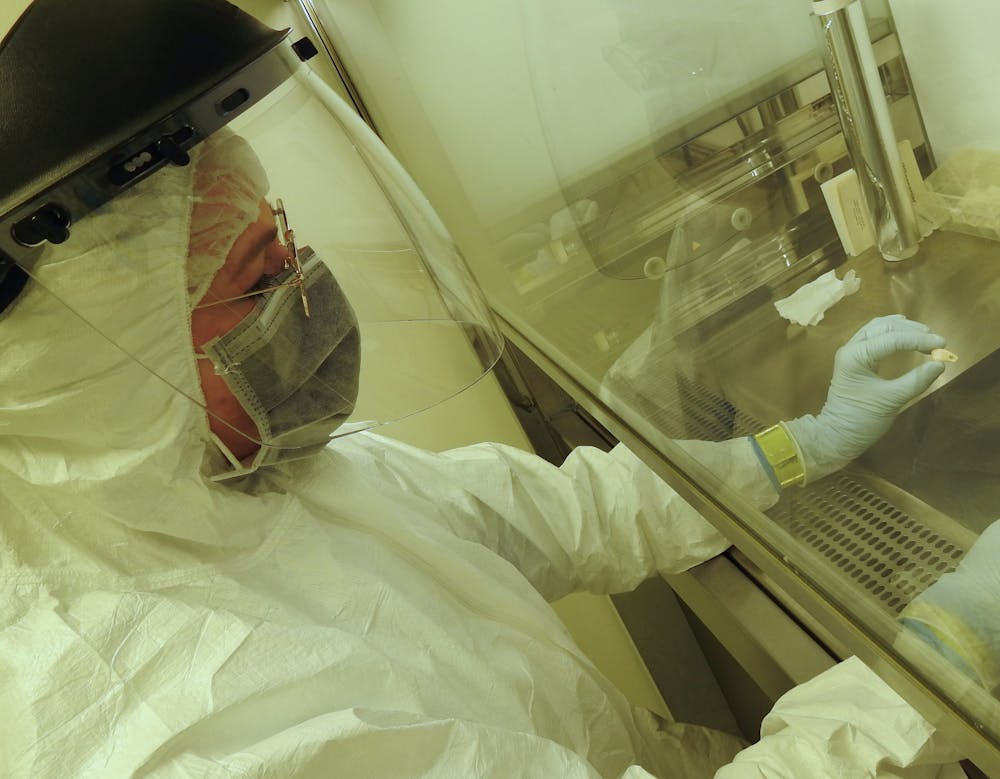
A photo of a woman in clean-room gear holding a small bone object inside a perspex box.
Elena Essel working on the pierced deer tooth discovered at Denisova Cave. Max Planck Institute for Evolutionary Anthropology

The method can only be used for artefacts made from bone or tooth as these materials are porous and can soak up human DNA from repeated contact with bodily fluids (sweat, blood, saliva). Luckily, the bones and teeth of animals (and sometimes humans) were widely used throughout the past to create everyday tools, sacred items, and personal adornment.

These osseous artefacts were held in the hand or worn against the body for extended periods, resulting in sweat and other fluids soaking into their surfaces over time. As a result, the artefact records the genetic information of the wearer.

Through experimentation with different techniques, Essel and her team found a way to recover that DNA record in a form that is intact enough to be read.

Is this yours?

Using this new method of DNA extraction, the researchers were able to extract a wealth of archaeological information from a single tooth pendant recovered from the famous archaeological site of Denisova Cave in Siberia.

The cave, tucked away in the foothills of the Altai mountains, has fascinated researchers for decades as its past inhabitants included not only Homo sapiens but also Neanderthals and another enigmatic extinct human species known as Denisovans.

A photo of the entrance to a cave in a tree-covered hill.
Over the millennia, Denisova Cave has been inhabited by Homo sapiens as well as our extinct cousins the Neanderthals and Denisovans. Richard G. Roberts

First, they were able to extract the DNA of the animal the tooth belonged to, a wapiti deer (Cervus canadensis).

They were then able to extract human DNA from the pores of the tooth and deduce that this DNA had come from a female individual whose ancestry is most similar to ancient people found further east in Siberia and with Native Americans.

They were also able to use the DNA data to estimate the date of the pendant’s creation, somewhere between 19,000 and 25,000 years ago. This date fits with previous radiocarbon dating of the layer of the cave floor sediment in which the artefact was found.

DNA found in soil, or “environmental DNA”, can also inform our understanding of who used an archaeological site such as Denisova Cave.

Without the extraction and analysis of the human DNA held in the tooth, archaeologists would have been able to tell what animal it had come from and how old it was. However, we could never have guessed the owner of this ornament. Now we can identify a specific individual.

Using the additional DNA information attached to individual artefacts, archaeologists will be able to create an understanding of past societies with a level of detail never before possible.

Read more: Dirty secrets: sediment DNA reveals a 300,000-year timeline of ancient and modern humans living in Siberia

Authors: Michelle Langley, Associate Professor of Archaeology, Griffith University

Read more https://theconversation.com/who-owned-this-stone-age-jewellery-new-forensic-tools-offer-an-unprecedented-answer-204797

Business News

How Fulfilment Services in Australia Help Businesses Scale Efficiently

The growth of e-commerce and modern retail has transformed customer expectations. Consumers now expect fast shipping, accurate order processing, and seamless delivery experiences regardless of where...

Daily Bulletin - avatar Daily Bulletin

Practical Ways Australian Workplaces Can Reduce Operating Costs

Reducing business costs doesn’t always mean cutting staff, shrinking services or making the workplace feel bare-bones. In many cases, the smarter savings are hiding in everyday operations: the light...

Daily Bulletin - avatar Daily Bulletin

Executive Recruitment Solutions That Help Organisations Secure Exceptional Leaders

Leadership has a direct impact on organisational performance, employee engagement, strategic growth, and long-term success. Businesses operating in increasingly competitive environments require experi...

Daily Bulletin - avatar Daily Bulletin

Why A WooCommerce Website Designer Matters For Online Growth

Running an online store today requires more than simply listing products and waiting for customers to arrive. Businesses need a website that is fast, reliable, easy to navigate, and designed to suppor...

Daily Bulletin - avatar Daily Bulletin

Turning Your Empty Tables into Revenue

The rise of AI demand tools in hospitality, the EatClub–CommBank partnership, and seven trends reshaping Australian dining  A growing number of Australian venues are turning to AI-powered demand ma...

Daily Bulletin - avatar Daily Bulletin

High-Impact Dental Marketing Strategies That Are Driving Real Practice Growth Today

The landscape of dental practice growth in Australia has shifted dramatically over recent years. Standard, broad-spectrum advertising campaigns no longer yield the return on investment they once did. ...

Daily Bulletin - avatar Daily Bulletin

How Telematics Helps Australian Companies Improve Productivity

Operating a commercial fleet in Australia is a uniquely demanding endeavour. Between the sprawling urban sprawl of cities like Sydney and Melbourne and the immense, unforgiving stretches of the Outb...

Daily Bulletin - avatar Daily Bulletin

Inside the Icon: The BridgeMuseum Officially Opens at the Sydney Harbour Bridge

A bold new way to experience one of Australia’s most recognisable landmarks has arrived, with BridgeClimb Sydney officially opening the all-new BridgeMuseum.  Located inside the Sydney Harbour Bridge...

Daily Bulletin - avatar Daily Bulletin

Is Your Brand Showing Up in AI Search? Most Melbourne Brands Aren't.

The New Front Door Nobody Told You About Something changed. Quietly. Without a press release. The way buyers find businesses in Australia has been rewired. Not replaced, rewired. Google isn't dead...

Daily Bulletin - avatar Daily Bulletin

The Daily Magazine

Traffic Light System Solutions For Safer And More Efficient Traffic Management

Modern cities and growing communities rely heavily on effective traffic management to ensure safety...

Gold Migration Lawyers in Liquidation: How the Closure Affects Your ART Appeal

If your appeal was with Gold Migration Lawyers, a recent change to how the Tribunal decides cases ...

The pressure cooker: life in urban Australia in 2026

Australian cities have always been demanding. Long commutes, rising housing costs, busy schedules a...

What Actually Makes a Good Criminal Lawyer in Melbourne

Most people only think about this question once. That is usually too late. Most people charged wi...

Why Working With A Chatswood Tutor Can Improve Academic Performance

Academic expectations continue increasing for students across primary school, high school, and senio...

Is It Worth Getting Solar Panels in Melbourne?

The real question is not whether solar works in Melbourne. It works. The question is what it is co...

How A Diploma Of Project Management Builds Practical Skills For Modern Work Environments

Developing the ability to plan, execute, and deliver outcomes efficiently is a key requirement in to...

How to Choose the Right Football for Every Level

Choosing a football may seem straightforward, but the right option depends on who will be using it a...

What to Ask a Wedding Photographer Before You Book

Booking a wedding photographer can feel deceptively simple: you like the photos, you like the vibe...