

Read The Times Australia

Daily Bulletin

People are complaining about Mercury in retrograde. But what does it actually mean?

  • Written by: Laura Nicole Driessen, Postdoctoral researcher in radio astronomy, University of Sydney
People are complaining about Mercury in retrograde. But what does it actually mean?

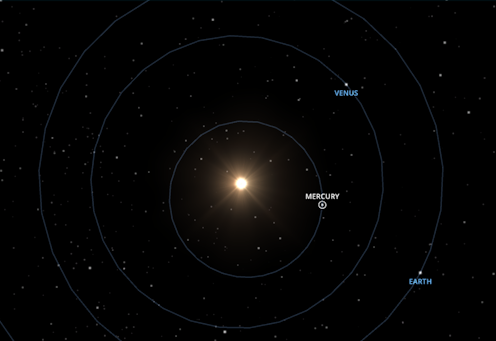
Mercury is the closest planet to the Sun, whipping around our star every 88 days compared to Earth’s 365.25 days. Mercury will also be the first planet destroyed when the Sun expands on its way to becoming a red giant in about 5 billion years.

So it seems a bit rough that we blame Mercury for all our problems three to four times a year when it’s in retrograde. But what does it mean when we say Mercury is “in retrograde”?

An image of Mercury - a partially obscured dark grey sphere with lots of texture created by many craters on its surface, on a black background
Image of Mercury from MESSENGER’s Wide Angle Camera. NASA/Johns Hopkins University Applied Physics Laboratory/Carnegie

A matter of orbits

Retrograde motion means a planet is moving in the opposite direction to normal around the Sun. However, the planets never actually change direction. What we are talking about is apparent retrograde motion, when to us on Earth it looks like a planet is moving across the sky in the opposite direction to its usual movement.

Because Mercury is closest to the Sun and has the fastest orbit, it appears to move backwards in the sky more often than any other planet.

Let’s use my dog Astro to help explain what’s happening when we see a planet in retrograde. Astro is a whippet, or a mini-greyhound, and he has a need for speed. If I take Astro for a run on my local cricket oval, he does super-speed laps on the inside while I run much more slowly around the outside.

If we’re both going anti-clockwise around the cricket pitch, when Astro is on the opposite side of the oval to me it looks like he’s going left while I’m jogging right. But when he gets to the same side of the oval as me, it suddenly looks like he’s running right instead of left (retrograde).

This happens because Astro is going much faster than me, and is inside my “orbit” of the oval.

Diagram of me (Laura) and Astro running around the oval, from my point of view. At the top we can see the top-down view of the oval. At the bottom we can see the side-on view. From my point of view it looks like Astro is running right-to-left when he’s on the opposite side of the oval to me, but it looks like he’s running left-to-right when he’s on the same side of the oval to me. Laura Driessen (author provided)

Because Mercury’s orbit is inside Earth’s orbit, seeing it from our planet is like me watching Astro run.

But Mercury isn’t the only planet to do this. Venus also orbits inside our orbit of the Sun, zipping around once every 224.7 days. This means Venus is in retrograde twice every three years.

Diagram of the concentric rings around the Sun showing the orbits of all the planets (and Pluto).
Diagram of the orbits of the planets (and dwarf planet Pluto) in the Solar System. The dwarf planet Ceres orbits between Mars and Jupiter. NASA Space Place

The other retrograde

It works the other way around, too. The planets outside our orbit (Mars, Jupiter, Saturn, Uranus, and Neptune) also go into retrograde.

To work this out, we need to swap our perspective. Astro is definitely not a deep thinker, but let’s imagine for a moment that he is and think about what he sees as he runs around the oval.

He’s running around the oval and he starts catching me up from behind. At this moment it seems like we’re both going the same direction, to the right. But as he starts to pass me, it seems like I’m going backwards or left (retrograde) while he continues to run forwards to the right.

This is what happens when we look up at the sky and see one of the outer planets in retrograde.

Mars is in retrograde once every two years. The other planets are so far from the Sun and travelling so slowly compared to Earth that it’s almost like they’re standing still. So we see them in retrograde approximately once a year as we whip around the Sun so much faster than they do.

Artist's impression of retrograde motion from Astro the whippet's perspective.
Diagram of me (Laura) and Astro running around the oval, this time from Astro’s perspective. At the top we can see the top-down view of the oval. At the bottom we can see the side-on view. From Astro’s view, it appears that I’m going backwards as he overtakes me. Laura Driessen (author provided)

A well-known illusion

Retrograde motion bamboozled ancient astronomers since humans started looking up in space, and we only officially figured it out when Copernicus proposed in 1543 that the planets are orbiting the Sun (though he wasn’t the first astronomer to propose this heliocentric model).

Before Copernicus, many astronomers thought Earth was the centre of the universe and the planets were spinning around us. Astronomers like Apollonius around 300 BCE saw the planets going backwards, and explained this by adding more circles called epicycles.

So, humans found out retrograde motion was an optical illusion 500 years ago. However, the pseudoscientific practice of astrology continues to ascribe a deeper meaning to this illusion.

Diagram with coloured lines spanning the dates in 2023 that each planet is in retrograde.
Diagram of the dates in 2023 that each planet (and the two dwarf planets Pluto and Ceres) will be in retrograde. Laura Driessen (author provided)

There’s a retrograde most of the time

If we consider the seven planets other than Earth, at least one planet is in retrograde for 244 days of 2023 – that’s around two-thirds of the year.

A white dog with a brown patch over his eye is wearing a yellow jacket and sitting in from of a dam
Astro the whippet thinking about all the possums he’s going to bark at later. Laura Driessen (author provided)

If we include the dwarf planets Pluto and Ceres (and exclude the other seven dwarf planets in the Solar System), at least one planet or dwarf planet is in retrograde for 354 days of 2023, leaving only 11 days without any retrograde motion.

I like to think the biggest impact the planets have on Earth is bringing wonder and joy every time we turn our eyes (and our telescopes) to the night sky. Astro, on the other hand, is happy as long as he gets to run around the oval and bark at possums.

Read more: From platypus to parsecs and milliCrab: why do astronomers use such weird units?

Authors: Laura Nicole Driessen, Postdoctoral researcher in radio astronomy, University of Sydney

Read more https://theconversation.com/people-are-complaining-about-mercury-in-retrograde-but-what-does-it-actually-mean-205032

Business News

How Fulfilment Services in Australia Help Businesses Scale Efficiently

The growth of e-commerce and modern retail has transformed customer expectations. Consumers now expect fast shipping, accurate order processing, and seamless delivery experiences regardless of where...

Daily Bulletin - avatar Daily Bulletin

Practical Ways Australian Workplaces Can Reduce Operating Costs

Reducing business costs doesn’t always mean cutting staff, shrinking services or making the workplace feel bare-bones. In many cases, the smarter savings are hiding in everyday operations: the light...

Daily Bulletin - avatar Daily Bulletin

Executive Recruitment Solutions That Help Organisations Secure Exceptional Leaders

Leadership has a direct impact on organisational performance, employee engagement, strategic growth, and long-term success. Businesses operating in increasingly competitive environments require experi...

Daily Bulletin - avatar Daily Bulletin

Why A WooCommerce Website Designer Matters For Online Growth

Running an online store today requires more than simply listing products and waiting for customers to arrive. Businesses need a website that is fast, reliable, easy to navigate, and designed to suppor...

Daily Bulletin - avatar Daily Bulletin

Turning Your Empty Tables into Revenue

The rise of AI demand tools in hospitality, the EatClub–CommBank partnership, and seven trends reshaping Australian dining  A growing number of Australian venues are turning to AI-powered demand ma...

Daily Bulletin - avatar Daily Bulletin

High-Impact Dental Marketing Strategies That Are Driving Real Practice Growth Today

The landscape of dental practice growth in Australia has shifted dramatically over recent years. Standard, broad-spectrum advertising campaigns no longer yield the return on investment they once did. ...

Daily Bulletin - avatar Daily Bulletin

How Telematics Helps Australian Companies Improve Productivity

Operating a commercial fleet in Australia is a uniquely demanding endeavour. Between the sprawling urban sprawl of cities like Sydney and Melbourne and the immense, unforgiving stretches of the Outb...

Daily Bulletin - avatar Daily Bulletin

Inside the Icon: The BridgeMuseum Officially Opens at the Sydney Harbour Bridge

A bold new way to experience one of Australia’s most recognisable landmarks has arrived, with BridgeClimb Sydney officially opening the all-new BridgeMuseum.  Located inside the Sydney Harbour Bridge...

Daily Bulletin - avatar Daily Bulletin

Is Your Brand Showing Up in AI Search? Most Melbourne Brands Aren't.

The New Front Door Nobody Told You About Something changed. Quietly. Without a press release. The way buyers find businesses in Australia has been rewired. Not replaced, rewired. Google isn't dead...

Daily Bulletin - avatar Daily Bulletin

The Daily Magazine

Traffic Light System Solutions For Safer And More Efficient Traffic Management

Modern cities and growing communities rely heavily on effective traffic management to ensure safety...

Gold Migration Lawyers in Liquidation: How the Closure Affects Your ART Appeal

If your appeal was with Gold Migration Lawyers, a recent change to how the Tribunal decides cases ...

The pressure cooker: life in urban Australia in 2026

Australian cities have always been demanding. Long commutes, rising housing costs, busy schedules a...

What Actually Makes a Good Criminal Lawyer in Melbourne

Most people only think about this question once. That is usually too late. Most people charged wi...

Why Working With A Chatswood Tutor Can Improve Academic Performance

Academic expectations continue increasing for students across primary school, high school, and senio...

Is It Worth Getting Solar Panels in Melbourne?

The real question is not whether solar works in Melbourne. It works. The question is what it is co...

How A Diploma Of Project Management Builds Practical Skills For Modern Work Environments

Developing the ability to plan, execute, and deliver outcomes efficiently is a key requirement in to...

How to Choose the Right Football for Every Level

Choosing a football may seem straightforward, but the right option depends on who will be using it a...

What to Ask a Wedding Photographer Before You Book

Booking a wedding photographer can feel deceptively simple: you like the photos, you like the vibe...