

How fast is the Universe really expanding? Multiple views of an exploding star raise new questions
- Written by: Brad E Tucker, Astrophysicist, Australian National University
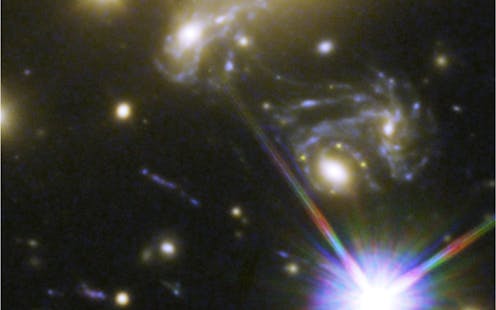
How did we get here? Where are we going? And how long will it take? These questions are as old as humanity itself, and, if they’ve already been asked by other species elsewhere in the Universe, potentially very much older than that.
They are also some of the fundamental questions we are trying to answer in the study of the Universe, called cosmology. One cosmological conundrum is how fast the Universe is expanding, which is measured by a number called the Hubble constant. And there is quite a bit of tension around it.
In two new papers led by my colleague Patrick Kelly at the University of Minnesota, we have successfully used a new technique – involving light from an exploding star that arrived at Earth via multiple winding routes through the expanding Universe – to measure the Hubble constant. The papers are published in Science and The Astrophysical Journal.
And if our results don’t quite resolve the tension, they do give us another clue – and more questions to ask.
Standard candles and the expanding Universe
We have known since the 1920s that the Universe is expanding.
Around 1908, US astronomer Henrietta Leavitt found a way to measure the intrinsic brightness of a kind of star called a Cepheid variable – not how bright they appear from Earth, which depends on distance and other factors, but how bright they really are. Cepheids grow brighter and dimmer in a regular cycle, and Leavitt showed the intrinsic brightness was related to the length of this cycle.
Leavitt’s Law, as it is now called, lets scientists use Cepheids as “standard candles”: objects whose intrinsic brightness is known, and therefore, whose distance can be calculated.
How does this work? Imagine it is night, and you are standing on a long, dark street with only a few light poles going down the road. Now imagine every light pole has the same type of light bulb, with the same power. You’ll notice the distant ones appear fainter than the nearby ones.
We know that light fades proportionately to its distance, in something called the inverse-square law for light. Now, if you can measure how bright each light appears to you, and if you already know how bright it should be, you can then figure out how far away each light pole is.
In 1929, another US astronomer, Edwin Hubble, was able to find a number of these Cepheid stars in other galaxies and measure their distance – and from those distances and other measurements, he could determine that the Universe was expanding.
Different methods give different results
This standard candle method is a powerful one, allowing us to measure the vast Universe. We are always looking for different candles that can be better measured, and seen at much greater distances.
Some recent efforts to measure the Universe further from Earth, like the SH0ES project I was a part of, led by Nobel laureate Adam Riess, have used Cepheids alongside a type of exploding star called a Type Ia supernova, which can also be used as a standard candle.
There are also other methods to measure Hubble’s constant, such as one that uses the cosmic microwave background – relic light or radiation that began to travel through the Universe shortly after the Big Bang.
The problem is that these two measurements, one nearby using supernovae and Cepheids, and one much farther away using the microwave background, differ by nearly 10%. Astronomers call this difference the Hubble tension, and have been looking for new measurement techniques to resolve it.
A new method: gravitational lensing
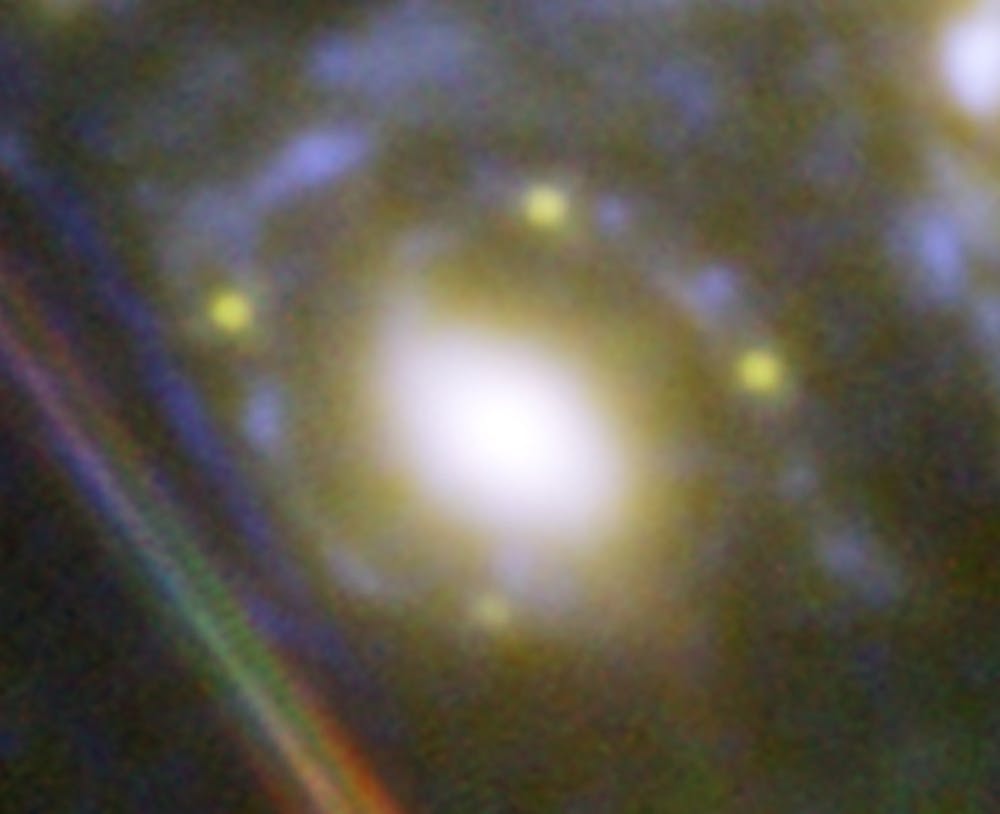
In our new work, we have successfully used a new technique to measure this expansion rate of the Universe. The work is based on a supernova called Supernova Refsdal.
In 2014, our team spotted multiple images of the same supernova – the first time such a “lensed” supernova had been observed. Instead of the Hubble Space Telescope seeing one supernova, we saw five!
How does this happen? The light from the supernova went out in all directions, but it travelled through space warped by the enormous gravitational fields of a huge cluster of galaxies, which bent some of the light’s path in such a way that it ended up coming to Earth via multiple routes. Each appearance of the supernova had reached us along a different path through the Universe.
Imagine three trains leaving the same station at the same time. However, one goes directly to the next station, the other makes a wide trip through the mountains, and another via the coast. They all leave and arrive at the same stations, but take different trips and so while they leave at the same time, they will arrive at different times.
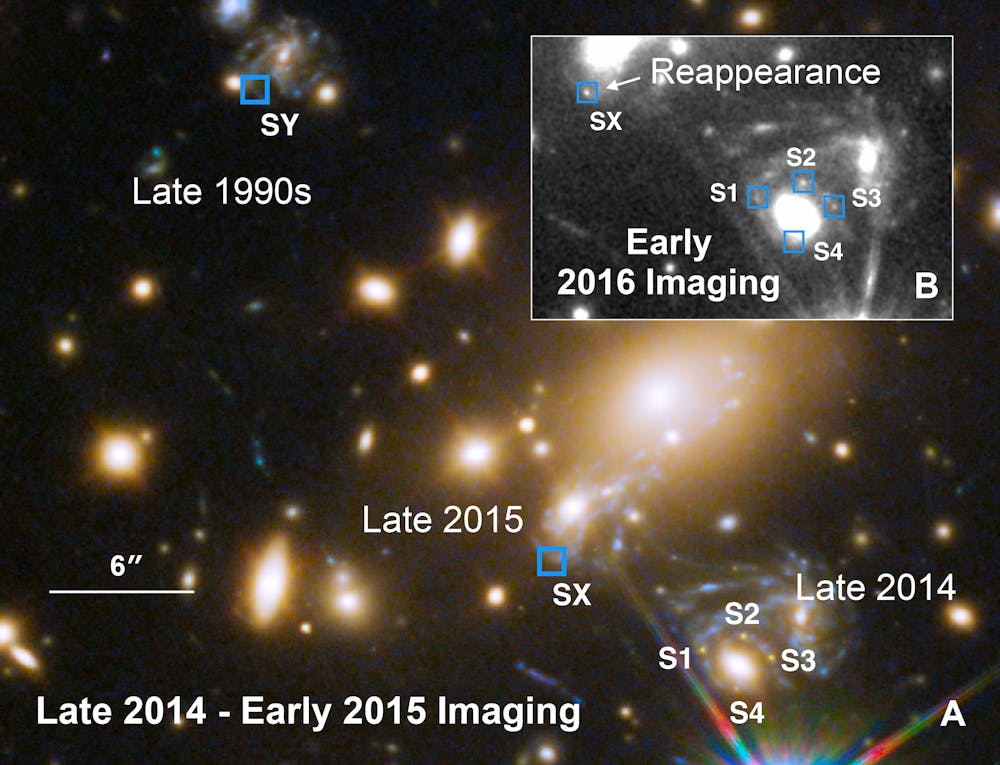 Multiple views of a single supernova – spread across time and space – allowed scientists to measure how fast the Universe is expanding.
P.L. Kelly et al., Science 10.1126/science.abh1322 (2023), Author provided
Multiple views of a single supernova – spread across time and space – allowed scientists to measure how fast the Universe is expanding.
P.L. Kelly et al., Science 10.1126/science.abh1322 (2023), Author provided
So our lensed images show the same supernova, that exploded at one certain point in time, but each image has travelled a different path. By looking at the arrival at Earth of each appearance of the supernova – one of which happened in 2015, after the exploding star had been spotted already – we were able to measure their travel time, and therefore how much the Universe had grown while the image was in transit.
Are we there yet?
This gave us a different, but unique measurement of the growth of the Universe. In the papers, we find this measurement is closer to the cosmic microwave background measurement, rather than the nearby Cepheid and supernova measurement. However, based on its location, it should be closer to the Cepheid and supernova measurement.
While this does not settle the debate at all, it gives us another clue to look at. There could be a problem with the supernova value, or our understanding of galaxy clusters and the models to apply to lensing, or something else entirely.
Like the kids in the back of the car on a road trip asking “are we there yet”, we still don’t know.
Authors: Brad E Tucker, Astrophysicist, Australian National University


 Daily Bulletin


