

Why doesn't Australia have greater transparency around Taser use by police?
- Written by: Emma Ryan, Lecturer in Criminology, Deakin University
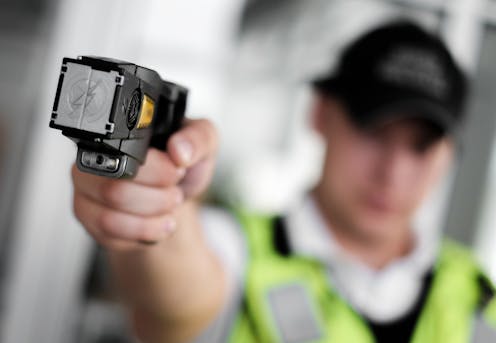
The use of a Taser to subdue a 95-year-old dementia patient at an aged care home in Cooma, New South Wales, last week is yet another sickening example of what can go wrong when police rely too heavily on force to resolve challenging situations.
Although the senior constable who used the Taser on Clare Nowland has now been suspended from duty, calls are growing for an independent investigation into the incident, as well as police treatment of people with dementia.
It is crucial for any investigations that follow to also include a thorough examination of the use of Tasers by police in Australia. Why do general duties police officers need to carry Tasers? What purpose do they serve and do they improve outcomes in any way? If so, for whom?
Lack of reporting on Taser use
When Tasers were introduced in Australia in the early 2000s, the public was told they would replace firearms and reduce the need for police to resort to using lethal force. In fact, the opposite has occurred – fatal police shootings reached an all-time high in 2019-20.
Given this, it is presently not clear what benefit Tasers offer over other less-lethal weapons, such as OC spray, except to protect police officers themselves from coming into close proximity to people armed with weapons.
The problem is a lack of transparency and accountability around their use. There is no public reporting on Taser use by police in any state or territory (except in the ACT where minimal detail is provided).
Taser use has been formally reported to the public in New South Wales only once, in a report by the state ombudsman in 2012.
This analysis of more than 600 Taser incidents in a six-month period in 2010 found a third of people tasered by police were believed to be suffering from mental health issues. Three-quarters of the people were unarmed.
More recent internal police figures obtained by the media showed NSW police used Tasers almost 3,000 times from 2014-18. More than 1,000 of those incidents involved people with mental health conditions.
In other comparable countries, like the United Kingdom and New Zealand, reporting on Taser use by police is mandated. Statistics show Tasers in these countries are used disproportionately against minority groups and other vulnerable populations.
By comparison, the Australian public does not know how many times Tasers are drawn, fired or misfired by police. We know virtually nothing about their real efficacy and impacts. We only learn about their potential harms from the media or the coroner’s reports that follow tragic outcomes.
In 2018, for example, a 30-year-old Sydney man, Jack Kokaua, died during an altercation with police in which a Taser had been deployed three times. The coroner found multiple factors, including the use of a Taser, positional asphyxia and a heart condition, had caused his death.
After the incident, civil liberties groups called for more transparency around how and when NSW police use Tasers. These calls went unheeded.
Read more: Why the taser-related death toll is rising
Why transparency matters
In Nowland’s case, there are other fundamental questions beyond Taser use that speak to a broader problem of inappropriate use of force by police, particularly against vulnerable people in distress.
For example, one retired officer has suggested police could have thrown a blanket over Nowland, who weighed just 43 kilograms and was just 160 centimetres tall.
Read more: When someone living with dementia is distressed or violent, 'de-escalation' is vital
Reports of previous settlements in civil cases involving inappropriate use of force in aged care settings show the extent of the problem.
Body-worn cameras are helpful in providing insight into the various situations that police encounter. But in the Kokaua case, the cameras were not turned on. And oftentimes, the footage rarely finds its way into the public domain, as complainants fight for access in the courts.
This means the public is under-informed about the problematic incidents that do occur in police interactions with the public. This is especially the case with Tasers.
For example, there is body-camera footage of the tasering of Nowland, but NSW Police Commissioner Karen Webb has not only said she would not watch the footage, she also won’t release it to the public unless there was “a process at the end of this that would allow it”.
She suggested there was no value in reviewing the footage until she knew “what else happened pre and post that incident”.
Questions must be asked
In the absence of greater transparency and reporting on Taser use by police, it is unlikely much will change.
Asking the right questions about the patterns of Taser use in all jurisdictions is now vital if we are to learn anything from the events that unfolded in Cooma and ensure Tasers are not disproportionately used against vulnerable and marginalised people.
Read more: Police body cameras may provide the best evidence – but need much better regulation
Authors: Emma Ryan, Lecturer in Criminology, Deakin University


 Daily Bulletin


