

Read The Times Australia

Daily Bulletin

'WA's Christmas tree': what mungee, the world's largest mistletoe, can teach us about treading lightly

  • Written by: Alison Lullfitz, Research Associate, The University of Western Australia
'WA's Christmas tree': what mungee, the world's largest mistletoe, can teach us about treading lightly

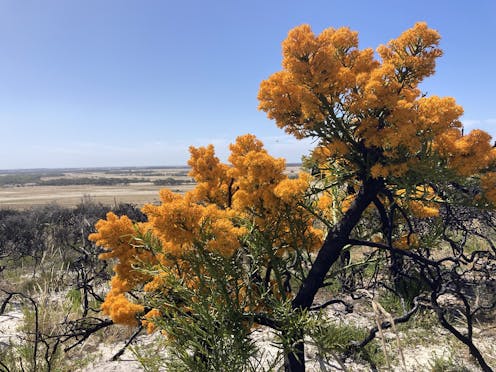
Noongar Country of southwestern Australia is home to the world’s largest parasitic plant, a mighty mistletoe that blooms every December. That’s why it’s commonly known as WA’s Christmas Tree. But it also goes by other names, mungee and moodjar. And it holds great significance for Noongar people including the Merningar people of the south coast.

While the unique biology and charisma of the species (Nuytsia floribunda) has been recognised by Traditional Owners for millennia, such rich Indigenous knowledge is barely known to Western science. Our research team includes three generations of Merningar alongside non-Indigenous scientists. In our new research, we set out to explore mungee’s physiology, ecology and evolution from both Indigenous and Western science perspectives.

The plant’s ability to access a wide array of resources is remarkable, enabling it to prosper in the hostile, infertile, but biologically rich landscapes of southwestern Australia. This is also the case for Noongar people, whose traditional diet reflects the biological richness of their Country.

Mungee is a revered teacher to Noongar people, with lessons for us all about living sustainably and in harmony with one another.

A family photograph showing (left to right) Harrison Rodd-Knapp, Jessikah Woods, Lynette Knapp and Shandell Cummings, with flowering mungee near Waychinicup, on Merningar Country
Three generations of the Merningar Knapp family have contributed to this research: (left to right) Harrison Rodd-Knapp, Jessikah Woods, her grandmother Lynette Knapp and mother Shandell Cummings, with flowering mungee near Waychinicup, on Merningar Country. Alison Lullfitz, Author provided

Read more: Ancient knowledge is lost when a species disappears. It's time to let Indigenous people care for their country, their way

A sand-loving parasite

Nuytsia floribunda is widespread across Noongar Country (Boodja) and known to most Noongar as moodjar. But it’s also called mungee by Merningar and other southern Noongar groups. Being mostly Merningar, we call it mungee and use that term here.

Mungee is a mistletoe tree that grows up to 10m tall in sandy soils. It’s endemic to southwestern Australia, but widespread throughout. The parasitic capability of the plant comes from highly modified, ring-shaped roots (haustoria) that act like secateurs to mine other plants for water and nutrients.

We used “two way science” (cross-cultural ecology) methods – including a literature review, shared recording of visits on Country, and an author workshop – to investigate mungee more thoroughly than would be possible through Western science alone.

Read more: To address the ecological crisis, Aboriginal peoples must be restored as custodians of Country

A revered teacher offering divine guidance

Like other Indigenous Australian knowledge systems, Merningar lore is place-based. It inextricably links people, specific places, other organisms and non-living entities of Country. Mungee tells specific stories through where it lives, the plants it lives with, and when it flowers.

The species is widely held as sacred among Noongar peoples. For Merningar, it has the highest status of all plants. Mungee holds important lore about how we as humans relate to each other and with the world around us, similar to a cornerstone religious text such as the Christian Bible.

For Merningar, mungee is a powerful medium that helps restless spirits move on to the afterlife, known to us as Kuuranup. This enables those of us still living to be untroubled by their presence.

Senior elder Lynette describes mungee as her teacher, providing guidance on how to exist in Merningar Boodja. The annual summer flowers represent her ancestors returning to their Country, reminding her to cherish and respect both her old people and her Boodja.

Lynette calls the ring-shaped haustoria of mungee her “bush lolly”. Under Merningar lore, digging for these sweet treats is not allowed when mungee is flowering. This is when bush lollies are scarce, so the rule is about living within seasonal constraints.

A closeup photograph showing the specialised ring-shaped root of the mungee tree, tapping into the resources of other plants.
The specialised ring-shaped haustorium of the mungee tree Nuytsia floribundataps into the resources of other plants. Mike Shayne

An example of living sustainably

Mungee primarily reproduces by cloning, sending out suckers up to 100m from the parent plant to produce identical copies. This results in patches of mungee clones gathered together in tight-knit populations.

We saw parallels between patches of mungee and the communal kinship structures of Noongar society, where family is more important than individuals.

Before European settlement, extended Noongar families lived in largely separate groups, interconnected with other family groups as part of a wider geopolitical system. We see mungee as a botanical exemplar of putting community before individuals, for the greater good.

Mungee accesses water and nutrients by tapping into a wide range of host plants. This diversity of hosts enables mungee to live in many different landscapes. This parallels with the sophisticated, but often place-specific knowledge of Noongar peoples across their botanically rich Boodja, which has enabled use of a wide range of traditional plants.

Living a prosperous life within environmental boundaries is achieved by conservatively drawing upon a wide range of resources. It provides a lesson for all who live in dry and infertile regions such as southwestern Australia.

A landscape photo showing the mungee tree in full flower
Mungee in full flower at Stirling Range National Park, about 300km south-east of Perth. Steve Hopper

A tree to be celebrated

Mungee’s bright orange flowers bring joy to all who witness their display during the celebratory summer months in southwestern Australia. The plant’s unique biology, ingenuity and charisma has long been recognised by Noongar peoples and their lore.

Prolific annual flowers are a memorial to the many old people who have cared for their Boodja through millennia. They also remind us to protect the old peoples’ legacy.

To Merningar, mungee is a valuable teacher and exemplar of prosperous biological (including human) existence in the southwest Australian global biodiversity hotspot. It has much to teach the rest of us, too.

A close-up photo of a thynnid wasp on a mungee flower
Thynnid wasps (flower wasps) on a mungee flower at Torndirrup National Park, 10km south of Albany in WA. Steve Hopper

Read more: Connecting to culture: here's what happened when elders gifted totemic species to school kids

Authors: Alison Lullfitz, Research Associate, The University of Western Australia

Read more https://theconversation.com/was-christmas-tree-what-mungee-the-worlds-largest-mistletoe-can-teach-us-about-treading-lightly-205568

Business News

How Telematics Helps Australian Companies Improve Productivity

Operating a commercial fleet in Australia is a uniquely demanding endeavour. Between the sprawling urban sprawl of cities like Sydney and Melbourne and the immense, unforgiving stretches of the Outb...

Daily Bulletin - avatar Daily Bulletin

Inside the Icon: The BridgeMuseum Officially Opens at the Sydney Harbour Bridge

A bold new way to experience one of Australia’s most recognisable landmarks has arrived, with BridgeClimb Sydney officially opening the all-new BridgeMuseum.  Located inside the Sydney Harbour Bridge...

Daily Bulletin - avatar Daily Bulletin

Is Your Brand Showing Up in AI Search? Most Melbourne Brands Aren't.

The New Front Door Nobody Told You About Something changed. Quietly. Without a press release. The way buyers find businesses in Australia has been rewired. Not replaced, rewired. Google isn't dead...

Daily Bulletin - avatar Daily Bulletin

How Australian Businesses Can Measure SEO ROI

SEO can feel vague when you are staring at a dashboard full of numbers that do not clearly connect to revenue. The key is to measure the right signals in the right order, then tie them back to outcome...

Daily Bulletin - avatar Daily Bulletin

How Commercial Roller Shutters Improve Site Security Without Slowing Operations

Security upgrades can be frustrating when they make everyday work harder. A door that takes too long to open, creates bottlenecks at shift change, or fails at the worst time can turn “better protectio...

Daily Bulletin - avatar Daily Bulletin

Why a Document Destruction Service Still Matters for Modern Businesses

Businesses generate large volumes of information every day, from staff records and contracts to invoices, reports and customer files. While attention often focuses on how documents are stored, the way...

Daily Bulletin - avatar Daily Bulletin

Bicycle Rack Safety and Space-Smart Storage

Bike storage problems usually show up as small annoyances first: tangled handlebars, scratched frames, and bikes that topple when you pull one out. Over time, those issues become safety risks, especia...

Daily Bulletin - avatar Daily Bulletin

How to Tell if a Childcare Centre Is a Good Fit for Your Child

Choosing childcare can feel like you’re making a huge decision with limited information. Tours are short, centres are often on their best behaviour, and your child might act differently in a new space...

Daily Bulletin - avatar Daily Bulletin

Car Import Timeline: What Usually Happens at Each Stage

Importing a car into Australia can feel confusing because multiple agencies and checkpoints are involved, and the timeline is shaped as much by paperwork quality as it is by shipping speed. The most u...

Daily Bulletin - avatar Daily Bulletin

The Daily Magazine

Gold Migration Lawyers in Liquidation: How the Closure Affects Your ART Appeal

If your appeal was with Gold Migration Lawyers, a recent change to how the Tribunal decides cases ...

The pressure cooker: life in urban Australia in 2026

Australian cities have always been demanding. Long commutes, rising housing costs, busy schedules a...

What Actually Makes a Good Criminal Lawyer in Melbourne

Most people only think about this question once. That is usually too late. Most people charged wi...

Why Working With A Chatswood Tutor Can Improve Academic Performance

Academic expectations continue increasing for students across primary school, high school, and senio...

Is It Worth Getting Solar Panels in Melbourne?

The real question is not whether solar works in Melbourne. It works. The question is what it is co...

How A Diploma Of Project Management Builds Practical Skills For Modern Work Environments

Developing the ability to plan, execute, and deliver outcomes efficiently is a key requirement in to...

How to Choose the Right Football for Every Level

Choosing a football may seem straightforward, but the right option depends on who will be using it a...

What to Ask a Wedding Photographer Before You Book

Booking a wedding photographer can feel deceptively simple: you like the photos, you like the vibe...

Why Stress Relief For Dogs Is Essential For Emotional Balance And Long-Term Wellbeing

Managing emotional health is just as important as physical care when it comes to pets, which is why ...