

Expensive dental care worsens inequality. Is it time for a Medicare-style 'Denticare' scheme?
- Written by: Lesley Russell, Adjunct Associate Professor, Menzies Centre for Health Policy, University of Sydney
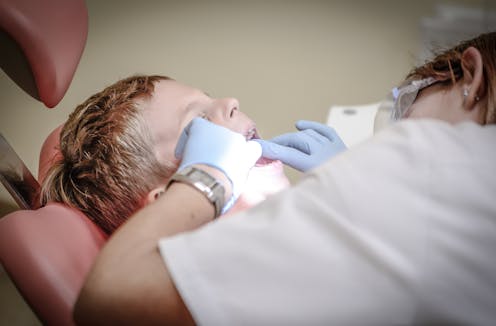
There’s growing awareness public dental programs are unable to meet the demand for services. Private dental care is increasingly unaffordable, and millions of Australians go without the treatment they need.
The potentially avoidable costs to the health-care system and to people’s quality of life has led to increased pressure for a Medicare-style universal insurance scheme for dental care (Denticare) or the inclusion of dental care into Medicare.
Affordable and available dental care is crucial to addressing inequality in Australia. Teeth and gum problems can affect everything from your life expectancy and general health to your job prospects. The “dental divide” between rich and poor actually replicates disadvantage in Australian society.
So how did we get here? And what might change look like?
Read more: The Greens want Medicare to cover a trip to the dentist. It's a grand vision but short on details
Why wasn’t dental included in Medicare in the first place?
The prevailing wisdom is that when the Whitlam Government put Medibank (the precursor to Medicare) forward in 1974, dental care was not included because of cost and politics – the battle with doctors’ groups opposed the new health-care insurance plan was difficult enough without taking on dental groups too.
There is, however, little to no evidence on the extent to which the Whitlam government pushed for dental to be included or how much it was opposed by dentists. It seems it was not on the agenda when Medicare was restored by the Hawke government.
Financial issues aside, there are two likely reasons dental wasn’t included.
Firstly, medicine and dentistry remain isolated practices that have never been treated the same way by the health-care system, health insurance funds, policymakers and the public.
Despite all the evidence on the importance of oral health, too often it is seen as merely a “nice-to-have”.
Secondly, the provision of public dental health services – often linked to dental hospitals and dental schools – has long been seen (especially by Coalition governments) as the responsibility of states and territories. These services have always been directed at children, low-income adults, and defined disadvantaged groups.

A short history
Section 51(xxiiiA) of the Australian Constitution, added in 1946, accords dental services the same status as medical services. This section gives the Commonwealth the power to legislate and fund these services but it’s not obligated to do so.
The Whitlam government was the first to provide national funding and direction to these state-based programs through the Australian School Dental Program.
Under the Keating government, the Commonwealth took a more substantial role in the funding of dental services with the introduction of the Commonwealth Dental Health Program, directed at financially disadvantaged adults.
This began in January 1994 but was abolished by the Howard government in 1996.
The Gillard government introduced National Partnership Agreements for Public Dental Services for Adults, which currently provide A$107.8 million annually to the states and territories.
The barriers to universal dental care
Proposals to expand Medicare to include dental services have been variously estimated to cost between $5.6 billion in additional Commonwealth spending per year (according to the Grattan Institute) and $7.5 billion a year (according to The Greens’ 2022 election policy).
These figures don’t factor in the savings made to health-care costs due to preventable dental cavities and gum disease (estimated by the Australian Dental Association at $818 million per year) and reduced productivity. Nevertheless, this is a huge budget impost. It would require increases in the Medicare levy, and/or increased taxation and/or cuts to the private health insurance rebate.
The other approach is to reduce costs by limiting the number of people covered and/or the number and type of services covered.
Means testing access to Medicare Benefits Schedule items for dental care is risky; it could easily lead to means testing of access to other MBS items.
Limiting the type of services covered is possible but would require a huge amount of work and endless debate on what constitutes basic and necessary services.
The establishment of an entirely separate scheme (the Denticare model) will still require enormous amounts of evidence-based decision-making around who and what is covered, how this is paid for, and what subsequently happens to current federally- and state-funded dental programs.
There’s more we can do
Previous attempts to incorporate dental services into Medicare have arguably failed. Researchers have described the Chronic Dental Disease Scheme (introduced by the Howard government) as as “the most expensive and controversial public dental policy in Australian history”. As a 2012 analysis showed, it blew out its budget and did not result in dental health improvements.
The current Child Dental Benefits Schedule has a low uptake. Less than 40% of those eligible for the scheme actually use it.
As I wrote in 2014, there is plenty Australia could do to better integrate dental and medical care, including focusing on best-value investments such as fluoridation and preventive services. It’s worth noting many of the preventive actions needed to address obesity (for example, encouraging breast feeding and limiting sugary beverages) will also improve dental health.
We could also expand emergency dental services in hospital emergency departments and create a “Dental Health Service Corps” of dentists and other medical professionals to help in rural and remote areas.
Almost a decade later, little as been done. Sadly, in the many years I’ve been writing about the dental divide, the only movement I’ve seen is in the increasingly bad numbers around waiting lists and costs to patients.
A Senate Select Committee is currently conducting yet another inquiry into dental services in Australia. Its just-released interim report, which discussed some of the proposals heard so far by the committee and some possible questions for it to consider, described Australia’s current oral and dental health system as “broken”. Public hearings, which will inform the committee’s final report, will be held later in the year.
Hopefully, this inquiry will (finally) drive politicians to see dental care as essential to health, wellbeing and a fair society – and to act.
Read more: How to fill the gaps in Australia's dental health system
Authors: Lesley Russell, Adjunct Associate Professor, Menzies Centre for Health Policy, University of Sydney


 Daily Bulletin


