

Fungi could be the next frontier in fire safety
- Written by: Tien Huynh, Associate Professor, School of Sciences, RMIT University
Australia is no stranger to fire-related disasters. The country experiences more than 17,000 residential fires each year.
Each winter brings an increase in potential fire hazards due to the use of heaters and candles. Couple this with our already fire-prone vegetation, and a generally hot and dry climate, and you can see why there’s an urgent need to develop effective and sustainable fireproofing methods.
This is what inspired our research team to create fireproofing materials made from edible fungi. These materials can withstand flames to protect the integrity of a building’s structure (and any occupants).
Our work presents an exciting opportunity for an industry that has spent too long using materials that are harmful to human health and the environment.
Fireproofing through the decades
In the 1970s, construction companies in Australia widely used chemicals categorised as “halogenated flame retardants” to fireproof buildings, furnishings and electronics.
These flame retardants, which largely consist of bromide or chlorine-containing chemicals, are effective in interrupting combustion. But many have been associated with adverse health effects including immunotoxicity, reproductive toxicity, cancer and impaired neurological function.
Phosphorus and nitrogen-based flame retardants are preferred over their halogenated counterparts and are still used for fireproofing today, including in Australia. However, these too pose some risk to human health and to nature (through toxicity and accumulation in the environment).
Exploring a better alternative
Our team has produced a material made entirely out of mycelium, which shows great promise for fireproofing.
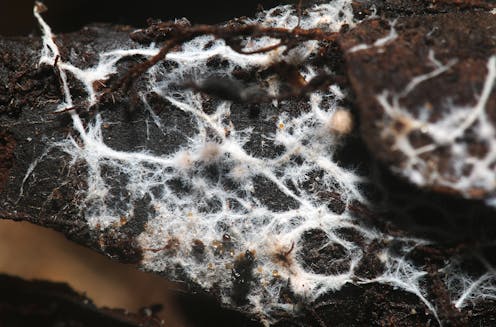
Mycelium is the root-like structure of fungi. It’s made up of many thin, branched filaments. The cell walls of these filaments are largely composed of a natural polymer called chitin (which you can also find in crab shells and insect exoskeletons).
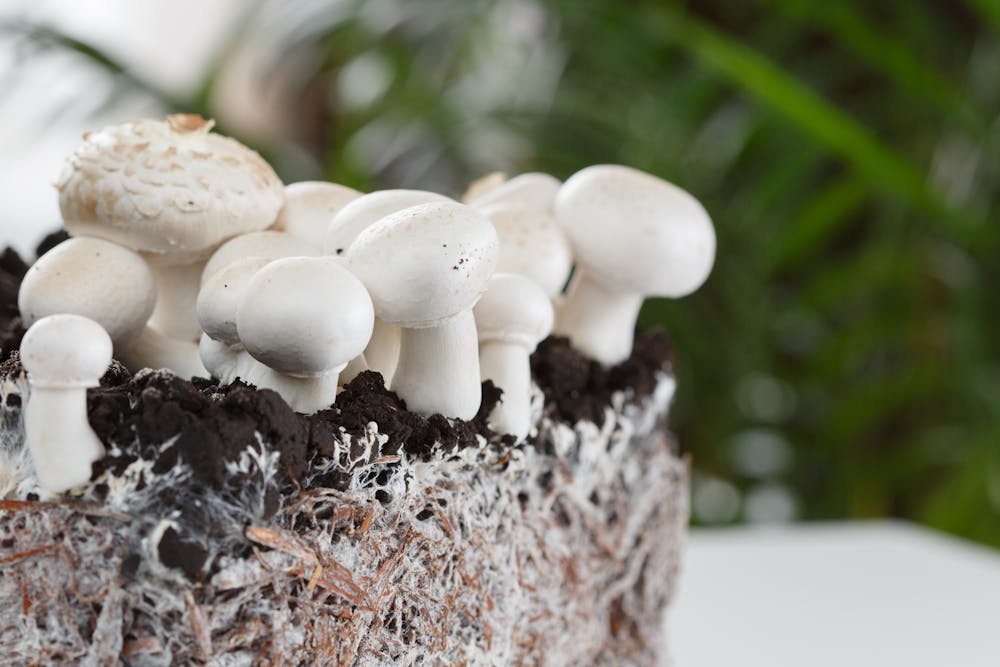
Our mycelium-based material is lightweight, eco-friendly, biodegradable and has a relatively long ignition time.
When exposed to intense fire or heat, the material can transform to char – a black high-carbon residue that remains when all the water and volatile compounds have burned off. This is similar to the charcoal that remains when wood is burned. This char protects any underlying flammable material by slowing down heat transfer and preventing further combustion.
Unlike current fireproofing materials, our material releases only harmless natural products when exposed to fire, such as water and carbon dioxide.
Read more: Scientists create new building material out of fungus, rice and glass
A versatile material
Our material is flexible and can be manipulated to varying thinness, including down to a 1mm thin wallpaper. This makes it more useful than the bulky fungal bricks our group previously created.
It could be used as thin wallpaper-like sheets, or consolidated into thicker and stronger core materials that resemble timber or cladding.
We showcase two possible applications for the building and construction industry (although there would be other uses in industries such as automotive and aerospace engineering):
fungal-only sheets as laminates, where the thickness can be customised, which would be ideal for use as insulation panels
fungal layers attached to the surface of flammable structures, in the same way wallpaper is applied to walls, to enhance fire protection.
The next steps
Although mycelium-based materials are currently used globally for construction, packaging and insulation, none are so far commercially available. Moreover, none have been used or approved for fireproofing.
We’ve been approached by the mushroom industry to develop our material and its feasibility for commercialisation. Collaboration will be crucial to creating a closed-loop industry where agricultural waste can be up-cycled into sustainable biomaterials that meet fire safety needs.
There’s a long way to go before our product can be bought off-the-shelf, and we’ll need to address various large-scale manufacturing challenges in the process.
Nonetheless, we hope our work can eventually contribute to a future where building fires are significantly reduced, and where our homes are safer and more sustainable spaces to live in.
Read more: 5 ways fungi could change the world, from cleaning water to breaking down plastics
Authors: Tien Huynh, Associate Professor, School of Sciences, RMIT University
Read more https://theconversation.com/fungi-could-be-the-next-frontier-in-fire-safety-209142


 Daily Bulletin


